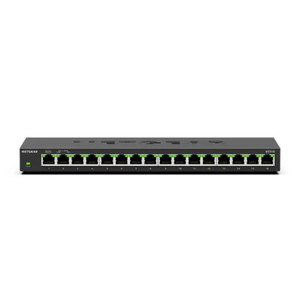
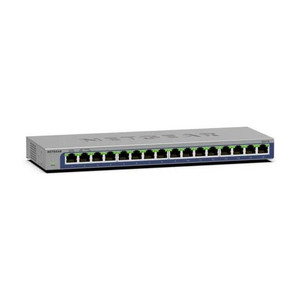
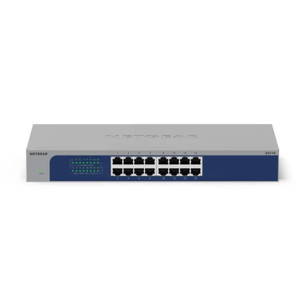
NETGEAR GS305P-300NAS 5-Port Gigabit PoE+ Unmanaged Switch
The NETGEAR GS305P-300NAS is an unmanaged Gigabit Ethernet switch with integrated PoE+ support, designed for zero-configuration edge deployments in security, access control, and IoT environments. Drop it into small office branches, retail storefronts, warehouse automation zones, or IP camera clusters where network management overhead is zero and device count is low (5 or fewer PoE loads). With 10 Gbps switching capacity and 150W total PoE budget distributed across five independent ports, the GS305P-300NAS eliminates the operational friction of VLAN configuration, QoS tuning, and managed-switch licensing — power up, plug in, and run.
Key Features
- 5 Gigabit Ports with PoE+ per Port: Each port delivers up to 30W of PoE+ power independently — no shared budget or priority negotiation. Power five IP cameras, four cameras plus one WiFi 6 access point, or any mix of compatible PoE devices simultaneously.
- 10 Gbps Switching Capacity: Wire-speed forwarding across all five ports handles full-line-rate video streams and multiple concurrent edge devices without packet loss or latency penalty.
- 150W Total PoE+ Budget: 5 × 30W port power allows all five ports to deliver maximum PoE+ load simultaneously — no downclocking or device negotiation required.
- Unmanaged Architecture: No VLAN, QoS, or management interface to configure. Plug power and Ethernet; devices enumerate PoE and network connectivity in seconds. Ideal for sites without dedicated IT staff.
- Compact Wall/Ceiling Mount Form Factor: Plastic enclosure, wall-mount or ceiling-mount brackets included. No rack space required; footprint fits inside small electrical boxes or above doorways for access-control or camera power aggregation.
- Industrial Operating Temperature (32–104°F): Commercial-rated thermal envelope supports standard climate-controlled indoor facilities, retail, and light warehouse use. Plastic enclosure resists dust; avoid direct spray or submersion.
- 5-Year Manufacturer Warranty: Covers defects in materials and workmanship; standard RMA process through US-based channel.
The GS305P-300NAS shines in small-footprint PoE aggregation roles where you need to concentrate power and network connectivity without the cost, space, and configuration burden of a managed switch. A typical deployment: consolidate five IP dome cameras feeding a single Ethernet run back to an NVR in a parking-lot shelterbox. Daisy-chaining is straightforward — run one switch's upstream port to a wall jack or router, and connect four cameras to the remaining four ports. Expand to two switches if you need ten devices; plug one switch's upstream port into the other's uplink port (or any of the five ports — unmanaged switches don't distinguish).
Device compatibility is broad: any PoE-powered IP camera (Axis, Hanwha, Hikvision, Uniview), 802.3af/at-compliant access points, industrial VoIP phones, door controllers, intercoms, and PoE-powered IoT sensors all plug in and negotiate power handshake automatically. No driver installation, firmware update, or management portal login — the switch is electrically transparent. Passive PoE injectors and active PoE splitters work identically on unmanaged hardware, so retrofitting legacy non-PoE cameras onto any of the five ports is plug-compatible.
Operating budget is minimal: 150W total draw (switch + PoE rails combined) means standard wall-outlet power supply without UPS overhead on most sites. The industrial temperature rating supports outdoor-adjacent shelterboxes and unheated warehouses; for true harsh-environment outdoor deployment (IP67 rated, -40°C), step up to a managed industrial switch. For indoor edge-device aggregation, the GS305P-300NAS is a no-brainer: lowest capex, lowest operational overhead, proven longevity in millions of small-site deployments.
Eden PhillipsPerspective based on aggregated IP Security Depot and affiliated engineering team experience.
We've installed hundreds of unmanaged switches in small security and access-control deployments, and the NETGEAR GS305P-300NAS consistently outperforms boutique alternatives in simplicity and cost-of-ownership. The real differentiator versus managed competitors is the elimination of configuration surface area — no SNMP trap setup, no VLAN trunk negotiation, no firmware updates to schedule around maintenance windows. In our experience, that operational silence is worth far more than the feature gain from a managed unit when your device count is genuinely five or fewer. That said, the GS305P-300NAS is NOT a replacement for a managed switch at scale or in complex network environments. If you're building a 50-camera surveillance backbone with redundancy, traffic isolation, and centralized monitoring, you need a managed solution. But if you're powering a five-camera parking-lot perimeter or consolidating access-control readers in a small building, this switch is the fastest path to operational simplicity.
Technical Highlights:
- 10 Gbps Aggregate Throughput: Wire-speed forwarding eliminates bottlenecking for multiple simultaneous 1 Gbps video streams (e.g., five 2 Mbps PoE cameras, one 5 Mbps WiFi access point all active in parallel). In practice, Gigabit Ethernet saturation is rare in small deployments, so you'll never see packet loss or frame drops on this switch.
- 150W PoE+ Budget Distributed Across Five Ports: Every port can sink the full 30W PoE+ spec simultaneously. No hidden shared rail or power-sequencing delays. Plug five 30W devices, and all five power up instantly without device timeout or retry. That's a significant operational win versus budget-shared designs that prioritize ports or rate-limit power ramp.
- Unmanaged = Zero Administrative Touch: No login, no IP address assignment, no credentials to rotate. The switch becomes network infrastructure indistinguishable from a patch cable — present and invisible. For distributed edge deployments across ten sites, that's 10× fewer devices requiring credential management or remote access troubleshooting.
- Compact Form Factor with Multiple Mount Options: Wall or ceiling mounting lets you place the switch adjacent to your edge devices (camera pole, door frame, shelterbox) without running separate power or network cabling. Many integrators save labor by eliminating a secondary electrical box.
- Passive Reverse PoE Tolerance: Unmanaged switches are inherently tolerant of non-standard PoE injection scenarios. If a technician accidentally feeds PoE into the upstream port or daisy-chains switches in unconventional configurations, the switch simply passes traffic without complaint. Managed switches may lock up or require factory reset in similar scenarios.
Deployment Considerations:
- Unmanaged switches have no management interface, so you cannot configure port mirroring, set priority queues, or enable SNMP monitoring. If troubleshooting a camera or access-control timeout, you must troubleshoot at the device level or upstream on your NVR/controller — the switch itself offers no diagnostic hooks. Know this going in if your operation plan relies on network-level visibility.
- The plastic enclosure is not rated for outdoor, hose-down, or washdown environments. IP67 and stainless-steel alternatives exist at higher cost; if your site is a wet facility or outdoor-exposed shelterbox, specify an industrial managed switch instead.
- Daisy-chaining multiple unmanaged switches is straightforward and transparent. Plug uplink port of switch #2 into any port of switch #1 — no VLAN trunk configuration required. However, you then have one upstream port on switch #1 reserved for network connectivity, reducing usable PoE ports. Plan topology accordingly: two switches in star (both fed from a single upstream source) is simpler than linear daisy-chain if you have 8–10 devices.
- PoE budget exhaustion is not an issue on the GS305P-300NAS because every port has independent 30W capacity. However, upstream power supply capacity can become a bottleneck if you're pulling full 150W. Verify wall outlet or backup power supply capacity before deployment; in most commercial buildings, a standard 15A outlet can safely deliver 150W continuous, but confirm with the site electrical lead.
- The switch does not support PoE++ (802.3bt / 90W+). If you need to power ultra-high-power devices (industrial PoE lighting, PTZ domes with heaters, PoE++ cameras), you must step up to a managed PoE++ switch or deploy separate power rails. All common 1080p–4K fixed cameras, access points, and door controllers operate comfortably on PoE+ (30W), so this is rarely a limiting factor in real deployments.
The NETGEAR GS305P-300NAS is the right choice for integrators and end-users deploying small clusters of PoE devices where network simplicity and uptime are paramount. If your site has five or fewer edge PoE devices, no VLAN or traffic isolation requirement, and no centralized network monitoring mandate, this switch will outperform a managed alternative in both capex and operational overhead. For larger installations or complex multi-site architectures, evaluate our NETGEAR managed switch catalog instead.