
TP-Link SG3452XP vs Ubiquiti USW-PRO-MAX-48: Specification Comparison
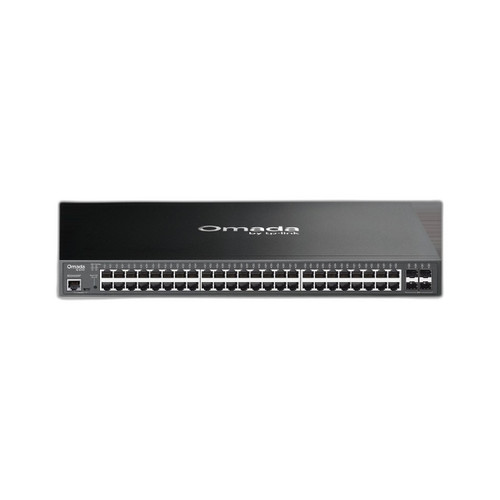
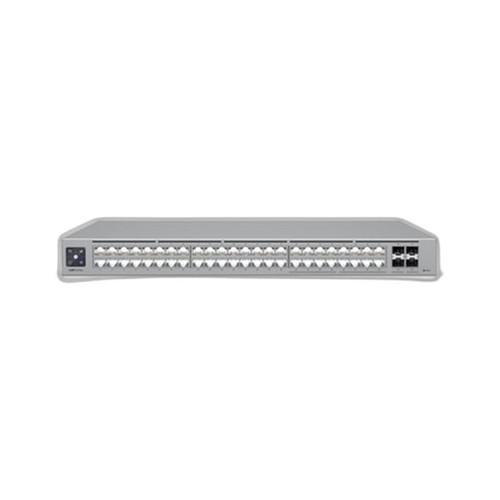
Both the TP-Link SG3452XP and the Ubiquiti USW-PRO-MAX-48 are 1U rackmount, 48-port L2+ managed switches with 4× 10GbE SFP+ uplinks targeting enterprise access or aggregation tiers. The SG3452XP adds full 802.3at PoE+ across all 48 ports at a 500 W budget, making it relevant for IP camera and VoIP deployments. The USW-PRO-MAX-48 foregoes PoE on copper ports but delivers a mixed-speed fabric of 32×1G and 16×2.5G ports with a higher 224 Gbps switching capacity. Buyers choosing between them are trading PoE power delivery against port-speed flexibility.
In This Guide
Which switch delivers more bandwidth and port-speed flexibility?
The USW-PRO-MAX-48 leads on raw switching fabric: 224 Gbps switching capacity and 167 Mpps forwarding rate versus the SG3452XP's 176 Gbps and 130.94 Mpps. That 27% fabric advantage comes from the USW-PRO-MAX-48's mixed-speed architecture — 32 ports at 1G and 16 ports at 2.5G — so endpoints with 2.5G NICs (modern Wi-Fi 6/6E APs, workstations) can operate at full speed without an uplink upgrade. Both switches provide 4× 10GbE SFP+ for backbone interconnects.
The SG3452XP caps all 48 copper ports at 1G. Its 176 Gbps capacity is sufficient for pure gigabit access layers but offers no headroom for 2.5G or 5G endpoint growth. If the installed base is entirely 1G, the fabric delta is less meaningful. The USW-PRO-MAX-48 spec does not list ONVIF support; the SG3452XP spec lists ONVIF: Yes, which may simplify camera network provisioning in Omada-managed environments.
How do the two switches compare on PoE capability and power draw?
The SG3452XP is a full PoE+ switch: 802.3af/at on all 48 ports, 30 W per port maximum, 500 W total PoE budget, with perpetual PoE and fast PoE modes. For surveillance deployments powering IP cameras, intercoms, or access readers entirely over Ethernet, this is a decisive functional difference. Total system draw at full PoE load is listed at 500 W.
The USW-PRO-MAX-48 spec lists PoE++ (802.3bt) under Poe Power, but the power consumption spec is only 100 W and no PoE budget figure appears anywhere in the provided specifications. Given a 100 W power supply and no per-port PoE wattage or total PoE budget stated, it is not possible to confirm PoE delivery capacity from the provided data. Buyers requiring verified PoE budgets for the USW-PRO-MAX-48 should consult Ubiquiti's published datasheet directly before specifying it for powered-device deployments.
What management platforms and integration options does each switch support?
The SG3452XP supports three operating modes: standalone web/CLI, Omada on-premises controller, and Omada cloud. It specifies SNMP, 802.1x port authentication, and RADIUS/TACACS+ for AAA. Management connectivity is listed as USB in addition to in-band Ethernet. The Omada ecosystem provides centralized visibility across switches, APs, and gateways under one pane.
The USW-PRO-MAX-48 lists management via Ethernet and VLAN support for up to 1,000 VLANs — a higher stated VLAN count than any explicit figure provided for the SG3452XP. It is NDAA-compliant per its spec sheet and carries CE, FCC, IC, and Anatel certifications. Beyond VLAN count, NDAA compliance, and Ubiquiti's UniFi controller ecosystem, the provided spec does not detail SNMP version, authentication protocols, or cloud-vs-on-premises controller options. Buyers committed to UniFi already gain native integration; mixed-vendor deployments should verify SNMP and RADIUS support independently.
Which should you choose: the SG3452XP or the USW-PRO-MAX-48?
Our take: The SG3452XP is the stronger choice when the deployment requires powering 48 IP cameras or other PoE devices from a single switch: it delivers a confirmed 500 W PoE budget at up to 30 W per port, which the USW-PRO-MAX-48's provided specs do not clearly substantiate despite listing 802.3bt. The USW-PRO-MAX-48 is the stronger choice when port-speed mix matters: its 224 Gbps fabric (vs. 176 Gbps) and 16× 2.5G copper ports accommodate next-generation endpoints that the SG3452XP's all-1G copper cannot serve. The USW-PRO-MAX-48 also specifies 1,000 VLANs and NDAA compliance — useful for segmented or government-adjacent deployments. Choose the SG3452XP for camera-dense, PoE-heavy physical security access layers running Omada; choose the USW-PRO-MAX-48 for mixed-speed enterprise LANs inside a UniFi infrastructure where PoE budget requirements can be independently verified.
Side-by-Side Comparison
Spec-for-spec, from manufacturer data.
| Specification | TP-Link SG3452XP | Ubiquiti USW-PRO-MAX-48 |
|---|---|---|
| Product Type | L2+ Managed Access Switch | L2+ Managed Switch |
| Form Factor | 1U Rackmount | 1U Rackmount |
| Total Copper Ports | 48× Gigabit (RJ45) | 32× 1G + 16× 2.5G (RJ45) |
| SFP+ Uplinks | 4× 10GbE SFP+ | 4× 10GbE SFP+ |
| Switching Capacity | 176 Gbps | 224 Gbps |
| Forwarding Rate | 130.94 Mpps | 167 Mpps |
| PoE Standard | 802.3af/at (PoE+) | 802.3bt listed; budget not specified in provided specs |
| PoE Budget | 500 W total, 30 W per port | — (not stated in provided specs) |
| Power Consumption | 500 W (full PoE load) | 100 W |
| Power Input | 100–240 V~ 50/60 Hz | 100–240 V AC |
| VLAN Support | — (not stated in provided specs) | 1,000 VLANs |
| Management Modes | Standalone, Omada Cloud, Omada On-Premises, CLI, SNMP | Ethernet management (UniFi ecosystem; details not in provided specs) |
| Authentication | 802.1x, RADIUS/TACACS+ | — (not stated in provided specs) |
| NDAA Compliant | — (not stated in provided specs) | Yes |
| Operating Temperature | -5°C to 45°C (23°F to 113°F) | -5°C to 40°C (23°F to 104°F) |
| Dimensions (mm) | 440 × 330 × 44 | 442 × 325 × 44 |
Frequently Asked Questions
Which should you choose: the SG3452XP or the USW-PRO-MAX-48?
The SG3452XP is the stronger choice when the deployment requires powering 48 IP cameras or other PoE devices from a single switch: it delivers a confirmed 500 W PoE budget at up to 30 W per port, which the USW-PRO-MAX-48's provided specs do not clearly substantiate despite listing 802.3bt. The USW-PRO-MAX-48 is the stronger choice when port-speed mix matters: its 224 Gbps fabric (vs. 176 Gbps) and 16× 2.5G copper ports accommodate next-generation endpoints that the SG3452XP's all-1G copper cannot serve. The USW-PRO-MAX-48 also specifies 1,000 VLANs and NDAA compliance — useful for segmented or government-adjacent deployments. Choose the SG3452XP for camera-dense, PoE-heavy physical security access layers running Omada; choose the USW-PRO-MAX-48 for mixed-speed enterprise LANs inside a UniFi infrastructure where PoE budget requirements can be independently verified.
Is the SG3452XP or USW-PRO-MAX-48 better for powering IP cameras over PoE?
Based on the provided specifications, the SG3452XP is the clear choice for PoE camera deployments. It lists a confirmed 500 W total PoE budget across all 48 ports at up to 30 W per port (802.3af/at), plus perpetual PoE and fast PoE modes useful for camera reboots. The USW-PRO-MAX-48 spec lists 802.3bt (PoE++) under its PoE Power field, but its power supply is rated at only 100 W and no per-port or total PoE budget figure appears in the provided specs — meaning PoE delivery capacity cannot be confirmed from the available data.
Which switch supports faster endpoints like Wi-Fi 6E access points or 2.5G workstations?
The USW-PRO-MAX-48 is designed for mixed-speed environments: 16 of its 48 copper ports run at 2.5G natively, supporting Wi-Fi 6/6E APs and workstations with 2.5G NICs without additional hardware. Its 224 Gbps fabric and 167 Mpps forwarding rate back this up. The SG3452XP's 48 copper ports are all 1G maximum; it cannot natively service 2.5G endpoints on copper, making it less suitable as the endpoint tier evolves beyond gigabit.
Can either switch be managed through a centralized cloud controller?
The SG3452XP explicitly supports three management modes — standalone web/CLI, Omada on-premises controller, and Omada cloud controller — with SNMP and RADIUS/TACACS+ authentication documented in the provided specs. The USW-PRO-MAX-48 is part of Ubiquiti's UniFi ecosystem and would be managed through the UniFi Network controller (cloud or self-hosted), which is the standard for all UniFi switches; however, the provided specifications for the USW-PRO-MAX-48 do not detail controller options, SNMP version, or authentication protocol support, so those details should be confirmed against Ubiquiti's published documentation.
More Network Switch Comparisons
- TP-Link SG6654XHP vs Ubiquiti USW-PRO-MAX-48
- TP-Link SG6654XHP vs Ubiquiti USW-PRO-48
- TP-Link SG6654XHP vs TP-Link SG3452XMPP
- TP-Link SG6654XHP vs TP-Link SG3452XP
- TP-Link SG3452XMPP vs Ubiquiti USW-48
- TP-Link SG3452XMPP vs Ubiquiti USW-PRO-MAX-48
Network Switch Buying Guides
Get a Second Opinion on Your Camera Choice
Share your site layout, coverage goals, and budget. Our team will validate the camera selection, flag anything we would change, and recommend products that match the use case.