
TP-Link SG2210P vs Allied Telesis AT-x530L-10GHXm-10: Specification Comparison
Both the TP-Link SG2210P and the Allied Telesis AT-x530L-10GHXm-10 are 8-port PoE smart switches designed for IP device deployments such as surveillance cameras, VoIP phones, and wireless access points. They share the same port count and PoE topology but differ substantially in PoE power class, uplink speed, multi-gigabit capability, and management depth. This comparison evaluates the three dimensions most critical to a network switch purchase: PoE capacity and port power delivery, switching throughput and uplink architecture, and management and platform integration.

In This Guide
- Which switch delivers more PoE power per port and in total budget?
- How do the switching fabric, port speeds, and uplink architecture compare?
- What management capabilities and platform integrations does each switch support?
- Which should you choose: the SG2210P or the AT-x530L-10GHXm-10?
- Side-by-Side Specs
- FAQ
Which switch delivers more PoE power per port and in total budget?
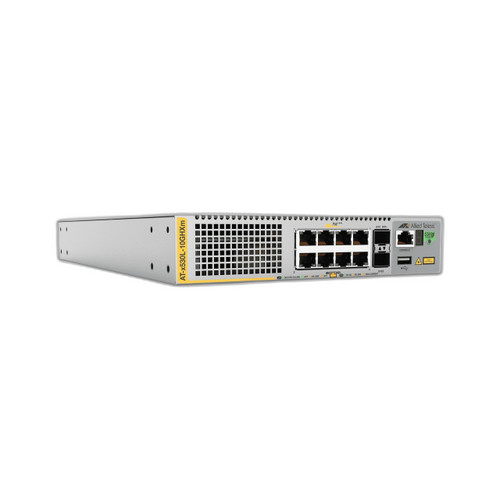
The AT-x530L-10GHXm-10 provides a 500W total PoE budget across all 8 ports, supporting IEEE 802.3bt PoE++ at up to 90W per port on 5 ports simultaneously and 60W per port on all 8. This makes it capable of powering high-draw devices such as 90W PTZ cameras, dual-radio Wi-Fi 6E access points, or small edge computing appliances directly from the switch.
The SG2210P carries a 58W total PoE budget across its 8 ports, rated to 802.3af/at (PoE+), with a maximum of 30W per port. This budget is sufficient for standard IP cameras, single-radio access points, and VoIP phones, but cannot power PoE++ devices. With 58W shared across 8 ports, average available power per active port is approximately 7.25W under full load.
The power gap between the two products is significant: the AT-x530L-10GHXm-10 offers 8.6× the total PoE budget (500W vs. 58W) and 3× the per-port maximum (90W vs. 30W). Buyers powering more than two or three simultaneous 15W-class devices on the SG2210P will encounter budget exhaustion; the AT-x530L-10GHXm-10 has no such constraint at typical surveillance loads.
How do the switching fabric, port speeds, and uplink architecture compare?
The AT-x530L-10GHXm-10 is built on a 120 Gbps switching fabric with a forwarding rate of 89.2 Mpps. Its 8 access ports are variable-speed at 100M/1/2.5/5 Gigabit, and its 2 uplink slots are 1/10 Gigabit SFP+. Additionally, 2 stacking ports are specified, enabling logical aggregation with other x530L units. Latency is documented at 2.12 µs at 10 Gbps, 3.49 µs at 5 Gbps, and 7.89 µs at 1 Gbps.
The SG2210P operates at Gigabit (1000BASE-T) on all 8 access ports with 2 Gigabit SFP uplink slots. Switching fabric capacity and forwarding rate are not specified in the provided data. No multi-gigabit access port speeds and no 10G uplink capability are listed. No stacking specification is provided.
The AT-x530L-10GHXm-10 substantially outperforms the SG2210P on throughput headroom: 10G SFP+ uplinks versus 1G SFP uplinks, and multi-gigabit access ports (up to 5G) versus fixed 1G. For high-density 4K video surveillance networks or environments aggregating multiple access-layer switches, the AT-x530L-10GHXm-10's fabric and uplink capacity are materially relevant; the SG2210P's fabric and uplink data are absent from the provided spec set.
What management capabilities and platform integrations does each switch support?
The SG2210P is described as 'smart managed' and explicitly Omada SDN compatible. Documented Layer 2 features include VLAN (802.1Q), STP/RSTP/MSTP, IGMP Snooping, QoS (802.1p/DSCP), and ACL. Security features include 802.1X port-based access control with RADIUS and TACACS+ authentication. Omada SDN provides centralized controller-based management via hardware controller, software controller, or cloud portal, which is relevant to installers already in the TP-Link ecosystem.
The AT-x530L-10GHXm-10 specs provided do not include explicit management feature enumeration (VLAN, QoS, ACL, STP variant, or authentication protocol details). No cloud management platform affiliation is listed in the supplied data. The stacking capability (2 stacking ports marked with asterisk) implies Layer 2/3 enterprise-class management software is available, consistent with Allied Telesis x530L series positioning, but no specific management platform name or feature set is confirmed by the provided spec fields.
For buyers already operating Omada-managed networks, the SG2210P offers a documented, ecosystem-native integration path. For the AT-x530L-10GHXm-10, management platform and specific protocol support cannot be confirmed from the provided specifications alone; buyers should consult the Allied Telesis x530L datasheet directly for AlliedWare Plus or Vista Manager compatibility details.
Which should you choose: the SG2210P or the AT-x530L-10GHXm-10?
Our take: The SG2210P is the stronger choice when the deployment is cost-sensitive, PoE loads are light (802.3af/at devices only), and the installer is already operating an Omada SDN environment. The AT-x530L-10GHXm-10 is the appropriate choice for deployments requiring high per-port power delivery: it provides 500W total PoE budget versus 58W (an 8.6× difference) and supports up to 90W per port versus 30W per port, enabling PoE++ devices the SG2210P cannot power. Its 10G SFP+ uplinks versus the SG2210P's 1G SFP uplinks and multi-gigabit access ports (up to 5G) versus fixed 1G offer substantially greater bandwidth headroom. The AT-x530L-10GHXm-10 also documents switching fabric at 120 Gbps and 89.2 Mpps; equivalent figures are absent from the SG2210P's provided specs. The SG2210P is suited to small branch or edge closets with standard IP cameras and VoIP; the AT-x530L-10GHXm-10 targets higher-density surveillance or enterprise wiring closets where PoE++, multi-gigabit access, and stacking are required.
Side-by-Side Comparison
Spec-for-spec, from manufacturer data.
| Specification | TP-Link SG2210P | Allied Telesis AT-x530L-10GHXm-10 |
|---|---|---|
| Product Type | 8-Port Gigabit Smart PoE+ Switch | 8-Port PoE++ Switch |
| Total PoE Budget | 58W | 500W |
| PoE Standard | 802.3af/at (PoE+) | 802.3af/at/bt (PoE++) |
| Max PoE Per Port | 30W | 90W (5 ports); 60W (all 8) |
| PoE-Enabled Ports | 8 | 8 |
| Access Port Speeds | 1G (Gigabit) | 100M/1/2.5/5G (multi-gigabit) |
| Uplink Ports | 2x Gigabit SFP | 2x 1/10G SFP+ |
| Stacking Ports | — | 2 (specified) |
| Switching Fabric | — | 120 Gbps |
| Forwarding Rate | — | 89.2 Mpps |
| Latency (1G) | — | 7.89 µs |
| Latency (10G) | — | 2.12 µs |
| Management Type | Smart managed, Omada SDN | — |
| Security / Auth | 802.1X, RADIUS, TACACS+ | — |
| Form Factor | — | 1U Rack-mount |
| Max Power Consumption | 58W | 605W |
Frequently Asked Questions
Which should you choose: the SG2210P or the AT-x530L-10GHXm-10?
The SG2210P is the stronger choice when the deployment is cost-sensitive, PoE loads are light (802.3af/at devices only), and the installer is already operating an Omada SDN environment. The AT-x530L-10GHXm-10 is the appropriate choice for deployments requiring high per-port power delivery: it provides 500W total PoE budget versus 58W (an 8.6× difference) and supports up to 90W per port versus 30W per port, enabling PoE++ devices the SG2210P cannot power. Its 10G SFP+ uplinks versus the SG2210P's 1G SFP uplinks and multi-gigabit access ports (up to 5G) versus fixed 1G offer substantially greater bandwidth headroom. The AT-x530L-10GHXm-10 also documents switching fabric at 120 Gbps and 89.2 Mpps; equivalent figures are absent from the SG2210P's provided specs. The SG2210P is suited to small branch or edge closets with standard IP cameras and VoIP; the AT-x530L-10GHXm-10 targets higher-density surveillance or enterprise wiring closets where PoE++, multi-gigabit access, and stacking are required.
Can either switch power a PTZ camera or Wi-Fi 6E access point that requires 60W or 90W PoE++?
Only the AT-x530L-10GHXm-10 supports PoE++ (IEEE 802.3bt). It delivers up to 90W per port on 5 ports simultaneously and up to 60W per port on all 8. The SG2210P is rated to 802.3af/at (PoE+) with a maximum of 30W per port and cannot power PoE++ devices regardless of total budget.
Is the SG2210P or AT-x530L-10GHXm-10 better for a multi-switch, multi-closet deployment?
The AT-x530L-10GHXm-10 specifies 2 stacking ports (noted with an asterisk in the provided specs), which enables logical stacking with other x530L units. Its 10G SFP+ uplinks also support higher-capacity inter-switch links. The SG2210P has no stacking specification in the provided data and offers only 1G SFP uplinks. For larger deployments requiring switch aggregation or high uplink throughput, the AT-x530L-10GHXm-10 has the documented hardware advantage; stacking software requirements should be confirmed against Allied Telesis documentation.
Which switch is appropriate for a Omada-managed network?
The SG2210P is explicitly specified as Omada SDN compatible and integrates with TP-Link's Omada hardware controller, software controller, and cloud portal. The AT-x530L-10GHXm-10 has no Omada compatibility listed in the provided specifications. If the deployment is managed through Omada SDN, the SG2210P is the compatible choice; the AT-x530L-10GHXm-10 would require a separate Allied Telesis management platform, details of which are not confirmed in the provided spec data.
More Network Switch Comparisons
- Vivotek IHT-1271 vs TP-Link SG3210XHP-M2
- Vivotek IHT-1271 vs TP-Link S4500-8GP2F
- Vivotek IHT-1271 vs TP-Link SG1210P
- Vivotek IHT-1271 vs Allied Telesis AT-x530L-10GHXm-10
- Vivotek IHT-1271 vs Vivotek GEV-108A-130
- Vivotek IHT-1271 vs Vivotek IHT-1000
Network Switch Buying Guides
Get a Second Opinion on Your Camera Choice
Share your site layout, coverage goals, and budget. Our team will validate the camera selection, flag anything we would change, and recommend products that match the use case.