
TP-Link SG105PE vs TP-Link ES205G: Specification Comparison
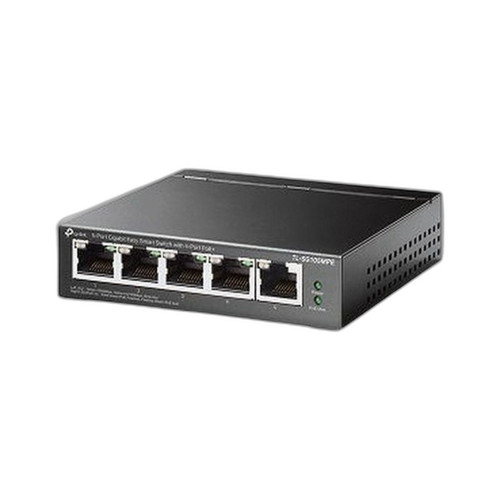
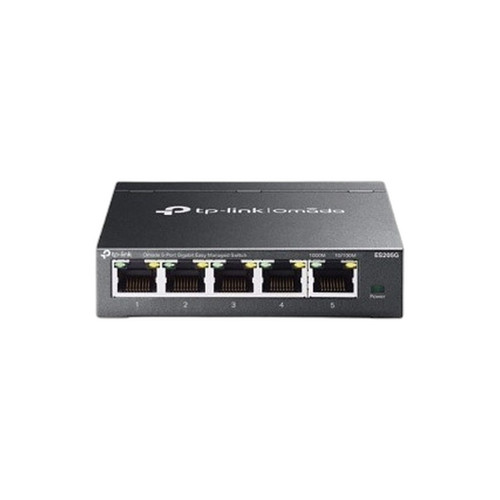
Both products are 5-port gigabit desktop switches from TP-Link targeting small-site and edge deployments. The TL-SG105PE is an Easy Smart PoE+ switch delivering up to 65 W across four powered ports, while the ES205G is a fully managed, non-PoE Omada SDN switch. Buyers evaluating this tier typically face a core choice: powered-device delivery (cameras, APs, phones) versus richer Layer-2 management without the PoE overhead. This comparison uses only the published specifications for each unit.
In This Guide
- Which switch can power connected devices, and how much wattage is available per port?
- How do switching capacity and packet-forwarding performance compare across the five ports?
- What level of network management and platform integration does each switch offer?
- Which should you choose: the SG105PE or the ES205G?
- Side-by-Side Specs
- FAQ
Which switch can power connected devices, and how much wattage is available per port?
The TL-SG105PE provides PoE+ (802.3at) on four of its five RJ45 ports with a shared 65 W budget and up to 30 W per port. This makes it capable of powering IP cameras, wireless access points, VoIP phones, and other 802.3at-class endpoints without separate power injectors or local AC outlets at each device.
The ES205G carries no PoE delivery capability per its published specifications. It is powered by an external 5 VDC / 0.6 A adapter and provides no PoE budget. All five of its ports are strictly data ports. Buyers who need to power any endpoint must supply AC adapters or external PoE injectors separately.
How do switching capacity and packet-forwarding performance compare across the five ports?
The ES205G publishes a 10 Gbps switching capacity and 7.4 Mpps forwarding rate, with 64 Mbit Flash and 4 Mbit packet buffer also documented. These figures confirm non-blocking performance at full gigabit line-rate across all five ports simultaneously.
The TL-SG105PE specifies 10/100/1000 Mbps on all five RJ45 ports and a 65 W PoE budget, but its datasheet as provided does not publish a discrete switching-capacity figure, forwarding rate, or buffer size. Cross-shopping buyers should note this gap when evaluating throughput-sensitive deployments.
What level of network management and platform integration does each switch offer?
The ES205G is a fully managed switch integrated into TP-Link's Omada SDN platform, enabling centralized configuration, monitoring, and control alongside other Omada devices. Its documented management feature set includes a DHCP client. It also carries CE, FCC, and RoHS certifications, and supports single-mode fiber with a published 20 km max range — indicating at least one SFP or fiber-capable port, though port-type breakdown is not fully detailed in the provided specs.
The TL-SG105PE is classified as 'Easy Smart,' a limited-management tier below full Omada SDN. It is wall-mountable and targets simple edge deployments where basic PoE delivery — not deep VLAN, QoS, or centralized SDN management — is the primary requirement. No certifications, buffer size, or switching-capacity figure are listed in the provided specifications.
Which should you choose: the SG105PE or the ES205G?
Our take: The TL-SG105PE is the stronger choice when the deployment requires powering attached devices — cameras, access points, or VoIP phones — at the edge, because it delivers 65 W of 802.3at PoE+ across four ports at up to 30 W each, a capability the ES205G entirely lacks. Conversely, the ES205G is the stronger choice when PoE is not needed but managed-network control matters: it offers full Omada SDN integration, a documented 10 Gbps non-blocking switching capacity with 7.4 Mpps forwarding, and a 4 Mbit packet buffer — none of which are specified for the SG105PE. The ES205G also adds CE/FCC/RoHS certifications and fiber-range capability not present in the SG105PE spec sheet. Choose the SG105PE for PoE-powered device deployment on a simple network; choose the ES205G for non-PoE edge segments that demand centralized Omada SDN management and verified forwarding performance.
Side-by-Side Comparison
Spec-for-spec, from manufacturer data.
| Specification | TP-Link SG105PE | TP-Link ES205G |
|---|---|---|
| Product Class | Easy Smart PoE+ Switch | Fully Managed SDN Switch |
| SKU | TL-SG105PE | ES205G |
| Total Ports | 5 × RJ45 Gigabit | 5 × RJ45 Gigabit |
| Port Speed | 10/100/1000 Mbps | 10/100/1000 Mbps |
| PoE Output | PoE+ (802.3at), 4 ports | None |
| PoE Budget | 65 W total | — |
| Max PoE per Port | 30 W | — |
| Switching Capacity | — | 10 Gbps |
| Forwarding Rate | — | 7.4 Mpps |
| Packet Buffer | — | 4 Mbit |
| Flash Memory | — | 64 Mbit |
| Management Tier | Easy Smart | Full Managed (Omada SDN) |
| Power Input | — | 5 VDC / 0.6 A |
| Mount Style | Wall-mount | Desktop / Wall-mount |
| Operating Temp | — | 0 °C to 40 °C (32 °F to 104 °F) |
| Certifications | — | CE, FCC, RoHS |
Frequently Asked Questions
Which should you choose: the SG105PE or the ES205G?
The TL-SG105PE is the stronger choice when the deployment requires powering attached devices — cameras, access points, or VoIP phones — at the edge, because it delivers 65 W of 802.3at PoE+ across four ports at up to 30 W each, a capability the ES205G entirely lacks. Conversely, the ES205G is the stronger choice when PoE is not needed but managed-network control matters: it offers full Omada SDN integration, a documented 10 Gbps non-blocking switching capacity with 7.4 Mpps forwarding, and a 4 Mbit packet buffer — none of which are specified for the SG105PE. The ES205G also adds CE/FCC/RoHS certifications and fiber-range capability not present in the SG105PE spec sheet. Choose the SG105PE for PoE-powered device deployment on a simple network; choose the ES205G for non-PoE edge segments that demand centralized Omada SDN management and verified forwarding performance.
Can either of these switches power IP cameras or wireless access points directly?
Only the TL-SG105PE can. It supplies PoE+ (802.3at) on four ports with a 65 W total budget and up to 30 W per port, sufficient for most IP cameras and indoor access points. The ES205G has no PoE output — it runs off a 5 VDC / 0.6 A adapter and cannot power any attached device.
Is the ES205G or TL-SG105PE better for a managed Omada SDN network?
The ES205G is the correct choice for Omada SDN deployments. It is explicitly listed as an Omada managed switch with centralized SDN management support. The TL-SG105PE is 'Easy Smart' — a lighter management tier that is not part of the full Omada SDN ecosystem.
Which switch has better-documented forwarding performance?
The ES205G. Its specifications list a 10 Gbps switching capacity, 7.4 Mpps forwarding rate, and 4 Mbit packet buffer — confirming non-blocking line-rate operation across all five gigabit ports. The TL-SG105PE's provided specifications do not include a switching-capacity figure, forwarding rate, or buffer size.
More Network Switch Comparisons
- TP-Link SG2005P-PD vs Ubiquiti USW-FLEX-2.5G-5
- TP-Link SG2005P-PD vs TP-Link ES205G
- TP-Link SG2005P-PD vs TP-Link DS105G
- TP-Link ES205G vs Ubiquiti USW-FLEX-2.5G-5
- TP-Link ES205G vs TP-Link DS105G
- Ubiquiti USW-FLEX-2.5G-5 vs TP-Link DS105G
Network Switch Buying Guides
Get a Second Opinion on Your Camera Choice
Share your site layout, coverage goals, and budget. Our team will validate the camera selection, flag anything we would change, and recommend products that match the use case.