
TP-Link SG105MPE vs TP-Link ES205G: Specification Comparison
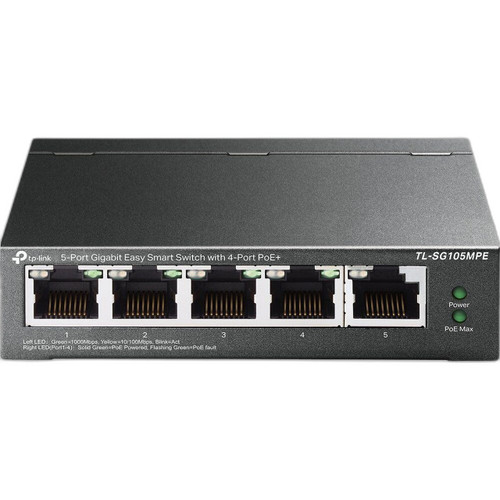
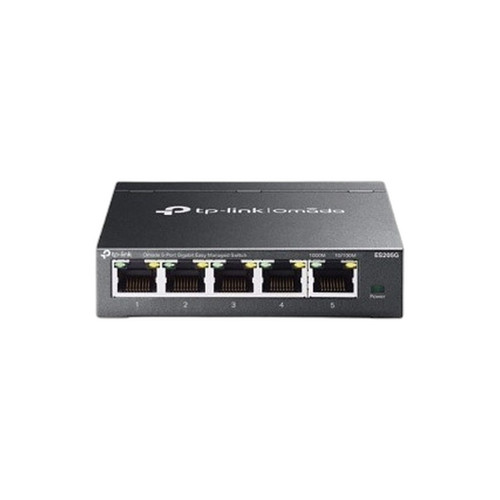
The TP-Link TL-SG105MPE and ES205G are both 5-port Gigabit desktop switches aimed at small-office and edge-of-network deployments. The SG105MPE is an Easy Smart switch with four PoE+ ports and a 120 W PoE budget, targeting IP camera and VoIP installations. The ES205G is a full Omada SDN-managed switch with 10 Gbps non-blocking switching capacity and 7.4 Mpps forwarding, targeting environments that require centralized Layer 2 management. Neither product is positioned for high-density or rack-only deployments.
In This Guide
Which switch delivers the right PoE power for your edge devices?
The TL-SG105MPE provides four IEEE 802.3af/at (PoE+) ports with a combined 120 W budget. At 30 W per port, that realistically powers three to four IP cameras or VoIP endpoints simultaneously from a single desktop unit, with no separate injector required.
The ES205G's spec sheet lists a power supply of 5 VDC / 0.6 A — a 3 W total draw that is physically inconsistent with onboard PoE delivery. The '65 W' and 'Power: PoE' entries in the provided spec data appear to be a metadata inconsistency; the 5 V adapter supply cannot source PoE. Buyers requiring powered edge devices must treat the ES205G as a non-PoE switch and budget for separate PoE injectors or a different upstream switch.
For any deployment where IP cameras, access-control readers, or VoIP phones must be powered over the cable run, the SG105MPE's 120 W budget is a direct, hardware-confirmed capability; the ES205G offers no equivalent from its provided specifications.
How do switching throughput and management depth compare?
The ES205G is spec'd at 10 Gbps switching capacity and 7.4 Mpps forwarding rate across its five 10/100/1000 Mbps RJ45 ports, which represents a non-blocking fabric — all five ports can simultaneously operate at full Gigabit without internal congestion. The ES205G is a full Omada SDN-managed switch, supporting DHCP client and centralized cloud or controller-based management.
The TL-SG105MPE is classified as an 'Easy Smart' switch — a middle tier above unmanaged but below fully managed. Its switching capacity is not stated in the provided specifications. It supports web-based configuration for basic features such as VLAN, QoS, and port mirroring, but it does not participate in the Omada SDN controller ecosystem.
For IT environments running Omada hardware (EAPs, routers, other Omada switches) and requiring centralized policy, VLAN automation, or remote monitoring, the ES205G integrates natively. The SG105MPE operates as a standalone managed device only.
How do physical footprint, mounting, and operating environment compare?
The ES205G has documented dimensions of 3.9 × 3.9 × 1.0 in (99.8 × 98 × 25 mm) — an unusually compact square form factor — and supports desktop and wall-mounting. Its operating temperature is specified at 0 °C to 40 °C (32 °F to 104 °F). It carries CE, FCC, and RoHS certifications. Memory is 64 Mbit Flash and 4 Mbit Packet Buffer.
The TL-SG105MPE's physical dimensions are not provided in the supplied specifications. Its mount type is listed as wall, with no DIN-rail support confirmed. No operating temperature range, certifications, or memory specifications are stated in the provided data.
Both units are described as desktop/wall-mount switches with no rack-mount ears included per the provided specs; neither is listed as DIN-rail capable. The ES205G provides a more complete environmental and certification picture from the available data; the SG105MPE's environmental ratings are absent from the supplied spec set.
Which should you choose: the SG105MPE or the ES205G?
Our take: The SG105MPE is the stronger choice when powering IP cameras or other PoE devices is required, delivering 120 W across four PoE+ ports with no injectors needed. The ES205G is the stronger choice when centralized Omada SDN management matters more than PoE: it provides a fully non-blocking 10 Gbps / 7.4 Mpps fabric, native Omada controller integration, and documented certifications (CE, FCC, RoHS) — none of which the SG105MPE matches from the supplied data. The SG105MPE's switching capacity is unspecified, its environmental ratings are absent, and it tops out at Easy Smart management rather than full SDN participation. Buyers deploying IP cameras at a small edge site with no existing Omada ecosystem should choose the SG105MPE for its proven PoE budget. Buyers standardizing on Omada infrastructure — or connecting only non-PoE endpoints — should choose the ES205G for its management depth and confirmed throughput figures.
Side-by-Side Comparison
Spec-for-spec, from manufacturer data.
| Specification | TP-Link SG105MPE | TP-Link ES205G |
|---|---|---|
| Product Type | Easy Smart Switch | Managed Switch (Omada SDN) |
| Total Ports | 5 | 5 |
| Port Speed | Gigabit (1 Gbps) | 10/100/1000 Mbps (Gigabit) |
| Interface Type | — | RJ45 × 5 |
| Switching Capacity | — | 10 Gbps |
| Forwarding Rate | — | 7.4 Mpps |
| PoE Ports | 4 (PoE+) | 0 (per power supply spec) |
| PoE Budget | 120 W | — |
| Power Supply | — | 5 VDC / 0.6 A |
| Management Platform | Easy Smart (standalone web UI) | Omada SDN (controller / cloud) |
| Mount Type | Wall | Desktop / Wall |
| Dimensions | — | 3.9 × 3.9 × 1.0 in (99.8 × 98 × 25 mm) |
| Operating Temperature | — | 0 °C to 40 °C (32 °F to 104 °F) |
| Flash Memory | — | 64 Mbit |
| Packet Buffer | — | 4 Mbit |
| Certifications | — | CE, FCC, RoHS |
Frequently Asked Questions
Which should you choose: the SG105MPE or the ES205G?
The SG105MPE is the stronger choice when powering IP cameras or other PoE devices is required, delivering 120 W across four PoE+ ports with no injectors needed. The ES205G is the stronger choice when centralized Omada SDN management matters more than PoE: it provides a fully non-blocking 10 Gbps / 7.4 Mpps fabric, native Omada controller integration, and documented certifications (CE, FCC, RoHS) — none of which the SG105MPE matches from the supplied data. The SG105MPE's switching capacity is unspecified, its environmental ratings are absent, and it tops out at Easy Smart management rather than full SDN participation. Buyers deploying IP cameras at a small edge site with no existing Omada ecosystem should choose the SG105MPE for its proven PoE budget. Buyers standardizing on Omada infrastructure — or connecting only non-PoE endpoints — should choose the ES205G for its management depth and confirmed throughput figures.
Can the ES205G power IP cameras or VoIP phones directly?
Based on the provided specifications, the ES205G runs on a 5 VDC / 0.6 A power supply, which cannot deliver PoE. The SG105MPE is the only unit in this comparison with a confirmed PoE capability — 120 W across four PoE+ ports. If you need to power edge devices over Ethernet, the SG105MPE is the appropriate choice; the ES205G would require separate PoE injectors for each powered device.
Is the SG105MPE or ES205G better for a site already running Omada access points and routers?
The ES205G is the better fit. It is a full Omada SDN-managed switch and integrates with the Omada controller for centralized VLAN, QoS, and monitoring alongside other Omada hardware. The SG105MPE is an Easy Smart switch that does not participate in the Omada SDN ecosystem; it requires separate web-based management and cannot be provisioned or monitored through an Omada controller.
Which switch is physically smaller and easier to conceal at a wall-mount location?
The ES205G has documented dimensions of 3.9 × 3.9 × 1.0 in (99.8 × 98 × 25 mm), making it an exceptionally compact unit. Physical dimensions for the SG105MPE are not stated in the provided specifications, so a direct size comparison cannot be made from the available data. The ES205G's confirmed footprint gives it a documented advantage for space-constrained installations.
More Network Switch Comparisons
- TP-Link SG2005P-PD vs Ubiquiti USW-FLEX-2.5G-5
- TP-Link SG2005P-PD vs TP-Link ES205G
- TP-Link SG2005P-PD vs TP-Link DS105G
- TP-Link ES205G vs Ubiquiti USW-FLEX-2.5G-5
- TP-Link ES205G vs TP-Link DS105G
- Ubiquiti USW-FLEX-2.5G-5 vs TP-Link DS105G
Network Switch Buying Guides
Get a Second Opinion on Your Camera Choice
Share your site layout, coverage goals, and budget. Our team will validate the camera selection, flag anything we would change, and recommend products that match the use case.