
TP-Link SG1008MP vs Comnet CNGE8MS: Specification Comparison
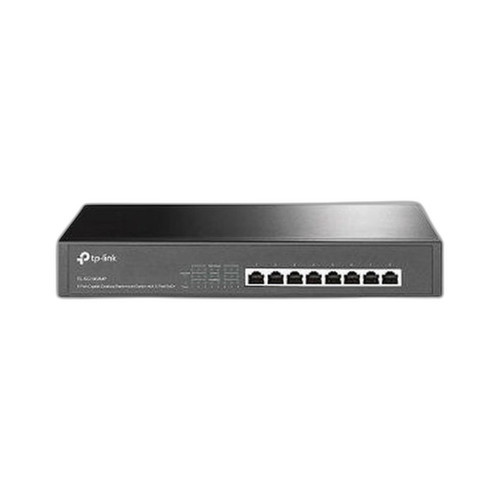
This comparison covers two 8-port Gigabit switches positioned for physical-security edge deployments such as IP camera distribution nodes. The TP-Link TL-SG1008MP is an unmanaged PoE+ switch built for indoor desktop or rack environments where powering cameras and access-control readers from a single device matters most. The Comnet CNGE8MS is a managed, hardened switch engineered for harsh-environment installations requiring a wide temperature range, dual DC inputs, fiber uplinks, and Layer 2 resiliency protocols. Neither product is declared the winner here; the right choice depends on deployment conditions and management requirements.
In This Guide
- What do the port configuration, throughput, and PoE capability look like?
- How do environmental hardening, power input, and physical form factor compare?
- What management capabilities, resiliency protocols, and standards compliance does each switch offer?
- Which should you choose: the SG1008MP or the CNGE8MS?
- Side-by-Side Specs
- FAQ
What do the port configuration, throughput, and PoE capability look like?
The TL-SG1008MP provides eight RJ-45 Gigabit copper ports, all PoE+ capable at up to 30 W per port under the 802.3at standard, with an extended-reach mode that stretches PoE delivery to 250 m — useful for cameras mounted far from the IDF. The total PoE budget is not stated in the provided specifications, which limits pre-design power planning. The switch also notes 802.3bt (PoE++) support in its PoE descriptor, though the per-port wattage listed is 30 W, consistent with 802.3at rather than the 90 W maximum of 802.3bt; buyers should verify the actual per-port ceiling before connecting high-draw devices such as PTZ cameras with heaters.
The CNGE8MS offers four RJ-45 Gigabit copper ports and four SFP combo ports, giving the option to terminate fiber runs directly at the edge switch — a meaningful advantage in long-distance trunk runs or electrically noisy environments. PoE is not specified in the provided specs for the CNGE8MS, so it cannot be relied upon to power cameras or other PoE-dependent endpoints without separate injectors or a downstream PoE switch. Switching bandwidth is rated at 16 Gbps with a forwarding latency of 7 µs, and the MAC address table holds 8,192 entries.
How do environmental hardening, power input, and physical form factor compare?
The TL-SG1008MP is designed for conditioned indoor environments. Its operating temperature range is not explicitly stated in the provided specifications. It mounts on a desktop or in a standard rack, making it a natural fit for an equipment room, server closet, or patch-panel bay. It draws power from a standard AC input (implied by the desktop/rack form factor and absence of DC input specs), and power consumption figures are not provided.
The CNGE8MS is rated for operation from -40°C to +75°C and storage from -40°C to +85°C at 5–95% non-condensing humidity, meeting the definition of a hardened switch suitable for outdoor enclosures, traffic cabinets, factory floors, or unheated utility spaces. Power input is dual DC at 12–48 VDC, enabling connection to industrial DC power plants, solar/battery systems, or redundant 24 VDC camera power buses. Typical power consumption is 25 W. The unit mounts on DIN-Rail or wall and weighs under 1.1 kg, dimensioned at 7.43 × 10.92 × 15.36 cm — compact enough for a pole-mount enclosure.
What management capabilities, resiliency protocols, and standards compliance does each switch offer?
The TL-SG1008MP is explicitly unmanaged. Its management descriptor references a provisioning, monitoring, and Wi-Fi 6 management app, which appears to reflect TP-Link's broader Omada ecosystem rather than per-port VLAN, QoS, or ring-resiliency configuration on this specific switch. With no managed Layer 2 features, there is no VLAN segmentation, no RSTP, no port mirroring, and no SNMP trapping available on the device itself. This simplifies deployment and eliminates configuration overhead for small, flat-network camera runs.
The CNGE8MS is a fully managed switch supporting up to 4,096 VLANs (802.1Q), Link Aggregation (802.3ad), Rapid Spanning Tree (802.1w), Multiple Spanning Tree (802.1s), Port-based Access Control (802.1x), and LLDP (802.1AB). It also implements Comnet's proprietary ring protocols — C-Ring, Legacy Ring, and C-RSTP — which provide fast network recovery in ring topologies, a common architecture in industrial and perimeter-security fiber runs. The CNGE8MS carries a lifetime warranty, while the TL-SG1008MP warranty is not stated in the provided specifications.
Which should you choose: the SG1008MP or the CNGE8MS?
Our take: If the deployment is in a conditioned indoor space and every port must power a PoE camera or access reader, the TL-SG1008MP is the functionally direct choice; if the installation is in a harsh environment or requires managed Layer 2 features, the CNGE8MS is the appropriate platform. Key spec deltas: the TL-SG1008MP delivers PoE+ at up to 30 W per port while the CNGE8MS lists no PoE capability; the CNGE8MS operates from -40°C to +75°C versus no stated operating temperature range for the TL-SG1008MP; and the CNGE8MS supports 4,096 VLANs and proprietary ring recovery while the TL-SG1008MP offers no managed Layer 2 features. Installers running fiber trunks, deploying into outdoor enclosures, or building ring-redundant camera networks should select the CNGE8MS. Installers wiring a standard IDF or server room with PoE IP cameras on copper runs should evaluate the TL-SG1008MP, subject to confirming the total PoE budget before finalizing the design.
Side-by-Side Comparison
Spec-for-spec, from manufacturer data.
| Specification | TP-Link SG1008MP | Comnet CNGE8MS |
|---|---|---|
| Switch Type | Unmanaged | Managed |
| Total Ports | 8 | 8 |
| Copper (RJ-45) Ports | 8 | 4 |
| Fiber (SFP Combo) Ports | — | 4 |
| Port Speed | 1000 Mbps | 1000 Mbps |
| Switching Bandwidth | — | 16 Gbps |
| Forwarding Latency | — | 7 µs |
| MAC Address Table | — | 8,192 |
| VLANs Supported | — | 4,096 |
| PoE Capability | PoE+ (802.3at); 30 W per port | Not specified |
| Extended PoE Range | 250 m | — |
| Operating Temperature | Not specified | -40°C to +75°C |
| Power Input | AC (not specified in provided specs) | Dual DC 12–48 VDC |
| Mounting | Desktop or Rack | DIN-Rail or Wall |
| Ring Resiliency | None | C-Ring, Legacy Ring, C-RSTP |
| Warranty | Not specified in provided specs | Lifetime |
Frequently Asked Questions
Which should you choose: the SG1008MP or the CNGE8MS?
If the deployment is in a conditioned indoor space and every port must power a PoE camera or access reader, the TL-SG1008MP is the functionally direct choice; if the installation is in a harsh environment or requires managed Layer 2 features, the CNGE8MS is the appropriate platform. Key spec deltas: the TL-SG1008MP delivers PoE+ at up to 30 W per port while the CNGE8MS lists no PoE capability; the CNGE8MS operates from -40°C to +75°C versus no stated operating temperature range for the TL-SG1008MP; and the CNGE8MS supports 4,096 VLANs and proprietary ring recovery while the TL-SG1008MP offers no managed Layer 2 features. Installers running fiber trunks, deploying into outdoor enclosures, or building ring-redundant camera networks should select the CNGE8MS. Installers wiring a standard IDF or server room with PoE IP cameras on copper runs should evaluate the TL-SG1008MP, subject to confirming the total PoE budget before finalizing the design.
Can the TL-SG1008MP power PTZ cameras with built-in heaters that draw more than 30 W?
The provided specifications list 30 W per port, which aligns with 802.3at (PoE+). The product also references 802.3bt (PoE++, up to 90 W per port) in its PoE descriptor, but the per-port figure stated is 30 W. Buyers should confirm the actual per-port power ceiling directly with TP-Link before connecting devices that exceed 30 W, such as high-wattage PTZ cameras or multi-radio access points.
Does the CNGE8MS support Power over Ethernet for cameras?
PoE is not specified in the provided specifications for the CNGE8MS. Do not assume PoE capability. If PoE-powered cameras are required at the CNGE8MS location, plan for separate PoE injectors or a downstream PoE switch on the copper ports.
Which switch is better suited for a perimeter fence-line camera run in an outdoor pole-mount enclosure?
The CNGE8MS is the appropriate choice for that environment. Its -40°C to +75°C operating range, dual DC 12–48 VDC input, DIN-Rail mounting, four SFP combo ports for fiber uplinks, and ring recovery via C-Ring, Legacy Ring, and C-RSTP all address the specific demands of outdoor industrial deployments. The TL-SG1008MP does not specify an operating temperature range or DC power input and is designed for indoor desktop or rack use.
More Network Switch Comparisons
- TP-Link SG2210XMP-M2 vs Ubiquiti USW-FLEX-2.5G-8
- TP-Link SG2210XMP-M2 vs Comnet CNGE8MS
- TP-Link SG2210XMP-M2 vs Lantronix S2220-1014-NA
- TP-Link SG2210XMP-M2 vs TP-Link S4500-8GP
- TP-Link SG2210XMP-M2 vs TP-Link SG2008P
- TP-Link S4500-8GP vs Ubiquiti USW-FLEX-2.5G-8
Network Switch Buying Guides
Get a Second Opinion on Your Camera Choice
Share your site layout, coverage goals, and budget. Our team will validate the camera selection, flag anything we would change, and recommend products that match the use case.