
TP-Link DS1024G vs Ubiquiti USW-ENTERPRISEXG-24: Specification Comparison
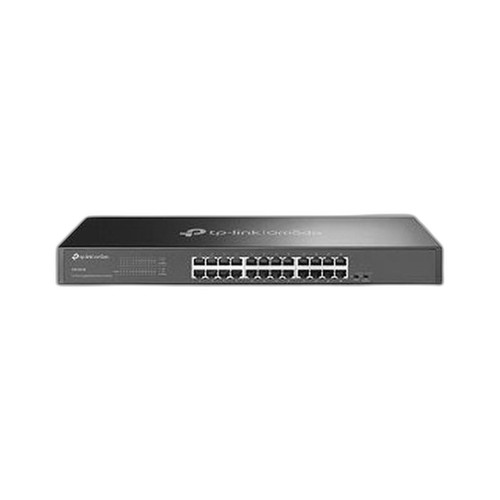
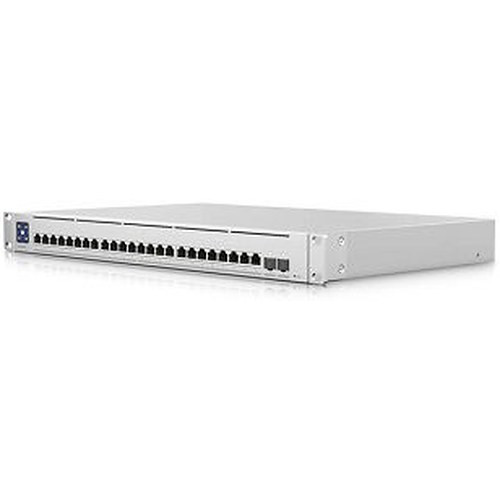
Both the TP-Link DS1024G and the Ubiquiti USW-ENTERPRISEXG-24 are 24-port, rack-mount, managed network switches — products a buyer might place in the same RFQ line item. However, they occupy fundamentally different performance tiers: the DS1024G is a 1 GbE access switch with 48 Gbps switching capacity, while the USW-ENTERPRISEXG-24 is a 10 GbE Layer 3 switch with 580 Gbps switching capacity and 25G uplinks. A buyer choosing between them is deciding whether gigabit or multi-gigabit access density is required, and whether Layer 2 or Layer 3 routing capability is needed.
In This Guide
- What port speeds and backplane capacity does each switch actually deliver?
- What management layer and software integration does each switch support?
- How do the two switches compare on power consumption, operating environment, and compliance?
- Which should you choose: the DS1024G or the USW-ENTERPRISEXG-24?
- Side-by-Side Specs
- FAQ
What port speeds and backplane capacity does each switch actually deliver?
The DS1024G provides 24 × 10/100/1000 Mbps (1 GbE) RJ-45 ports with a switching capacity of 48 Gbps and a packet forwarding rate of 35.7 Mpps. Its non-blocking fabric supports simultaneous full-rate use on all 24 ports at 1 GbE, and the maximum cable run is 100 m over Cat 5e/5. No uplink ports beyond the 24 access ports are specified in the provided data.
The USW-ENTERPRISEXG-24 provides 24 × 10 GbE RJ-45 access ports plus 2 × 25G SFP28 uplink ports. Its switching capacity is 580 Gbps — more than 12× that of the DS1024G — with a forwarding rate of 432 Mpps, approximately 12× higher as well. The 25G SFP28 uplinks are designed to aggregate traffic toward a core layer or NVR without congestion. Uplink port count and SFP28 module type are not specified for the DS1024G.
For deployments where each connected device (camera, workstation, NVR) requires sustained throughput well above 1 Gbps — such as multi-stream 4K or 8K IP cameras — the USW-ENTERPRISEXG-24's 10 GbE per-port bandwidth is the only option between these two. The DS1024G is appropriate where 1 Gbps per device is sufficient and budget efficiency on access ports is a priority.
What management layer and software integration does each switch support?
The DS1024G is listed in its specs with a conflict: the 'Managed' field states 'Yes,' but the 'Product_Type' field states 'Unmanaged Rackmount Switch.' Operating modes described — Isolation Mode (ports 1–22) and Loop Prevention (ports 1–24) — are consistent with limited or smart-managed features rather than full managed capabilities. VLAN, SNMP, CLI, or web-UI support are not confirmed in the provided specifications. The DS1024G is marketed under TP-Link's Omada ecosystem, but Omada controller integration is not explicitly confirmed in the specs provided.
The USW-ENTERPRISEXG-24 is specified as Layer 3 (Managed Routing), with management via SNMP, CLI, Web UI, and UniFi Network Integration. Layer 3 capability means the switch can perform inter-VLAN routing in hardware, eliminating the need for a separate router in many access-distribution deployments. It integrates natively into the Ubiquiti UniFi platform.
Buyers requiring full Layer 3 routing, SNMP monitoring, or a unified cloud/on-premises management plane should note that only the USW-ENTERPRISEXG-24 has those capabilities confirmed by the specs on hand. The DS1024G's management capabilities are ambiguous based on the provided data and should be verified against its datasheet before specifying.
How do the two switches compare on power consumption, operating environment, and compliance?
The DS1024G draws a maximum of 13.46 W and operates from 100–240 VAC, 50/60 Hz. Its operating temperature range is 0–40°C (32–104°F). Certifications listed are FCC, CE, and RoHS. Weight and enclosure material are not provided in the specs.
The USW-ENTERPRISEXG-24 consumes up to 100 W — approximately 7.4× more than the DS1024G — reflecting the power demands of 24 × 10 GbE ASICs and dual 25G uplink PHYs. It operates from 100–240 VAC with a dual AC/DC input and supports a slightly wider temperature range of -5 to 40°C (23–104°F), giving it a 5°C cold-side advantage. The enclosure is SGCC steel; weight without brackets is 4.5 kg (9.9 lb). Certifications include CE, FCC, IC, and Anatel. The USW-ENTERPRISEXG-24 is listed as NDAA compliant; NDAA compliance status is not stated for the DS1024G.
For deployments in facilities where NDAA compliance is mandated (federal, defense, or government-adjacent contracts), only the USW-ENTERPRISEXG-24 has that status confirmed. The DS1024G's 13.46 W draw makes it significantly easier to power from standard access-layer UPS budgets, while the USW-ENTERPRISEXG-24 will require careful power planning per rack.
Which should you choose: the DS1024G or the USW-ENTERPRISEXG-24?
Our take: The USW-ENTERPRISEXG-24 is the stronger choice when each access port must sustain 10 GbE line-rate throughput, full Layer 3 routing is required, or NDAA compliance is mandatory. Three concrete spec deltas drive this: switching capacity is 580 Gbps vs. 48 Gbps (a 12× gap); per-port access speed is 10 GbE vs. 1 GbE; and only the Ubiquiti unit confirms NDAA compliance and Layer 3 managed routing with SNMP/CLI/UniFi integration. The DS1024G is the stronger choice when port budget, rack power budget, or deployment scale makes 1 GbE access sufficient — its 13.46 W max draw is 7.4× lower, and it costs far less per port in a pure-gigabit access scenario. Buyers on the Ubiquiti UniFi platform gain native integration with the USW-ENTERPRISEXG-24; buyers on the TP-Link Omada platform should verify DS1024G controller compatibility against its datasheet before specifying, as management capabilities in the provided specs are internally inconsistent.
Side-by-Side Comparison
Spec-for-spec, from manufacturer data.
| Specification | TP-Link DS1024G | Ubiquiti USW-ENTERPRISEXG-24 |
|---|---|---|
| Device Type | Managed Network Switch | Layer 3 Managed Switch |
| Total Access Ports | 24 × 1 GbE RJ-45 | 24 × 10 GbE RJ-45 |
| Uplink Ports | — | 2 × 25G SFP28 |
| Switching Capacity | 48 Gbps | 580 Gbps |
| Forwarding Rate | 35.7 Mpps | 432 Mpps |
| Layer | — | Layer 3 (Managed Routing) |
| Management | — | SNMP, CLI, Web UI, UniFi |
| Power Consumption (Max) | 13.46 W | 100 W |
| Power Input | 100–240 VAC, 50/60 Hz | 100–240 VAC, Dual AC/DC |
| Operating Temp | 0 to 40°C (32–104°F) | -5 to 40°C (23–104°F) |
| Enclosure Material | — | SGCC steel |
| Weight | — | 4.5 kg (9.9 lb) w/o brackets |
| NDAA Compliant | — | Yes |
| Certifications | FCC, CE, RoHS | CE, FCC, IC, Anatel |
| Form Factor | 1U Rack Mount | 1U Rack Mount |
| MAC Address Table | 8K | — |
Frequently Asked Questions
Which should you choose: the DS1024G or the USW-ENTERPRISEXG-24?
The USW-ENTERPRISEXG-24 is the stronger choice when each access port must sustain 10 GbE line-rate throughput, full Layer 3 routing is required, or NDAA compliance is mandatory. Three concrete spec deltas drive this: switching capacity is 580 Gbps vs. 48 Gbps (a 12× gap); per-port access speed is 10 GbE vs. 1 GbE; and only the Ubiquiti unit confirms NDAA compliance and Layer 3 managed routing with SNMP/CLI/UniFi integration. The DS1024G is the stronger choice when port budget, rack power budget, or deployment scale makes 1 GbE access sufficient — its 13.46 W max draw is 7.4× lower, and it costs far less per port in a pure-gigabit access scenario. Buyers on the Ubiquiti UniFi platform gain native integration with the USW-ENTERPRISEXG-24; buyers on the TP-Link Omada platform should verify DS1024G controller compatibility against its datasheet before specifying, as management capabilities in the provided specs are internally inconsistent.
Is the DS1024G or USW-ENTERPRISEXG-24 better for high-density 4K or 8K IP camera deployments?
Based on the provided specs, the USW-ENTERPRISEXG-24 is better suited for high-density 4K or 8K camera deployments. Each of its 24 ports operates at 10 GbE, providing up to 10× the per-port bandwidth of the DS1024G's 1 GbE ports. Its 580 Gbps switching capacity and 432 Mpps forwarding rate are designed to prevent backplane saturation under simultaneous multi-stream loads. The DS1024G's 48 Gbps capacity and 1 GbE ports are appropriate for standard-definition or 1080p camera streams where per-camera bandwidth stays well below 1 Gbps.
Does either switch require an external router for inter-VLAN routing?
Based on the provided specs, the USW-ENTERPRISEXG-24 is specified as a Layer 3 switch capable of managed routing, which means inter-VLAN routing can be handled in hardware on the switch itself without a separate router. The DS1024G's management level is ambiguous in the provided specs — it is simultaneously listed as 'Managed: Yes' and 'Product_Type: Unmanaged Rackmount Switch,' and no Layer 3 or routing capability is mentioned. Buyers requiring inter-VLAN routing should verify the DS1024G's actual software feature set against its datasheet before assuming that capability exists.
Which switch is the right choice if my project requires NDAA compliance?
Based on the provided specs, only the Ubiquiti USW-ENTERPRISEXG-24 is listed as NDAA compliant. The DS1024G's specs do not include any NDAA compliance statement. For federal, government, or defense-adjacent projects where NDAA compliance is a hard procurement requirement, the USW-ENTERPRISEXG-24 is the only option between these two models that meets that criterion as documented.
More Network Switch Comparisons
- TP-Link S5500-24GP4XF vs NETGEAR GS728TP-300NAS
- TP-Link S5500-24GP4XF vs Comnet CNGE24FX12TX12MSPOE
- TP-Link S5500-24GP4XF vs Ubiquiti USW-24
- TP-Link S5500-24GP4XF vs Ubiquiti USW-ENTERPRISEXG-24
- TP-Link S5500-24GP4XF vs TP-Link SL2428P
- TP-Link S5500-24GP4XF vs TP-Link SG3428XPP-M2
Network Switch Buying Guides
Get a Second Opinion on Your Camera Choice
Share your site layout, coverage goals, and budget. Our team will validate the camera selection, flag anything we would change, and recommend products that match the use case.