
Sato WWCLP3801-WAR vs Brother TJ4520TN: Specification Comparison
Both the Sato WWCLP3801-WAR (CL4NX Plus) and the Brother TJ4520TN are industrial thermal transfer label printers designed for high-volume, mission-critical labeling environments. The comparison covers print quality and speed, media handling and RFID capability, and connectivity plus build characteristics. Buyers cross-shopping these units are typically evaluating industrial barcode, compliance, or encoded-label workflows where resolution, throughput, and integration flexibility are primary drivers.

In This Guide
- Which printer delivers higher resolution and faster throughput for demanding label runs?
- Which unit handles a wider media range and adds RFID encoding to the workflow?
- How do the two printers compare on interfaces, construction, and onboard resources?
- Which should you choose: the WWCLP3801-WAR or the TJ4520TN?
- Side-by-Side Specs
- FAQ
Which printer delivers higher resolution and faster throughput for demanding label runs?
The Sato WWCLP3801-WAR prints at 609 dpi and reaches 14 ips. The Brother TJ4520TN prints at 300 dpi and reaches 12 ips. The Sato unit therefore offers more than double the resolution — meaningful for pharmaceutical serialization, fine-pitch barcodes, or electronics labels where print quality must meet strict ISO or GS1 grading requirements. The 2 ips speed advantage on the Sato also compounds at volume: across an 8-hour shift, the difference accumulates to a measurable throughput gain on long runs.
Both units support thermal transfer print method, meaning ribbon-based printing for durable labels suited to freezer, outdoor, or chemical-exposure applications. Direct thermal is additionally available on the Sato WWCLP3801-WAR, giving it a ribbon-free option for short-life labels. The Brother TJ4520TN spec does not list a direct thermal mode.
Which unit handles a wider media range and adds RFID encoding to the workflow?
The Sato WWCLP3801-WAR accepts media widths from 0.87" to 5.04", accommodates roll diameters up to 10", and supports ribbon lengths up to 1,968 ft — all specified in the provided data. The Brother TJ4520TN specifies a 4.5" print width but does not provide minimum media width, max roll diameter, or ribbon length in the supplied specs.
RFID encoding is a major differentiator. The Sato WWCLP3801-WAR includes built-in HF RFID at 13.56 MHz with auto-antenna tuning, enabling simultaneous print-and-encode of smart labels (NFC, ISO 15693, ISO 14443 tag families). The Brother TJ4520TN spec lists no RFID capability whatsoever. For supply-chain, pharmaceutical, or access-control label programs that mandate encoded smart labels, the Sato is the only option of the two.
How do the two printers compare on interfaces, construction, and onboard resources?
The Sato WWCLP3801-WAR offers Ethernet, Wi-Fi, and USB 2.0, housed in a cast-aluminum frame weighing 33 lbs with a 3.5" full-color LCD touchscreen. Onboard memory is 2 GB Flash, 256 MB SDRAM, and 100 MB user storage — substantial for storing label formats, fonts, and graphics locally. Operating temperature is specified at 41°F to 104°F. Power input is AC 100–240 V, 50/60 Hz (universal).
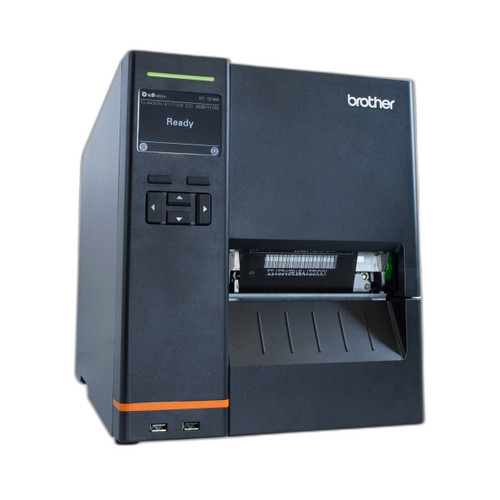
The Brother TJ4520TN offers Ethernet, USB 2.0, and RS-232C Serial as standard interfaces, with Wi-Fi and Bluetooth listed as optional modules. Its display is described as a color HVGA LCD touchscreen; display size in inches is not specified. Frame material, weight, operating temperature, and onboard memory are not provided in the supplied specs. The Brother's RS-232C serial port adds legacy PLC/host integration that the Sato spec does not mention. The Brother spec also states a 2-year Premier Limited warranty with printhead coverage; the Sato spec states a 1-year warranty.
Which should you choose: the WWCLP3801-WAR or the TJ4520TN?
Our take: The WWCLP3801-WAR is the stronger choice when print resolution, RFID encoding, and broad media handling are non-negotiable requirements. At 609 dpi versus the TJ4520TN's 300 dpi, the Sato delivers more than twice the print density — critical for GS1 DataMatrix, fine serialization, or pharmaceutical-grade labels. Its 14 ips versus 12 ips throughput edge adds meaningful volume capacity on high-shift runs. Built-in 13.56 MHz HF RFID encoding is exclusive to the Sato; the Brother carries no RFID capability per the supplied specs. Conversely, the Brother TJ4520TN is worth considering for buyers who need a wider 4.5" print width, optional Bluetooth connectivity, legacy RS-232C serial integration with PLCs or older hosts, and a 2-year warranty with printhead coverage — advantages the Sato spec does not match. Choose the Sato WWCLP3801-WAR for high-resolution print-and-encode smart-label programs; choose the TJ4520TN for wider media, serial-host integration, or longer warranty coverage.
Side-by-Side Comparison
Spec-for-spec, from manufacturer data.
| Specification | Sato WWCLP3801-WAR | Brother TJ4520TN |
|---|---|---|
| Print Method | Direct Thermal / Thermal Transfer | Thermal Transfer |
| Print Resolution | 609 dpi | 300 dpi |
| Print Speed | 14 ips | 12 ips |
| Max Print Width | 4.09" | 4.5" |
| Min Media Width | 0.87" | — |
| Max Media Width | 5.04" | — |
| Max Media Roll Diameter | 10" | — |
| Max Ribbon Length | 1,968 ft | — |
| RFID | HF 13.56 MHz (built-in) | None |
| Connectivity (Standard) | Ethernet, Wi-Fi, USB 2.0 | Ethernet, USB 2.0, RS-232C Serial |
| Wireless Options | Wi-Fi (built-in) | Wi-Fi, Bluetooth (optional modules) |
| Display | 3.5" Full-Color LCD | Color HVGA LCD (size not specified) |
| Onboard Flash Memory | 2 GB | — |
| Onboard SDRAM | 256 MB | — |
| Frame Material | Cast aluminum | — |
| Warranty | 1 year | 2 years (Premier Limited, printhead included) |
Frequently Asked Questions
Which should you choose: the WWCLP3801-WAR or the TJ4520TN?
The WWCLP3801-WAR is the stronger choice when print resolution, RFID encoding, and broad media handling are non-negotiable requirements. At 609 dpi versus the TJ4520TN's 300 dpi, the Sato delivers more than twice the print density — critical for GS1 DataMatrix, fine serialization, or pharmaceutical-grade labels. Its 14 ips versus 12 ips throughput edge adds meaningful volume capacity on high-shift runs. Built-in 13.56 MHz HF RFID encoding is exclusive to the Sato; the Brother carries no RFID capability per the supplied specs. Conversely, the Brother TJ4520TN is worth considering for buyers who need a wider 4.5" print width, optional Bluetooth connectivity, legacy RS-232C serial integration with PLCs or older hosts, and a 2-year warranty with printhead coverage — advantages the Sato spec does not match. Choose the Sato WWCLP3801-WAR for high-resolution print-and-encode smart-label programs; choose the TJ4520TN for wider media, serial-host integration, or longer warranty coverage.
Does the Sato WWCLP3801-WAR or the Brother TJ4520TN print at higher resolution?
The Sato WWCLP3801-WAR prints at 609 dpi. The Brother TJ4520TN prints at 300 dpi. The Sato provides more than double the resolution per the supplied specifications.
Can either of these printers encode RFID tags as well as print labels?
Only the Sato WWCLP3801-WAR includes built-in RFID encoding, operating at 13.56 MHz (HF) with auto-antenna tuning. The Brother TJ4520TN has no RFID capability listed in its specifications.
Which unit has the better warranty, and does either cover the printhead?
The Brother TJ4520TN specifies a 2-year Premier Limited warranty that explicitly includes printhead coverage. The Sato WWCLP3801-WAR specifies a 1-year warranty with no printhead coverage detail mentioned in the provided specs.
More Label Printer Comparisons
- Honeywell PX940 vs Sato WWCLP3B01-WAR
- Honeywell PX940 vs Sato WWCLP3801-NAR
- Honeywell PX940 vs Sato WWCLP3801-WAR
- Honeywell PX940 vs Wasp WPL408
- Honeywell PX940 vs Honeywell PX4654-020
- Honeywell PX940 vs Honeywell PX6654-000
Label Printer Buying Guides
Get a Second Opinion on Your Camera Choice
Share your site layout, coverage goals, and budget. Our team will validate the camera selection, flag anything we would change, and recommend products that match the use case.