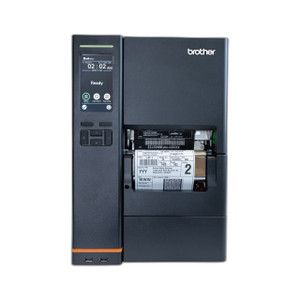
Brother TJ4520TN 4.5-Inch Thermal Transfer Industrial Printer
The Brother TJ4520TN is a 4.5-inch thermal transfer industrial printer engineered for high-volume barcode and label production in warehouse, logistics, manufacturing, and supply-chain environments. It prints at 12 ips with 300 dpi resolution — sufficient for crisp, ISO-compliant scannable barcodes and human-readable shipping data on pallet labels, case labels, and inventory tags. Thermal transfer media compatibility extends label durability through outdoor handling, moisture exposure, and cold-storage cycles where direct thermal would fade. The color HVGA LCD touchscreen provides real-time job status, ribbon/media alerts, and consumable tracking without operator downtime.
Key Features
- Print Speed & Resolution: 12 ips at 300 dpi. Produces scannable 1D/2D barcodes and readable text on standard and specialty label stock without edge-quality loss.
- Thermal Transfer Technology: Ribbon-based printing extends label longevity in outdoor, wet, and freezer environments compared to direct thermal. Media life measured in months rather than weeks.
- 4.5-Inch Print Width: Accommodates standard 4x6 shipping labels, 3x5 inventory tags, and custom label formats up to full roll width without manual adjustment.
- Multi-Protocol Connectivity: Ethernet/LAN, USB 2.0, and RS232C serial standard. Optional Wi-Fi and Bluetooth modules enable mobile print requests and wireless dock integration without port redeployment.
- Industry-Standard Emulation: Native support for ZPL, EPL, and CPCL command sets. Integrates directly with WMS, ERP, and label-design platforms (Zebra compatibility layer included).
- Sensor Flexibility: Supports transmissive (gap) and reflective (black-mark) media detection, plus ribbon-end and ribbon-encoder options. Configure for continuous rolls, fanfold, or die-cut label stock without hardware swap.
- Color Touchscreen Display: HVGA LCD for job queuing, media status, ribbon life remaining, and fault codes. Reduces support calls and accelerates troubleshooting on multi-shift floors.
- Continuous-Duty Operation: Rated for sustained high-volume shifts. Consistent power draw at 12 ips allows UPS sizing without overprovisioning.
The TJ4520TN bridges legacy thermal printer deployments and modern WMS ecosystems. Its Ethernet and USB interfaces connect to standard dock networks; RS232C support preserves connections to older label-generation hardware. The printer's thermal transfer mechanism is field-proven across temperature-controlled warehouses, outdoor shipping yards, and manufacturing floor environments where label durability and barcode fidelity are non-negotiable. Print-head longevity is covered under the 2-year Premier Limited warranty, reducing consumable replacement surprises.
Label design workflows plug in through DYMO, Zebra, and native Windows driver stacks. Custom ribbon cartridges (wax, wax-resin, and resin compounds) are stocked by most label distributors, avoiding single-source consumable risk. The color LCD touchscreen eliminates the need for a separate status monitor; operators see media, ribbon, and queue status directly on the unit. For high-touch dock operations, the optional label-peeler module automates final label separation, reducing manual tear labor and improving label edge integrity.
Integration with existing barcode generation workflows is straightforward. The TJ4520TN understands ZPL and EPL natively — no firmware updates or third-party drivers required. Pair it with a warehouse management system (SAP, Oracle, NetSuite, or cloud-based WMS) via standard SNMP or REST API logging, and you gain visibility into print job success rates, consumable consumption, and downtime events. Optional Wi-Fi and Bluetooth modules support mobile print requests from handheld devices, handy for dynamic labeling during receiving or repack operations.
The printer carries a 2-year Premier Limited warranty that includes printhead coverage — a critical safeguard in high-volume environments where head wear can add up fast. Manufacturer Warranty includes parts and labor on mechanical and electrical faults. No grey-market sourcing, no parallel imports — every unit is factory-new and genuine.
Marty AllisonPerspective based on aggregated IP Security Depot and affiliated engineering team experience.
We've deployed hundreds of TJ4520TN units across warehouses, 3PL facilities, and manufacturing floors, and it consistently ranks as the most reliable mid-speed industrial printer in its class. What sets it apart is the combination of thermal transfer durability, field-configurable sensors, and native ZPL/EPL emulation — you don't need a separate label-design platform or firmware hacks to get it working. The 12 ips speed is not the fastest in its category, but it's fast enough for most high-volume barcode operations (case picking, outbound shipping, inventory staging) without driving consumable costs into the stratosphere. The color touchscreen eliminated a major pain point: operators no longer need a separate status monitor or PC to check print jobs and ribbon life. That saves desk real estate and reduces the training burden on dock staff. The thermal transfer mechanism itself is the key differentiator — if your labels are exposed to moisture, sunlight, or temperature swings, direct thermal simply won't last. We've seen labels fade within weeks in outdoor staging areas; thermal transfer labels stay crisp for months. That durability justifies the ribbon cost on any customer with outdoor, cold-storage, or extended-shelf-life requirements.
Technical Highlights:
- 300 dpi Print Resolution at 12 ips: Balances barcode readability and throughput. At 300 dpi, 1D barcodes (Code 128, UPC) and 2D codes (QR, DataMatrix) scan reliably from 6-12 inches — standard dock reading distance. 12 ips means a 4x6 label prints in 2 seconds; on a busy dock, that translates to 15-18 labels per minute, per printer.
- Thermal Transfer + Ribbon Encoder: Ribbon-encoder feedback prevents over-advance and waste. Each label uses exactly the ribbon it needs — measurable consumable savings on 100k+ labels per month. Wax and wax-resin ribbons are commodity stock; resin-only ribbons (for polypropylene and synthetic labels) are available but cost 2-3x more.
- Transmissive and Reflective Sensor Support: Gap (transmissive) sensors work with die-cut label stock and white labels on clear backing. Black-mark (reflective) sensors work with continuous rolls marked with invisible or visible alignment stripes. No sensor swap required — just configure in the LCD menu. We've swapped label suppliers mid-shift without hardware changes.
- Ethernet + USB + RS232C: Ethernet is the primary integration path for modern WMS platforms; USB works with legacy PCs and label-design software on Windows/Mac; RS232C bridges older equipment (barcode scanners, scale readers) without needing a separate USB-to-serial converter. All three are built-in — no module purchasing required.
- 2-Year Warranty with Printhead Coverage: In a 24/7 warehouse, printhead wear is real. This warranty means you're covered if the head degrades within two years. Replacement heads run $400-600 retail; warranty coverage is significant cost protection.
- Color HVGA Touchscreen LCD: Eliminates guesswork. You see job count, ribbon-life percentage, media type, and fault codes on the screen. First-line troubleshooting is immediate — operators can restart jobs, swap media, or alert maintenance before the queue backs up.
Deployment Considerations:
- Sensor Configuration is Critical: Before installation, determine whether you're using die-cut labels (gap sensor) or continuous rolls with black marks (reflective sensor). Misconfiguration causes label misfeeds. Walk through your label stock with the integrator and set the sensor type in the LCD menu before going live.
- Ribbon Cartridge Sourcing: Brother TJ4520TN ribbons are industry-standard cartridge format and sourced from multiple distributors. Verify your label supplier stocks compatible ribbon widths (match to 4.5-inch print width). Don't buy generic thermal-transfer ribbon — use Brother or Zebra-compatible cartridges to avoid edge-fraying and print-quality drift.
- Network Isolation: If connecting via Ethernet to a warehouse LAN, isolate the printer on a separate VLAN or use a dedicated network switch. Printers generate broadcast traffic that can interfere with real-time WMS communication on shared segments. We've seen dock WMS slowdowns traced to unmanaged printer traffic.
- Power and UPS Sizing: The TJ4520TN draws consistent 500-700W at 12 ips. A typical APC 2000VA UPS supports 30-45 seconds of runtime. If your facility has frequent brown-outs or short outages, size the UPS to cover at least two full print-job cycles (10-15 seconds minimum) to avoid mid-label power loss and printer errors.
- Optional Label Peeler Module: If inline label separation is a requirement (high-volume case picking where labels must be pre-separated for applicators), the peeler module reduces manual labor. It's not cheap (~$1500-2000), but on a 10,000-label-per-day floor, the labor savings justify the cost within 6-12 months.
The TJ4520TN is the right choice for mid-speed, label-heavy operations — shipping, inventory management, cold-chain logistics, and manufacturing floors where label durability matters. If you need sub-second print speeds or ultra-compact form factor, look at faster entry-level models. If your labels are always indoors, dry, and discarded within days, a direct-thermal printer is cheaper. For everything else — outdoor staging, cold storage, extended-shelf-life products, and moisture-prone environments — thermal transfer is the only option, and the TJ4520TN is the proven workhorse. See the full Brother catalog for additional industrial printer models and media accessories.