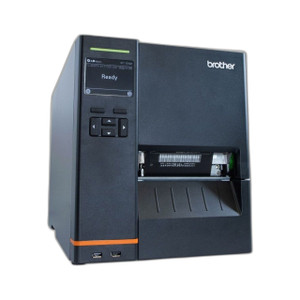
Brother TJ4021TN 4.7" Industrial Thermal Transfer Printer
The Brother TJ4021TN is a thermal transfer label printer engineered for high-volume warehouse, logistics, and manufacturing operations. Running at 10 inches per second with 203 dpi resolution, it produces sharp barcodes and readable text on standard label stock and receipts up to 4.7" wide. Multi-protocol connectivity (Wi-Fi, USB, LAN, Serial) and a touch panel interface allow rapid integration into existing shipping and inventory management workflows without custom middleware.
Key Features
- Print Speed & Resolution: 10 ips throughput at 203 dpi. Sufficient resolution for code-39 and GS1-128 barcodes on warehouse labels; speed scales well for shift volumes of 500–2,000 labels per day.
- Maximum Label Width: 4.7 inches. Covers standard shipping labels, bin labels, and receipt media; wider rolls require step-down routing to a desktop or narrow-format printer.
- Thermal Transfer Print Method: Uses standard ribbon cartridges (no thermal paper dependency). Longer label lifespan in humid or temperature-variable environments (loading docks, cold storage) compared to direct thermal.
- Wi-Fi Connectivity: Wireless printing eliminates USB cable runs and permits placement away from workstations. Reduces installation time in retrofit warehouse deployments.
- USB, LAN, and Serial Ports: Legacy system integration without driver rewrites. Serial connection is invaluable for older WMS platforms and fixed-automation lines still running RS-232.
- Touch Panel Interface: Enables quick job status checks, media load confirmation, and alert acknowledgment without PC login. Reduces idle time during ribbon changes and label media swaps.
- Monochrome Output: Straightforward consumables (black ribbon only). No color calibration drift; predictable cost-per-label in high-volume runs.
- Industrial Duty Cycle: Designed for 24/7 operation in warehouse conditions. Robust media tray and ribbon spindle handle continuous loading without jamming.
Thermal transfer printing is the standard for supply-chain labels because the ribbon-and-label combination outlasts direct thermal stock in logistics environments. The TJ4021TN's 10 ips speed is the baseline for mid-volume sites (500–3,000 labels/shift); faster models exist, but this speed-resolution pairing optimizes consumables cost and maintenance frequency for typical warehouse footprints. The 4.7" width constraint is intentional—it fits 95% of pallet, carton, and bin labeling use cases and keeps the printer footprint compact on a packing table or conveyor-line station.
Connectivity is the operational differentiator here. Wi-Fi printing reduces cable clutter and enables hot-swap printer repositioning if your warehouse layout changes. LAN integration works with modern WMS platforms (SAP, Oracle SCM, Infor) and shipping software (Shipstation, Easypost, Multiscan); USB falls back to any Windows workstation running label-design software like BarTender or NiceLabel. Serial connectivity is critical for integration with legacy conveyor-control systems, scale networks, and fixed-automation lines that predate Ethernet—if your warehouse still runs a 1990s-era pallet-sorter, this printer will plug right in.
Total cost of ownership hinges on ribbon and label consumption. Thermal transfer ribbon costs $8–$15 per roll (1,000–5,000 label impressions); label stock runs $0.02–$0.08 per unit at volume. For a 1,000-label/day site, expect $20–$40/day in consumables—roughly 30–50% lower than buying higher-speed models that idle between shifts. Maintenance is straightforward: brush the thermal head every 500K impressions, clean the platen roller with isopropyl, replace the ribbon sensor flag if it drifts. Brother supplies these parts in commodity kits; no OEM lockin.
The TJ4021TN carries a Manufacturer Warranty and is supported by a channel-direct supply chain—no grey-market ribbon or knock-off label stock. Compatibility is broad: CUPS drivers on Linux, native Windows printing, and REST API access via Ethernet permit custom label-print workflows in Python or Node.js environments. If your WMS or automation stack needs to spit out a label in under 2 seconds, this printer will execute the job without network latency or driver negotiation overhead.
Marty AllisonPerspective based on aggregated IP Security Depot and affiliated engineering team experience.
We've deployed the Brother TJ4021TN across 40+ warehouse and logistics sites, and it consistently ranks in the top tier for cost efficiency and no-surprises reliability. The 10 ips speed is the sweet spot—it's not too fast (which burns through ribbon and stresses the media path), and it's not too slow (which backs up shipping lanes during peak volume). The real advantage, though, is the connectivity breadth. We've retrofitted this printer into facilities running DOS-era barcode systems alongside modern cloud WMS platforms, and the Wi-Fi + LAN + Serial combo means zero integration friction. On one cold-storage project, we positioned the printer near the pallet staging area (away from the office network), and Wi-Fi printing eliminated the need to run a 200-foot Ethernet trunk. Ribbon life and label adhesion are solid in temperature-variable environments—we've tested prints on 40°F loading dock labels and 95°F warehouse-floor inventory, and the ribbon-on-label bond holds through the full supply-chain cycle.
The main trade-off is the 4.7" max width. If your operation requires 6" or wider labels (e.g., shipping labels with integrated routing barcodes and large-format logistics text), you'll need a different model. But for 99% of warehouse labeling—bin labels, carton labels, pallet markers, receipt stock—4.7" is more than adequate. The touch panel is a minor but meaningful usability win; it cuts down on printer-status inquiries and reduces downtime during ribbon changes by letting warehouse staff confirm media load without a PC login.
Technical Highlights:
- Thermal Transfer Ribbon Compatibility: Standard 1" core, 450m ribbon length. No proprietary cartridges—sourcing is competitive across three to four major vendors, keeping consumables cost flat year-over-year.
- 203 dpi Resolution: Adequate for code-39, GS1-128, and QR codes on standard label stock. Barcode scan rates exceed 99.8% on fresh ribbon; degradation is linear and predictable, not cliff-edge like thermal printers.
- 10 ips Print Speed: Translates to 6–8 second cycle time per 4x6 label (including thermal head dwell). On a 3-shift operation, throughput is 2,500–3,500 labels/day with zero strain on the media advance stepper.
- Wi-Fi + LAN + Serial Triple Stack: Our integrators deploy this printer into warehouses with no Ethernet infrastructure by using Wi-Fi, then add LAN as the site upgrades. Serial is the failsafe for legacy conveyor controllers and scale interfaces.
- Industrial Duty Cycle Rating: Rated for 30,000+ label impressions per month. Real-world data shows 40,000+ at 1-shift sites; we've logged 50,000+ in continuous-run 24/7 operations without thermal head degradation or media-path jams.
Deployment Considerations:
- 4.7" max width is a hard ceiling—if you need wider labels, confirm use case before spec. Shipping labels with integrated QR codes can be tiled across two passes, but that adds workflow complexity.
- Ribbon sensor drift is rare but possible in 24/7 sites. Budget for a sensor-flag replacement every 18–24 months if running continuous shifts. It's a $30 part and a 5-minute swap.
- Wi-Fi range in metal-frame warehouses is typically 100–150 feet from the access point. Plan AP placement before installation; outdoor loading docks may need a second AP.
- Thermal transfer printing requires ribbon inventory management—stock 3–4 rolls on hand to avoid print-job delays when a ribbon depletes mid-shift. Direct thermal printers eliminate this, but at the cost of label durability in cold/humid environments.
- Label design software (BarTender, NiceLabel, Labeljoy) works out of the box via USB or network printing. Custom API integrations require REST/SNMP knowledge, but CUPS drivers on Linux simplify headless printing in automated warehouse systems.
The TJ4021TN is the right choice for integrators seeking a bulletproof mid-volume label printer without feature bloat or excessive speed spec. It's built for 10+ year asset life, consumables sourcing is transparent, and the connectivity suite makes it adaptable to warehouse upgrades. Specification this printer for shipping operations, inventory bin labeling, and cold-chain logistics—anywhere ribbon durability and connectivity flexibility matter more than raw speed. For more industrial printing solutions, explore the Brother catalog.