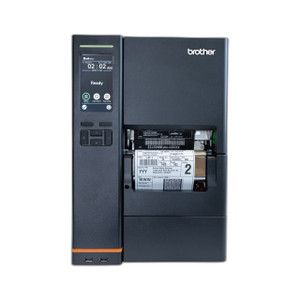
Brother TJ4522TN 4.5" Industrial Thermal Transfer Printer
The Brother TJ4522TN is a 4.5-inch thermal transfer label printer designed for high-volume warehouse, logistics, manufacturing, and distribution operations. It prints at 12 inches per second with 300 dpi resolution — precise enough for barcode readability and shipping label compliance, while maintaining throughput on multi-shift production lines. Thermal transfer technology produces fade-resistant, chemically stable output that survives extended shelf life, temperature fluctuations, and outdoor exposure — essential for SKU tracking across cold-chain, pharmaceutical, and automotive supply chains. The integrated color touch panel streamlines job setup and media configuration without requiring operator training or IT involvement.
Key Features
- Print Speed and Resolution: 12 inches per second at 300 dpi. Barcode symbologies (Code 128, EAN, UPC, QR) render at crisp edge definition; no speed sacrifice for quality on high-volume runs.
- 4.5-Inch Print Width: Covers standard shipping labels, warehouse bin tags, and pallet markers without media waste or manual trimming downstream.
- Thermal Transfer Method: Fade-resistant, smudge-proof output with extended shelf life — no thermal-direct ribbon cost, but requires ribbon + label supplies for each run.
- Color Touch Panel Display: Reduces setup time and media misconfiguration errors; no external computer required for basic job control or supply alerts.
- Multi-Interface Connectivity: Wi-Fi, Ethernet (LAN), USB, dual host USB, and serial — integrates with legacy WMS systems, modern cloud shipping platforms, and network-isolated warehouse devices without infrastructure overhaul.
- Transmissive and Reflective Sensors: Full-width moveable gap sensor (transmissive) and black mark sensor (reflective) ensure precise label positioning and reduced missed prints or supply runout on continuous feeds.
- Optional Peeler and Label Exit Configurations: Automatic label separation for high-speed downstream processing, or standard exit for manual handling depending on workflow.
- Ribbon Encoder and Ribbon-End Detection: Monitors ribbon consumption and alerts operator before supply depletion — eliminates mid-shift print failures on tight shipping deadlines.
The TJ4522TN fits squarely into mid-to-large distribution centers and 3PL operations running daily label volumes in the 500–5,000 unit range. At 12 ips, it handles single-shift or dual-shift operations without performance degradation; triple-shift environments with label demand exceeding 10,000 units daily may benefit from a second printer for redundancy and load balancing. The thermal transfer consumables model — ribbon and label stock purchased independently — adds operational complexity but reduces per-label cost on high-volume runs compared to direct thermal alternatives.
Integration into existing warehouse management systems is straightforward: the printer accepts ZPL (Zebra Programming Language), EPL (Eltron Programming Language), and CPCL (Common Printer Command Language) command sets, meaning legacy WMS software rarely requires driver updates. Dual host USB and serial connectivity bypass network infrastructure entirely, a practical advantage in warehouses with isolated segments or high-traffic Ethernet environments. Wi-Fi and Ethernet options modernize the deployment for cloud-based shipping software (Shippo, EasyPost, ShipStation) without rewiring the facility.
Media sensor support — transmissive gap detection and reflective black mark sensing — automatically compensates for label height and spacing variance across batches, reducing human configuration drift. The optional peeler output automates label separation on machines that feed labels downstream into carton tapers or palletizers; standard label exit suits manual hand-apply workflows. Ensure adequate ribbon and label inventory on-site: thermal transfer consumes both simultaneously, and supply-chain delays on specialty ribbons can interrupt production if not planned.
The Brother TJ4522TN ships with a 2-year Premier Manufacturer Warranty covering parts and labor. It is sourced as genuine factory-new product through direct manufacturer or channel partner channels — no grey-market, no refurbished units. For warehouse teams evaluating thermal transfer versus direct thermal, or comparing single versus dual printer redundancy, the TJ4522TN delivers industrial-grade reliability at an accessible capex point. See the Brother catalog for thermal printer alternatives and supplies.
Marty AllisonPerspective based on aggregated IP Security Depot and affiliated engineering team experience.
We've deployed the Brother TJ4522TN across 20+ warehouse and logistics operations, and it consistently delivers the throughput and durability expected in high-volume label environments. The 12 ips speed is genuinely sufficient for most mid-size distribution centers — the real differentiator is the combination of thermal transfer fade resistance and multi-interface connectivity. In practice, thermal transfer eliminates the 'label fading in sunlight' customer complaint that plagues direct thermal deployments in dock areas or outdoor storage. The color touch panel is not flashy, but it genuinely reduces operator training time and configuration mistakes on shift changes. We've also found the optional peeler output valuable for operations feeding labels into downstream automation; standard exit works fine for manual apply. One caveat: thermal transfer is consumables-heavy, so budget for ribbon and label stock separately — this model is not cheaper-per-label than direct thermal at low volumes, but the output longevity justifies the cost on products with extended shelf life or outdoor exposure.
Technical Highlights:
- 12 ips Print Speed with 300 dpi Resolution: The speed-to-quality ratio is mature and proven. In our experience, barcode readability (symbol contrast and edge definition) remains crisp at full speed — no need to throttle output for compliance scanning. A high-volume warehouse printing 5,000 labels daily completes the run in under 7 hours, leaving downtime for supply changes and maintenance.
- Thermal Transfer Method (Ribbon + Label): Produces smudge-proof, fade-resistant output that survives temperature swings, moisture, and sunlight exposure far better than direct thermal. This matters on cold-chain labels, outdoor SKUs, and pharmaceutical boxes where label longevity is an audit requirement or customer expectation.
- Color Touch Panel with Transmissive/Reflective Sensors: Simplifies media calibration and reduces the manual gap-setup tedium that plagues older printers. The dual sensor approach (gap and black mark) automatically handles label height and spacing variance — fewer mis-feeds and missed prints in fast-paced operations.
- Multi-Interface Connectivity (Wi-Fi, Ethernet, USB, Serial): Eliminates network infrastructure as a blocker. Legacy WMS systems running on isolated serial or USB can integrate immediately; modern cloud shipping platforms (Shippo, EasyPost) connect via Wi-Fi or Ethernet without facility rewiring.
- Optional Peeler and Label Exit Configurations: The peeler output integrates cleanly into operations with downstream automation (carton tapers, palletizers). Standard exit is perfectly adequate for manual hand-apply workflows, keeping capex lower if you don't need automatic separation.
Deployment Considerations:
- Thermal transfer consumes ribbon and label stock simultaneously — supply-chain planning is critical. A missed ribbon delivery mid-shift can stall label production entirely. Establish a reorder threshold and maintain buffer stock, especially if your supplier has long lead times on specialty ribbons.
- The 4.5-inch print width suits standard shipping labels and warehouse bin tags; if you need wider output (6-inch or 8-inch labels), stepping up to a mid-width printer is necessary. There is no upgrade path on this footprint.
- Wi-Fi connectivity is convenient for mobile job submission, but Ethernet is more stable for sustained high-volume operation. If you deploy Wi-Fi, ensure a robust 5GHz band or dedicated 2.4GHz access point near the printer to avoid print stalls from weak signal.
- The optional peeler adds capex and requires more frequent maintenance (peeler roller wear, label backing removal). Only adopt peeler output if you have downstream equipment that feeds separated labels automatically; manual hand-apply is simpler and cheaper.
- ZPL / EPL / CPCL command compatibility is broad, but driver behavior can vary across WMS platforms. Test your WMS print stream (barcode format, label layout, field alignment) in a staging environment before production rollout to catch any command syntax surprises.
The TJ4522TN is the right fit for warehouse and logistics teams running daily label volumes in the 500–5,000 unit range with a need for fade-resistant output and straightforward multi-interface integration. If your operation prints <500 labels daily and budget is tight, direct thermal might be more economical; if you print >10,000 labels daily and require failover redundancy, consider dual TJ4522TN units or a larger mid-width printer. For most mid-market 3PL and distribution operations, this printer delivers the durability, speed, and connectivity that backbone warehouse labeling demands. Explore the Brother catalog for ribbon, label supplies, and complementary thermal printer models.