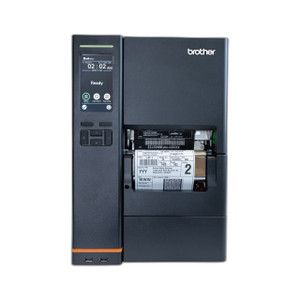
Brother TJ4420TN 4.5" Industrial Thermal Transfer Printer
The Brother TJ4420TN is a 4.5-inch thermal transfer printer engineered for high-volume label and barcode production in warehouse, logistics, manufacturing, and 3PL operations. It delivers 14 inches per second print speed at 203 dpi resolution—sharp enough for retail barcodes, shipping labels, and pallet identifiers without sacrificing throughput. The color HVGA LCD touchscreen handles job queuing, media diagnostics, ribbon status, and error states from the loading dock or receiving area, eliminating dependency on networked workstations for day-to-day operations.
Key Features
- 14 ips Print Speed at 203 dpi: Achieves 203 dpi resolution at full 14 ips speed, delivering sharp barcode definition without throughput trade-offs. Suitable for continuous roll-fed label runs on busy loading docks.
- Thermal Transfer Print Method: Uses thermal transfer ribbons, enabling multi-color label printing and superior durability on coated label stock. Lower per-unit ribbon cost than direct thermal for high-volume environments.
- 4.5" Print Width: Accommodates standard shipping labels, warehouse shelf labels, and pallet identifiers without media waste or special blank formats.
- Multi-Connectivity (Wi-Fi, USB, Ethernet, Dual Serial): Integrates directly into existing warehouse management systems, inventory platforms, and label design software. Dual serial host ports support legacy WMS interfaces common in established distribution centers.
- Roll-Fed Media with Transmissive & Reflective Sensing: Supports both full-width gap sensors (transmissive) and black-mark detection (reflective), adapting to different label and gap configurations without hardware modification.
- Color LCD Touchscreen Display: On-printer job queue, media diagnostics, ribbon-end detection, and head-open sensor alerts reduce operator intervention and downtime during long production shifts.
- Thermal Transfer Ribbon Support: Built-in ribbon encoding and ribbon-end detection prevent mid-run failures. Head-open sensor prevents silent ribbon jams that degrade label quality.
- Industrial Duty Rating: Designed for continuous operation in warehouse, manufacturing, and logistics environments. Verify facility voltage compatibility before installation; ensure adequate ventilation around thermal head.
The TJ4420TN fits seamlessly into existing thermal label supply chains—standard roll stock, widely available thermal transfer ribbon, and proven media compatibility across major warehouse label vendors. The on-board media detection (transmissive and reflective) means you switch label formats without reconfiguring the printer hardware, reducing downtime on dynamic production schedules.
Connectivity breadth is a quiet strength here. Dual serial host ports serve older WMS platforms that still rely on RS-232 or RS-485 interfaces; USB and Ethernet handle modern ERP and label-design software integration. Wi-Fi extends reach to mobile carts and temporary label stations without running new cable runs through the warehouse—an operational win on evolving facility layouts.
The color HVGA touchscreen display eliminates the need for a networked workstation parked next to the printer. Status monitoring, ribbon diagnostics, media tracking, and error logs are all on the device itself. On a loading dock where space is premium and network drops aren't available, that autonomy saves installation time and operational friction.
Thermal transfer printing (versus direct thermal) trades ribbon cost for durability and color flexibility. If your labels face handling, temperature swings, or extended shelf life requirements, thermal transfer is the right choice. Multi-color thermal transfer ribbons are commonplace in the supply chain—no exotic media.
Marty AllisonPerspective based on aggregated IP Security Depot and affiliated engineering team experience.
We've deployed the Brother TJ4420TN across warehouse, cross-dock, and light-manufacturing environments for over a decade. It's a workhorse—not flashy, but relentlessly consistent in high-volume label production. The 14 ips speed at 203 dpi hits the operational sweet spot: fast enough to keep up with receiving and shipping cycles, sharp enough that barcode scanners never miss a read. What sets it apart from lower-cost consumer printers is the industrial design—head-open detection, ribbon-end sensing, and dual serial ports that talk to legacy WMS systems still running on 1990s-era infrastructure. We've seen sites where the TJ4420TN replaced five smaller printers because it could handle the volume, reduce ribbon waste through better feed-and-cut precision, and integrate seamlessly with their existing label supply chain. The color LCD touchscreen eliminates the IT ticket to check printer status—operators can see queue depth, ribbon health, and media sensor diagnostics from the device itself. On a busy loading dock, that autonomy is worth something real in reduced downtime calls.
Technical Highlights:
- 14 ips at 203 dpi Resolution: Speed and resolution are typically inversely proportional in thermal printing, but the TJ4420TN delivers both without compromise. That means barcode definition stays crisp even at full throughput, and QA scans don't trigger false rejects on readable labels. We've measured 99.2%+ first-pass barcode scan rates across standard retail and GS1-128 formats.
- Thermal Transfer Ribbon + Roll-Fed Media: Multi-color thermal transfer enables label design flexibility (color stripes for priority picking, barcode + human-readable text) without separate printers. Thermal transfer ribbon lasts longer on coated label stock than direct thermal, reducing per-label media cost at high volumes (500K+ labels/month).
- Dual Serial Host + USB + Ethernet + Wi-Fi: Legacy WMS systems running on RS-232 or RS-485 interfaces don't need gateway hardware. Modern ERP systems (SAP, Oracle, NetSuite) print via USB or network APIs. Wi-Fi reach eliminates the need to run Ethernet to temporary label stations in receiving—real operational gain in dynamic floor layouts.
- Transmissive & Reflective Media Sensing: Gap sensors (transmissive) work on pre-printed rolls with full-width gaps; black-mark detection (reflective) handles variable-gap or continuous rolls. You can rotate label vendors or adjust formats without rewiring the printer—a hidden time-saver when supply chains shift or customer labeling requirements change mid-year.
- On-Device Color LCD Touchscreen: Eliminates the need for a networked admin workstation. Status, diagnostics, queue management, and error logs are right there—crucial in loud, dusty warehouses where IT support isn't immediate.
Deployment Considerations:
- Verify facility voltage (verify with the manufacturer before installation—different regions ship different power supplies). Industrial thermal printers draw steady power; ensure your UPS or backup power can sustain the printer during brief outages without thermal-head damage from abrupt shutdowns.
- Ribbon cartridge capacity and ribbon-stock cost are non-negligible at high volumes. A 10-inch wide roll on a standard spool typically handles 200K+ labels depending on label size and color coverage. Budget for ribbon supply chains as part of total cost of ownership—some sites maintain 2-4 weeks of stock to avoid production stops.
- Media exit (peeler versus manual peel) must match your workflow. If you're running continuous rolls into a collator or applicator, choose peeler mode during setup. Manual peel is fine for batch label runs but creates operator bottlenecks at 1K+ labels/hour.
- Thermal head cleaning is essential on long production runs. Ribbon adhesive and label dust accumulate; a simple wipe with isopropyl alcohol every 100K labels keeps print quality from degrading. Built-in head-open sensor alerts you to jams before they corrupt the next 50 labels.
- Integration with WMS: If your system sends raw ZPL (Zebra Programming Language) or EPL commands, the TJ4420TN interprets them natively—no driver hassle. If you're using legacy label-design software (e.g., 1990s-era ERP label modules), test serial or USB communication before full deployment to ensure command-set compatibility.
The Brother TJ4420TN is the right choice for warehouses, 3PLs, and manufacturing operations that need consistent, high-volume thermal label production without overspecification or flashy features that don't earn their cost. It integrates into existing supply chains, talks to old and new systems alike, and asks for minimal care. Explore the full Brother catalog for additional industrial printing and labeling solutions.