
Sato WWCLP2201-NAR vs Wasp WPL408: Specification Comparison
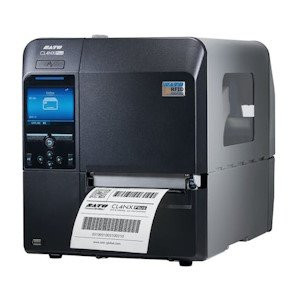
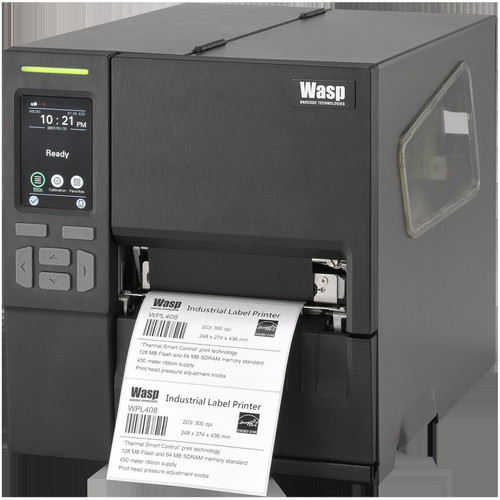
Both the Sato WWCLP2201-NAR and the Wasp WPL408 are industrial-class direct thermal and thermal transfer label printers targeting warehouse, compliance, and barcode labeling applications. This comparison evaluates the two on print performance and resolution, connectivity and interface breadth, and memory and media handling — the dimensions that most directly affect throughput, deployment flexibility, and total cost of operation in mid-to-high-volume industrial labeling environments.
In This Guide
- Which printer delivers better print quality and throughput for high-volume industrial labeling?
- Which printer offers broader connectivity for wired and wireless industrial deployments?
- Which printer handles larger ribbon stocks, wider media, and heavier workloads more capably?
- Which should you choose: the WWCLP2201-NAR or the WPL408?
- Side-by-Side Specs
- FAQ
Which printer delivers better print quality and throughput for high-volume industrial labeling?
The Sato WWCLP2201-NAR prints at 305 dpi and 14 ips, giving it a clear advantage in both resolution and speed over the Wasp WPL408, which is rated at 203 dpi and 10 ips. For applications requiring fine barcode density — pharmaceutical labels, small-pitch barcodes, or compliance labels with tight tolerances — the WWCLP2201-NAR's 305 dpi output produces materially sharper print at a 50% higher resolution.
At 14 ips versus 10 ips, the WWCLP2201-NAR also delivers 40% faster throughput, which compounds meaningfully in continuous production or end-of-line labeling scenarios. Both units support dual-mode Direct Thermal and Thermal Transfer operation, so neither imposes a media-type constraint. The WPL408 does not list a resolution higher than 203 dpi in the provided specs, making it more suited to standard GS1 barcodes and general shipping labels where sub-300-dpi output is acceptable.
Which printer offers broader connectivity for wired and wireless industrial deployments?
The Wasp WPL408 specifies USB 2.0, RS-232 serial, Ethernet 10/100 Mbps, a USB host port, and a WiFi slot — five distinct interface types including a legacy RS-232 serial port. RS-232 is significant in environments integrating with older PLCs, scales, or host systems that still use serial protocols. The WPL408's processor is documented as a 32-bit RISC CPU, and its Ethernet rate is explicitly stated at 10/100 Mbps.
The Sato WWCLP2201-NAR lists Ethernet, Wi-Fi, and USB as its primary connectivity. One data field also mentions Bluetooth, though this appears only in the tilde-prefixed (~) supplemental spec block and not in the underscore-prefixed (_) structured fields, so Bluetooth should be treated as unconfirmed from this spec set. Neither serial nor USB host are listed for the WWCLP2201-NAR. For modern networked facilities relying on Ethernet and Wi-Fi, both units are adequate; for sites requiring serial integration, the WPL408 has a documented advantage.
Which printer handles larger ribbon stocks, wider media, and heavier workloads more capably?
The Sato WWCLP2201-NAR carries significantly more memory: 2 GB Flash, 256 MB SDRAM, and 100 MB user storage, versus the WPL408's 128 MB Flash and 128 MB SDRAM with no dedicated user storage figure specified. Greater flash capacity supports larger on-board label format libraries, firmware, and font sets — an advantage in facilities running diverse label SKUs without frequent host-side data transmission.
On ribbon capacity, the WWCLP2201-NAR accepts ribbons up to 1,968 ft versus the WPL408's 1,474 ft — a 33% longer ribbon run that reduces changeover frequency in high-volume shifts. For max roll diameter, the WWCLP2201-NAR accepts up to 10 inches; the WPL408 does not specify a max roll diameter in the provided data. Media width range for the WWCLP2201-NAR is 0.87" to 5.04"; the WPL408 lists 1.6" to 4.3" paper width, making the Sato slightly more flexible on narrow media. The WWCLP2201-NAR weighs 33 lbs versus 20.28 lbs for the WPL408, reflecting its heavier-duty mechanical construction.
Which should you choose: the WWCLP2201-NAR or the WPL408?
Our take: The WWCLP2201-NAR is the stronger choice when print resolution, throughput speed, and media capacity are the primary selection criteria. It outperforms the WPL408 on three concrete dimensions: resolution (305 dpi vs. 203 dpi), print speed (14 ips vs. 10 ips), and ribbon capacity (1,968 ft vs. 1,474 ft). Its memory is also substantially larger — 2 GB Flash and 256 MB SDRAM versus the WPL408's 128 MB Flash and 128 MB SDRAM — supporting deeper on-board label libraries. The WPL408 is the more practical fit where RS-232 serial integration with legacy host systems is required, where a lighter footprint (20.28 lbs vs. 33 lbs) matters for bench or portable mounting, or where 203 dpi is sufficient and a lower acquisition cost is the priority. Both units support dual thermal modes and wireless Ethernet.
Side-by-Side Comparison
Spec-for-spec, from manufacturer data.
| Specification | Sato WWCLP2201-NAR | Wasp WPL408 |
|---|---|---|
| Print Method | Direct Thermal / Thermal Transfer | Direct Thermal / Thermal Transfer |
| Resolution | 305 dpi | 203 dpi |
| Print Speed | 14 ips | 10 ips |
| Max Print Width | 4.09" | 4.25" |
| Media Width Range | 0.87" – 5.04" | 1.6" – 4.3" |
| Max Roll Diameter | 10" | — |
| Max Ribbon Length | 1,968 ft | 1,474 ft |
| Flash Memory | 2 GB | 128 MB |
| SDRAM | 256 MB | 128 MB |
| User Storage | 100 MB | — |
| Display | 3.5" Full-Color LCD | 3.5" Color LCD Touchscreen HVGA |
| Connectivity | Ethernet, Wi-Fi, USB | USB 2.0, RS-232, Ethernet 10/100, USB Host, WiFi slot |
| Ethernet Rate | — | 10/100 Mbps |
| Processor | — | 32-bit RISC CPU |
| Weight | 33 lbs (15 kg) | 20.28 lbs |
| Dimensions (W x H x D) | 10.66" x 12.63" x 17.99" | 9.76" x 10.79" x 17.17" |
Frequently Asked Questions
Which should you choose: the WWCLP2201-NAR or the WPL408?
The WWCLP2201-NAR is the stronger choice when print resolution, throughput speed, and media capacity are the primary selection criteria. It outperforms the WPL408 on three concrete dimensions: resolution (305 dpi vs. 203 dpi), print speed (14 ips vs. 10 ips), and ribbon capacity (1,968 ft vs. 1,474 ft). Its memory is also substantially larger — 2 GB Flash and 256 MB SDRAM versus the WPL408's 128 MB Flash and 128 MB SDRAM — supporting deeper on-board label libraries. The WPL408 is the more practical fit where RS-232 serial integration with legacy host systems is required, where a lighter footprint (20.28 lbs vs. 33 lbs) matters for bench or portable mounting, or where 203 dpi is sufficient and a lower acquisition cost is the priority. Both units support dual thermal modes and wireless Ethernet.
Is the WWCLP2201-NAR or WPL408 better for pharmaceutical or high-density barcode labeling?
The WWCLP2201-NAR is better suited for that application. Its 305 dpi resolution versus the WPL408's 203 dpi produces finer barcode elements, which is important for small-pitch symbologies, unit-of-use pharmaceutical labels, and compliance labels requiring readable human-readable text at small point sizes. The WPL408's 203 dpi is adequate for standard GS1-128 and Code 128 shipping barcodes but is not specified above that resolution.
Does either printer support RS-232 serial for integration with older PLC or scale systems?
Yes — the Wasp WPL408 explicitly lists RS-232 in its interface specification (USB 2.0, RS-232, Ethernet 10/100 Mbps, USB host, WiFi slot). The Sato WWCLP2201-NAR's provided specs do not list RS-232 or any serial interface; its documented interfaces are Ethernet, Wi-Fi, and USB. If your deployment requires serial connectivity, the WPL408 has a documented advantage.
Which printer will need ribbon changes less frequently in a continuous production environment?
The Sato WWCLP2201-NAR accepts ribbon rolls up to 1,968 ft, compared to the Wasp WPL408's maximum of 1,474 ft. That is approximately 494 additional feet per roll — roughly a 33% longer run between changeovers. In high-volume or lights-out production shifts, the WWCLP2201-NAR's longer ribbon capacity reduces operator intervention frequency.
More Label Printer Comparisons
- Honeywell PX940 vs Sato WWCLP3B01-WAR
- Honeywell PX940 vs Sato WWCLP3801-NAR
- Honeywell PX940 vs Sato WWCLP3801-WAR
- Honeywell PX940 vs Wasp WPL408
- Honeywell PX940 vs Honeywell PX4654-020
- Honeywell PX940 vs Honeywell PX6654-000
Label Printer Buying Guides
Get a Second Opinion on Your Camera Choice
Share your site layout, coverage goals, and budget. Our team will validate the camera selection, flag anything we would change, and recommend products that match the use case.