
Panduit U10N32V vs APC by Schneider Electric SRT10KRMXLT-5KTF2: Specification Comparison
Both the Panduit U10N32V and the APC Smart-UPS SRT10KRMXLT-5KTF2 are 10 kVA rack-mount UPS units targeting data center and enterprise environments. The U10N32V is a Line-Interactive unit with AVR and pure sine wave output, while the SRT10KRMXLT-5KTF2 is a Double-Conversion (Online) unit bundled with two 208V-to-120V step-down transformers. Buyers comparing these are evaluating trade-offs in topology, efficiency, voltage flexibility, output protection depth, and management capability at the same power tier.
In This Guide
- Which topology delivers tighter output protection and transfer behavior?
- How do input voltage range, output voltage flexibility, and efficiency compare?
- What do the management interfaces, battery serviceability, and physical specs reveal about operational fit?
- Which should you choose: the U10N32V or the SRT10KRMXLT-5KTF2?
- Side-by-Side Specs
- FAQ
Which topology delivers tighter output protection and transfer behavior?
The Panduit U10N32V uses a Line-Interactive topology with Active Voltage Regulation (AVR), accepting an input range of 160–280V AC and correcting sags and surges without switching to battery. Its transfer time on a genuine power failure is specified at less than 4 ms. Output waveform is Pure Sine Wave (SteadySine), and output THD is not specified in the provided data.
The APC SRT10KRMXLT-5KTF2 uses Double-Conversion (Online) topology, meaning the load runs on inverter-generated power continuously. Transfer time in a double-conversion unit is effectively 0 ms because the load never runs directly off utility. Output THD is specified at 2%, and the crest factor is rated 3:1, indicating tolerance for non-linear loads. It also carries a surge energy rating of 480 J and includes an Emergency Power Off (EPO) function—neither of these is specified for the U10N32V.
For loads demanding zero transfer time and tightly conditioned power—medical, financial trading, or dense server rooms with switching power supplies—the double-conversion topology of the APC unit provides a measurably higher protection level. The Panduit's sub-4 ms transfer is adequate for most IT equipment but is architecturally a step below continuous online conversion.
How do input voltage range, output voltage flexibility, and efficiency compare?
The Panduit U10N32V accepts input from 160–280V AC and outputs at an unspecified voltage (the spec sheet does not state output voltage range explicitly). Its efficiency reaches up to 98% in ECO Mode, and it carries Energy Star and California Title 20 compliance—the only unit with stated energy certifications in this comparison.
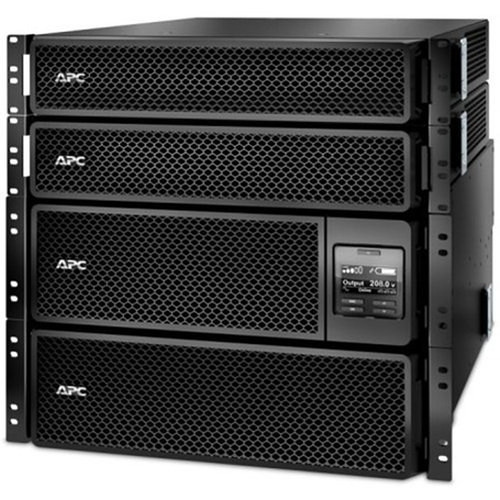
The APC SRT10KRMXLT-5KTF2 accepts input from 100–275V AC, a broader lower bound, and supports dual output voltages of 120V and 208V, enabled by the two bundled 5 kVA step-down transformers. Input frequency range is 40–70 Hz. APC does not specify an efficiency figure in the provided data for this SKU.
For sites requiring both 120V and 208V distribution from a single 10 kVA UPS—common in mixed North American data center environments with legacy 120V devices alongside newer 208V equipment—the APC bundle has a direct, specified advantage. The Panduit's 98% ECO Mode efficiency is a documented operating cost differentiator, but the APC's efficiency at rated load is not provided here and cannot be compared numerically.
What do the management interfaces, battery serviceability, and physical specs reveal about operational fit?
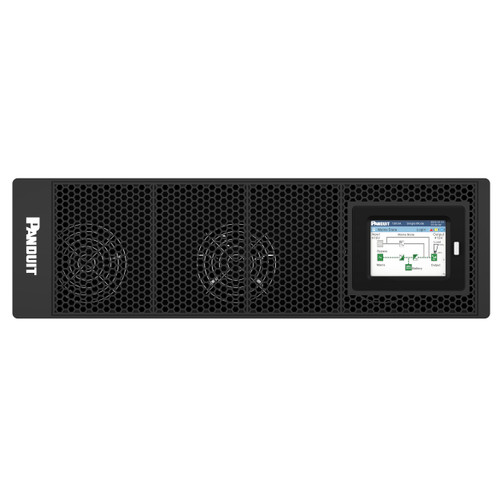
The Panduit U10N32V provides an LCD display, SNMP, Modbus, and a Web Interface. Modbus support is notable for integration into building management systems (BMS) and industrial SCADA environments beyond standard IT network management. The battery modules are Hot-Swappable, enabling runtime extension or replacement without a maintenance window. The form factor is 3U rack-mount, 12 inches high by 17.3 inches wide (306 mm × 440 mm).
The APC SRT10KRMXLT-5KTF2 includes web-based management and an audible alarm. It generates 55 dB of noise at load—a relevant factor in low-density or office-adjacent deployments. EPO is present for data center safety compliance. Physical dimensions, battery serviceability method, and specific management protocol support (e.g., SNMP version, Modbus) are not stated in the provided specifications.
The Panduit's explicit Modbus support broadens its integration footprint into OT/BMS environments. Hot-swap batteries reduce planned downtime risk. The APC's noise figure (55 dB) and EPO are operationally relevant details absent from the Panduit's provided spec set, leaving a partial comparison on those points.
Which should you choose: the U10N32V or the SRT10KRMXLT-5KTF2?
Our take: The SRT10KRMXLT-5KTF2 is the stronger choice when continuous zero-transfer-time protection and dual 120V/208V output distribution are required in a single rack unit. Its Double-Conversion Online topology eliminates the sub-4 ms transfer gap present in the U10N32V's Line-Interactive design, its 2% output THD is a specified measure of output quality absent from the Panduit data, and its bundled step-down transformers directly serve mixed-voltage environments the U10N32V does not address in its provided specs. Conversely, the U10N32V is the stronger choice where documented efficiency matters: its 98% ECO Mode rating (Energy Star, California Title 20 certified) provides a concrete operating cost advantage that APC does not match with a published figure here. Its Modbus interface also serves OT and BMS integration scenarios the APC's web-only management does not explicitly cover. Buyers in pure IT data center environments prioritizing protection depth should favor the APC; efficiency-sensitive or BMS-integrated deployments should evaluate the Panduit.
Side-by-Side Comparison
Spec-for-spec, from manufacturer data.
| Specification | Panduit U10N32V | APC by Schneider Electric SRT10KRMXLT-5KTF2 |
|---|---|---|
| UPS Topology | Line-Interactive with AVR | Double-Conversion (Online) |
| Output Capacity | 10 kVA / 10 kW | 10 kVA / 10,000 W |
| Transfer Time | <4 ms | 0 ms (continuous inverter) |
| Input Voltage Range | 160–280V AC | 100–275V AC |
| Input Frequency | — | 40–70 Hz |
| Output Voltage | Not specified | 120V and 208V |
| Output Waveform | Pure Sine Wave (SteadySine) | Sine Wave |
| Output THD | — | 2% |
| Crest Factor | — | 3:1 |
| Surge Energy Rating | — | 480 J |
| Efficiency | Up to 98% (ECO Mode) | — |
| Energy Certifications | Energy Star, California Title 20 | — |
| Battery Serviceability | Hot-Swappable Modules | — |
| Management Interfaces | LCD, SNMP, Modbus, Web | Web-based management |
| Emergency Power Off (EPO) | — | Yes |
| Audible Alarm | — | Yes |
| Noise Level | — | 55 dB |
| Form Factor | 3U Rack-Mount (12" H x 17.3" W) | — |
Frequently Asked Questions
Which should you choose: the U10N32V or the SRT10KRMXLT-5KTF2?
The SRT10KRMXLT-5KTF2 is the stronger choice when continuous zero-transfer-time protection and dual 120V/208V output distribution are required in a single rack unit. Its Double-Conversion Online topology eliminates the sub-4 ms transfer gap present in the U10N32V's Line-Interactive design, its 2% output THD is a specified measure of output quality absent from the Panduit data, and its bundled step-down transformers directly serve mixed-voltage environments the U10N32V does not address in its provided specs. Conversely, the U10N32V is the stronger choice where documented efficiency matters: its 98% ECO Mode rating (Energy Star, California Title 20 certified) provides a concrete operating cost advantage that APC does not match with a published figure here. Its Modbus interface also serves OT and BMS integration scenarios the APC's web-only management does not explicitly cover. Buyers in pure IT data center environments prioritizing protection depth should favor the APC; efficiency-sensitive or BMS-integrated deployments should evaluate the Panduit.
Is the U10N32V or SRT10KRMXLT-5KTF2 better for a mixed 120V and 208V server environment?
Based on the provided specifications, the APC SRT10KRMXLT-5KTF2 directly addresses this scenario: it includes two bundled 208V-to-120V 5 kVA step-down transformers and lists both 120V and 208V as supported output voltages. The Panduit U10N32V's output voltage range is not stated in its provided specifications, so no equivalent claim can be made for it.
Which UPS transfers to battery faster during a power failure?
The Panduit U10N32V specifies a transfer time of less than 4 ms. The APC SRT10KRMXLT-5KTF2 uses a Double-Conversion Online topology, in which the load runs on inverter power continuously—meaning there is effectively no transfer event on utility failure, making its transfer time architecturally 0 ms. For the most transfer-time-sensitive loads, the APC's topology is the stronger design.
Which unit is more energy-efficient and easier to service in the field?
The Panduit U10N32V specifies up to 98% efficiency in ECO Mode and carries Energy Star and California Title 20 certifications; its batteries are hot-swappable, enabling on-site replacement without downtime. The APC SRT10KRMXLT-5KTF2 does not provide an efficiency percentage in the specifications available here, and its battery serviceability method is not stated. On documented efficiency and battery serviceability, the available data favors the Panduit.
More UPS Comparisons
- APC by Schneider Electric SRTL10KRM4UT-5KTF2 vs Panduit U10N32V
- APC by Schneider Electric SRTL10KRM4UT-5KTF2 vs Panduit U10N11V
- APC by Schneider Electric SRTL10KRM4UT-5KTF2 vs Panduit U10N12V
- APC by Schneider Electric SRTL10KRM4UT-5KTF2 vs Vertiv GXT5-10KHVRT5UXLN
- APC by Schneider Electric SRTL10KRM4UT-5KTF2 vs APC by Schneider Electric E3SUPS10KFBS
- APC by Schneider Electric SRTL10KRM4UT-5KTF2 vs APC by Schneider Electric SRT10KRMXLT-10KTF
UPS Buying Guides
Get a Second Opinion on Your Camera Choice
Share your site layout, coverage goals, and budget. Our team will validate the camera selection, flag anything we would change, and recommend products that match the use case.