
APC by Schneider Electric SRTL10KRM4UT-5KTF2 vs APC by Schneider Electric E3SUPS10KFBS: Specification Comparison
Both the SRTL10KRM4UT-5KTF2 and the E3SUPS10KFBS are 10 kVA / 10,000 W online double-conversion UPS units rated at the same output capacity, making them direct cross-shop candidates for IT buyers protecting medium-to-large server or network loads. The comparison examines three decision-critical axes: power architecture and output capability, battery technology and runtime characteristics, and physical form factor with environmental and management specifications. Neither unit's price is referenced here; all claims derive strictly from the provided specification data.
In This Guide
- How do the two units differ in power topology, phase configuration, and output flexibility?
- Which unit offers more capable battery technology and runtime flexibility?
- How do form factor, management interfaces, and environmental ratings compare?
- Which should you choose: the SRTL10KRM4UT-5KTF2 or the E3SUPS10KFBS?
- Side-by-Side Specs
- FAQ
How do the two units differ in power topology, phase configuration, and output flexibility?
Both units share an online double-conversion topology and a 10,000 VA / 10,000 W rating with a unity power factor, meaning neither unit derates output wattage relative to its VA rating — an important distinction from legacy 0.8 PF designs. Both accept 208 V input and deliver 208 V output at 50/60 Hz.
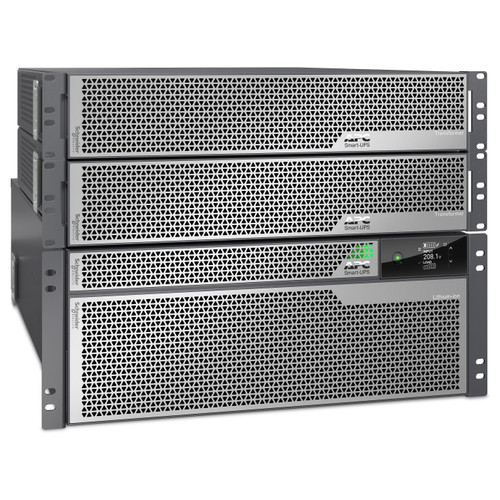
The SRTL10KRM4UT-5KTF2 is a single-phase (1:1) unit that also specifies 240 V AC as an alternate input and output voltage, and its model designation includes two 5 kVA step-down transformers, giving installers the ability to serve mixed 120 V loads from a 208 V feed. Its output frequency tracks the mains within ±3 Hz. Crest factor is specified at 3:1.
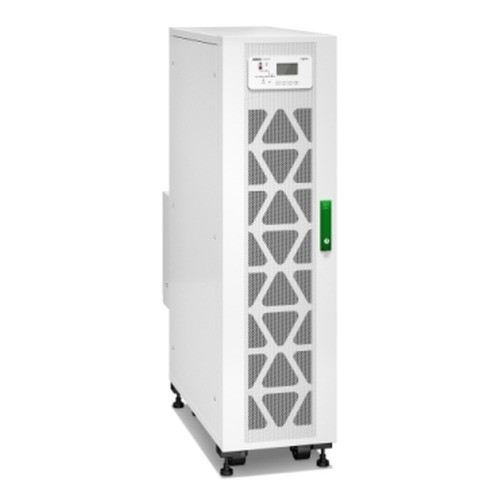
The E3SUPS10KFBS is a three-phase-input to three-phase-output (3:3) unit with a narrower rated input band of 208–220 V and a maximum output current of 31 A at 208 V. Its output frequency is stated as 50/60 Hz with no further synchronization tolerance specified. Crest factor is not listed in the provided specs.
Which unit offers more capable battery technology and runtime flexibility?
The SRTL10KRM4UT-5KTF2 uses a Lithium-Ion (Li-Ion) battery pack at a nominal 180 V battery bus voltage. Li-Ion chemistry typically yields a longer calendar life, lower weight per energy unit, and faster recharge compared with VRLA alternatives. APC specifies a typical recharge time of 1.5 hours and a battery charging power of 1,200 W. The spec lists extendable runtime as '0', indicating no external battery pack support is specified for this configuration.
The E3SUPS10KFBS uses an internal battery configuration at 120 V battery bus voltage. The model suffix 'FBS' (For Battery Storage / internal batteries) implies batteries are housed internally, but battery chemistry, recharge time, charging power, and runtime extension capability are not stated in the provided specifications. Buyers requiring those figures should consult APC's published datasheet for this model directly.
On the information available, the SRTL10KRM4UT-5KTF2 holds a clear advantage in battery specification transparency, with chemistry, bus voltage, recharge time, and charging power all documented. The E3SUPS10KFBS's battery chemistry and recharge profile are absent from the provided data.
How do form factor, management interfaces, and environmental ratings compare?
The SRTL10KRM4UT-5KTF2 occupies 4U in a rack and ships with a rack/tower convertible mounting kit, making it suitable for both data-center rack rows and standalone tower installations. It includes an embedded network management card 3 (NMC3) as well as USB and serial ports, and an available expansion slot. The LCD multi-function control console and audible/visible prioritized alarms are built in. The shipping package weighs 397.9 lb (180.5 kg), reflecting the transformer bundle. Acoustic noise is rated at 55 dB. Operating altitude extends to 10,000 ft; storage altitude to 50,000 ft.
The E3SUPS10KFBS is a tower-only unit with a metal housing in white. No rack-mount option, management card, LCD, expansion slot, USB, or serial interface is specified in the provided data. Maximum operating temperature is listed as 40 °C; storage temperature range is −15 to 40 °C.
The SRTL10KRM4UT-5KTF2 specifies a broader operating altitude ceiling (10,000 ft) and includes network management out of the box. The E3SUPS10KFBS provides no management interface data in the supplied specs, limiting the ability to make a direct comparison on that dimension. The SRTL10KRM4UT-5KTF2's storage altitude ceiling (50,000 ft) considerably exceeds anything stated for the E3SUPS10KFBS.
Which should you choose: the SRTL10KRM4UT-5KTF2 or the E3SUPS10KFBS?
Our take: The SRTL10KRM4UT-5KTF2 is the stronger choice when the deployment is a single-phase rack environment that demands fast battery recharge, integrated remote management, and flexible load distribution. Its Li-Ion battery at 180 V bus recharges in 1.5 hours at 1,200 W versus no recharge specification available for the E3SUPS10KFBS; it ships with an embedded NMC3 network card and USB/serial ports versus no management interface listed for the E3SUPS10KFBS; and its rack/tower convertibility with 4U footprint versus the E3SUPS10KFBS's tower-only form factor offers greater installation flexibility. The included dual 5 kVA step-down transformers extend its usefulness in mixed-voltage environments. The E3SUPS10KFBS may be relevant where a three-phase 3:3 input-to-output architecture is specifically required and a tower installation is acceptable, but critical specification gaps — battery chemistry, recharge time, and management capabilities — prevent a complete evaluation from the provided data alone.
Side-by-Side Comparison
Spec-for-spec, from manufacturer data.
| Specification | APC by Schneider Electric SRTL10KRM4UT-5KTF2 | APC by Schneider Electric E3SUPS10KFBS |
|---|---|---|
| Rated Output (VA) | 10,000 VA | 10,000 VA |
| Rated Output (W) | 10,000 W | 10,000 W |
| UPS Topology | Online double-conversion | Online double-conversion |
| Phase Configuration | 1-phase in / 1-phase out | 3-phase in / 3-phase out |
| Input Voltage | 208 V / 240 V AC | 208–220 V |
| Output Voltage | 208 V / 240 V AC | 208–220 V |
| Input Frequency | 50/60 Hz | 50/60 Hz |
| Output Frequency | 50/60 Hz ±3 Hz sync to mains | 50/60 Hz |
| Battery Chemistry | Li-Ion (Lithium-Ion) | — |
| Battery Bus Voltage | 180 V | 120 V |
| Typical Recharge Time | 1.5 h | — |
| Battery Charging Power | 1,200 W | — |
| Form Factor | Rack/tower convertible (4U) | Tower only |
| Network Management | Embedded NMC3 + USB + Serial | — |
| Acoustic Noise | 55 dB | — |
| Operating Altitude | 0–10,000 ft | — |
| IP Protection | IP20 | IP20 |
| Operating Temperature | — | 0–40 °C |
| Storage Temperature | −15–45 °C | −15–40 °C |
| Shipping Weight | 397.9 lb (180.5 kg) | — |
Frequently Asked Questions
Which should you choose: the SRTL10KRM4UT-5KTF2 or the E3SUPS10KFBS?
The SRTL10KRM4UT-5KTF2 is the stronger choice when the deployment is a single-phase rack environment that demands fast battery recharge, integrated remote management, and flexible load distribution. Its Li-Ion battery at 180 V bus recharges in 1.5 hours at 1,200 W versus no recharge specification available for the E3SUPS10KFBS; it ships with an embedded NMC3 network card and USB/serial ports versus no management interface listed for the E3SUPS10KFBS; and its rack/tower convertibility with 4U footprint versus the E3SUPS10KFBS's tower-only form factor offers greater installation flexibility. The included dual 5 kVA step-down transformers extend its usefulness in mixed-voltage environments. The E3SUPS10KFBS may be relevant where a three-phase 3:3 input-to-output architecture is specifically required and a tower installation is acceptable, but critical specification gaps — battery chemistry, recharge time, and management capabilities — prevent a complete evaluation from the provided data alone.
Is the SRTL10KRM4UT-5KTF2 or E3SUPS10KFBS better suited to a data-center rack installation?
Based on the provided specs, the SRTL10KRM4UT-5KTF2 is the only rack-mountable option of the two. It occupies 4U and ships with a rack/tower convertible kit. The E3SUPS10KFBS is specified as a tower form factor only, with no rack-mount option listed.
Which unit includes built-in network management for remote monitoring?
The SRTL10KRM4UT-5KTF2 includes an embedded network management card 3 (NMC3) plus USB and serial ports as specified. The E3SUPS10KFBS has no management interface listed in the provided specification data; buyers should verify with APC's published datasheet before assuming remote monitoring capability.
Does either unit support a three-phase power input?
Yes — the E3SUPS10KFBS is specified as a 3:3 (three-phase input to three-phase output) unit, which is relevant in facilities where the power distribution infrastructure is three-phase. The SRTL10KRM4UT-5KTF2 is a single-phase (1:1) unit and does not accept three-phase input per the provided specifications.
More UPS Comparisons
- APC by Schneider Electric SRTL10KRM4UT-5KTF2 vs Panduit U10N32V
- APC by Schneider Electric SRTL10KRM4UT-5KTF2 vs Panduit U10N11V
- APC by Schneider Electric SRTL10KRM4UT-5KTF2 vs Panduit U10N12V
- APC by Schneider Electric SRTL10KRM4UT-5KTF2 vs Vertiv GXT5-10KHVRT5UXLN
- APC by Schneider Electric SRTL10KRM4UT-5KTF2 vs APC by Schneider Electric SRT10KRMXLT-10KTF
- Panduit U10N32V vs APC by Schneider Electric E3SUPS10KFBS
UPS Buying Guides
Get a Second Opinion on Your Camera Choice
Share your site layout, coverage goals, and budget. Our team will validate the camera selection, flag anything we would change, and recommend products that match the use case.