
APC by Schneider Electric SRTL10KRM4UT-5KTF2 vs Vertiv GXT5-10KHVRT5UXLN: Specification Comparison
Both the APC Smart-UPS Ultra SRTL10KRM4UT-5KTF2 and the Vertiv GXT5 GXT5-10KHVRT5UXLN are 10 kVA / 10 kW online double-conversion rack/tower UPS systems targeting 208 V data-center and critical-infrastructure environments. This comparison examines their power architecture and battery technology, physical footprint and operating environment, and connectivity, management, and certifications — the three axes most relevant to an installer or IT buyer evaluating a 10 kVA UPS for a mid-to-large server room or edge deployment.
In This Guide
- How do the two units differ in power architecture, battery technology, and runtime flexibility?
- Which unit has the smaller rack footprint and broader environmental operating range?
- How do the units compare on management interfaces, protocol support, and compliance certifications?
- Which should you choose: the SRTL10KRM4UT-5KTF2 or the GXT5-10KHVRT5UXLN?
- Side-by-Side Specs
- FAQ
How do the two units differ in power architecture, battery technology, and runtime flexibility?
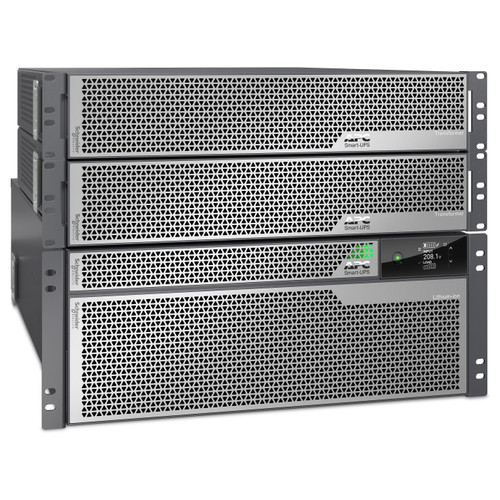
Both units deliver 10,000 VA / 10,000 W at unity power factor and use on-line double-conversion topology, so protected equipment always runs from a conditioned inverter output. The SRTL10KRM4UT-5KTF2 uses a Lithium-Ion battery pack at 180 V DC, with a rated recharge time of 1.5 hours and a 1,200 W charging power rating. APC specifies the unit as non-extendable for runtime (Extendable Runtime: 0), meaning external battery cabinets are not supported per the published spec. The GXT5-10KHVRT5UXLN spec sheet lists an external battery connector in the interface options, which implies runtime extension is architecturally supported, though no specific external battery model or runtime curve is provided in the supplied data. The GXT5 also publishes efficiency figures — up to 98% in Active ECO Mode and up to 95% in standard on-line mode — whereas no efficiency figure appears in the APC spec set. The APC unit bundles two 5 kVA step-down transformers (5KTF2 suffix), enabling it to feed 120 V loads directly; the GXT5 provides no step-down accessory per the supplied specs. Output waveform for the APC is specified as sine wave; the Vertiv topology is stated as on-line double-conversion, which inherently produces a sine wave output, though the word 'sine wave' does not appear verbatim in the Vertiv spec block.
Which unit has the smaller rack footprint and broader environmental operating range?
The SRTL10KRM4UT-5KTF2 occupies 4U of rack space. Physical dimensions of the unit itself are not listed in the provided spec; only shipping carton dimensions are given (41.5 × 25.6 × 39.4 in) with a package weight of 397.9 lb. The GXT5-10KHVRT5UXLN occupies 5U (per model suffix UXLN convention and the 8.5 in height at roughly 1.75 in per U) and has published unit dimensions of 8.5 in H × 16.9 in W × 24.8 in D at 166.4 lb. The APC unit is therefore 1U shorter in rack height; however, the APC's package weight of 397.9 lb versus the Vertiv's 166.4 lb unit weight indicates the APC assembly — which includes two step-down transformer modules — is substantially heavier, a critical consideration for floor loading and installation logistics. Operating temperature for the APC is not explicitly stated in the provided specs (only storage: −15 to 45 °C); the GXT5 specifies an operating range of +32 to +104 °F (0 to 40 °C). APC specifies IP20 ingress protection; Vertiv does not publish an IP rating in the supplied data. Both units support rack/tower convertible mounting.
How do the units compare on management interfaces, protocol support, and compliance certifications?
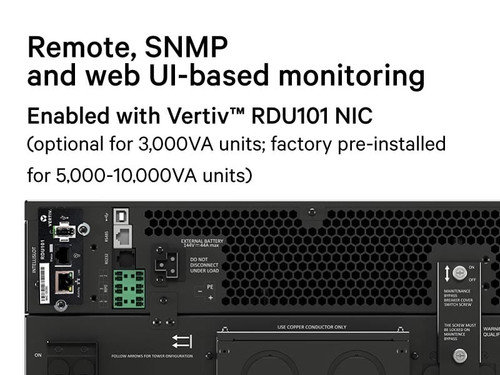
The SRTL10KRM4UT-5KTF2 ships with an embedded Network Management Card 3 (NMC3) as standard, plus a USB port, a serial port, and one available expansion slot. Management is via APC's NMC3 ecosystem. The spec references an RJ45 cable in provided equipment. No SNMP or web management protocol is explicitly called out by name in the provided APC spec, though NMC3 inherently supports those; this comparison can only cite what is in the supplied data. The GXT5-10KHVRT5UXLN ships with a factory pre-installed Vertiv Liebert IntelliSlot RDU120 SNMP/Webcard, with SNMP and web management explicitly enabled out of the box, plus USB, RS-485, RS-232, a terminal block, and an external battery connector. The Vertiv unit explicitly states SNMP and web management as factory-ready. On certifications, the GXT5 lists ENERGY STAR 2.0, UL1778, c-UL, RoHS2, and REACH; no equivalent compliance listings appear in the APC spec block. The APC panel uses a multi-function LCD with audible and visible alarms prioritized by severity; the Vertiv panel is described as a full-color graphic LCD with gravity-sensing orientation for installation in either rack or tower orientation.
Which should you choose: the SRTL10KRM4UT-5KTF2 or the GXT5-10KHVRT5UXLN?
Our take: The SRTL10KRM4UT-5KTF2 is the stronger choice when the deployment requires integrated step-down transformation, a faster recharge cycle, and a 4U rack profile. It includes two 5 kVA 208-to-120 V step-down modules — a capability absent from the GXT5 spec — recharges in 1.5 hours at 1,200 W, and saves 1U of rack space compared to the GXT5's 5U footprint. The GXT5-10KHVRT5UXLN is the stronger choice when efficiency, runtime extensibility, and out-of-box multi-protocol management matter most: it publishes up to 98% efficiency in ECO Mode versus no efficiency figure for the APC, supports an external battery connector for runtime extension (not available on the APC per spec), and ships with explicit SNMP/web management and ENERGY STAR 2.0 certification — none of which appear in the APC supplied data. Buyers powering mixed 120/208 V loads in a compact rack should favor the APC bundle; buyers prioritizing energy efficiency, expandable runtime, and verified compliance certifications in a 208 V hardwired environment should favor the Vertiv.
Side-by-Side Comparison
Spec-for-spec, from manufacturer data.
| Specification | APC by Schneider Electric SRTL10KRM4UT-5KTF2 | Vertiv GXT5-10KHVRT5UXLN |
|---|---|---|
| Rated Power | 10,000 VA / 10,000 W | 10,000 VA / 10,000 W |
| Topology | On-line double conversion | On-line double conversion |
| Output Waveform | Sine wave | Not specified in supplied data |
| Input Voltage | 208 V AC / 240 V AC (1-phase) | Typical 208 VAC; Range 176–288 VAC |
| Output Voltage | 208 V AC / 240 V AC (1-phase) | 200/208/220/230/240 VAC (user-configurable) |
| Battery Technology | Lithium-Ion (Li-Ion) | Not specified in supplied data |
| Typical Recharge Time | 1.5 hours | Not specified in supplied data |
| Extendable Runtime | No (spec: Extendable Runtime 0) | Yes (external battery connector listed) |
| Efficiency | Not specified in supplied data | Up to 98% ECO Mode; up to 95% on-line |
| Rack Height | 4U | 5U |
| Unit Weight | Not specified (package: 397.9 lb) | 166.4 lb |
| Unit Dimensions (H×W×D) | Not specified in supplied data | 8.5 in × 16.9 in × 24.8 in |
| Operating Temperature | Not specified in supplied data | +32 to +104 °F (0 to 40 °C) |
| Mounting | Rack/tower convertible | Rack/tower convertible |
| Network Management | Embedded NMC3 + USB + serial + expansion slot | Factory IntelliSlot RDU120 SNMP/Webcard + USB + RS-485 + RS-232 |
| Certifications | IP20 (no others in supplied data) | ENERGY STAR 2.0, UL1778, c-UL, RoHS2, REACH |
| Step-Down Transformer | 2 × 5 kVA included (5KTF2) | Not included per supplied data |
| Control Panel | Multi-function LCD with severity-prioritized alarms | Full-color graphic LCD with gravity-sensing orientation |
Frequently Asked Questions
Which should you choose: the SRTL10KRM4UT-5KTF2 or the GXT5-10KHVRT5UXLN?
The SRTL10KRM4UT-5KTF2 is the stronger choice when the deployment requires integrated step-down transformation, a faster recharge cycle, and a 4U rack profile. It includes two 5 kVA 208-to-120 V step-down modules — a capability absent from the GXT5 spec — recharges in 1.5 hours at 1,200 W, and saves 1U of rack space compared to the GXT5's 5U footprint. The GXT5-10KHVRT5UXLN is the stronger choice when efficiency, runtime extensibility, and out-of-box multi-protocol management matter most: it publishes up to 98% efficiency in ECO Mode versus no efficiency figure for the APC, supports an external battery connector for runtime extension (not available on the APC per spec), and ships with explicit SNMP/web management and ENERGY STAR 2.0 certification — none of which appear in the APC supplied data. Buyers powering mixed 120/208 V loads in a compact rack should favor the APC bundle; buyers prioritizing energy efficiency, expandable runtime, and verified compliance certifications in a 208 V hardwired environment should favor the Vertiv.
Is the SRTL10KRM4UT-5KTF2 or GXT5-10KHVRT5UXLN better for a mixed 120 V and 208 V server room?
The SRTL10KRM4UT-5KTF2 is the documented choice for mixed-voltage environments: it includes two 5 kVA step-down transformer modules (the -5KTF2 suffix) that allow 120 V loads to be powered directly. The GXT5-10KHVRT5UXLN spec lists only 200/208/220/230/240 VAC output options with no step-down accessory mentioned in the supplied data.
Which unit can I expand with external battery cabinets for longer runtime?
Per the supplied specifications, only the GXT5-10KHVRT5UXLN lists an external battery connector in its interface options, indicating runtime extension is architecturally supported. The SRTL10KRM4UT-5KTF2 spec explicitly states Extendable Runtime: 0, meaning external battery modules are not supported according to the provided data.
Does either UPS ship with SNMP network management included, or is that an add-on?
The GXT5-10KHVRT5UXLN ships with a factory pre-installed Vertiv Liebert IntelliSlot RDU120 SNMP/Webcard with SNMP and web management explicitly enabled out of the box. The SRTL10KRM4UT-5KTF2 ships with an embedded NMC3 card, which provides network management capability; however, SNMP is not explicitly named in the supplied APC spec block — buyers should confirm SNMP support with APC documentation before assuming parity.
More UPS Comparisons
- APC by Schneider Electric SRTL10KRM4UT-5KTF2 vs Panduit U10N32V
- APC by Schneider Electric SRTL10KRM4UT-5KTF2 vs Panduit U10N11V
- APC by Schneider Electric SRTL10KRM4UT-5KTF2 vs Panduit U10N12V
- APC by Schneider Electric SRTL10KRM4UT-5KTF2 vs APC by Schneider Electric E3SUPS10KFBS
- APC by Schneider Electric SRTL10KRM4UT-5KTF2 vs APC by Schneider Electric SRT10KRMXLT-10KTF
- Panduit U10N32V vs APC by Schneider Electric E3SUPS10KFBS
UPS Buying Guides
Get a Second Opinion on Your Camera Choice
Share your site layout, coverage goals, and budget. Our team will validate the camera selection, flag anything we would change, and recommend products that match the use case.