
Lantronix IES-5200-LRT vs Transition Networks SISPM1040-362-LRT: Specification Comparison
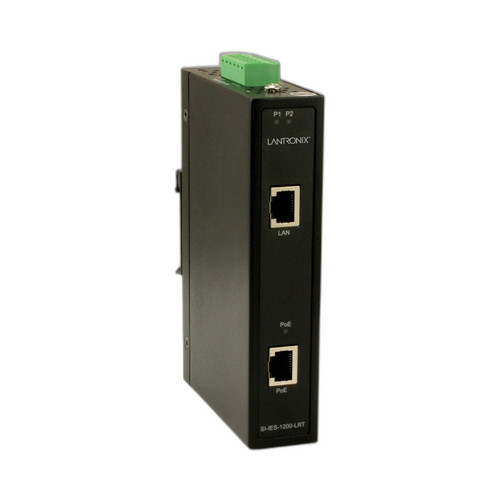
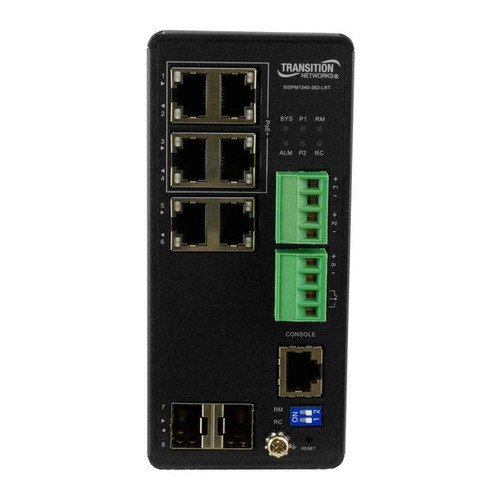
Both the Lantronix SI-IES-5200-LRT and the Transition Networks SISPM1040-362-LRT are 6-port industrial-grade Ethernet switches designed for hardened deployments such as IP surveillance backhaul, factory floors, and outdoor communications cabinets. Despite sharing port count and an industrial pedigree, they diverge sharply on port speed, management capability, PoE standard, and warranty terms—dimensions that directly determine fit for a given project. This comparison draws exclusively on published specifications for each unit.
In This Guide
- Which switch delivers greater per-port bandwidth and raw throughput?
- How do the two switches compare on PoE delivery, operating environment, and physical form factor?
- Which unit offers stronger network management, compliance credentials, and long-term support?
- Which should you choose: the IES-5200-LRT or the SISPM1040-362-LRT?
- Side-by-Side Specs
- FAQ
Which switch delivers greater per-port bandwidth and raw throughput?
The Lantronix SI-IES-5200-LRT is specified at 10 Gbps on all six ports, making every link capable of 10G wire-speed throughput. For applications such as multi-camera aggregation nodes, NVR uplinks, or high-density edge computing backhauling where bandwidth is the primary constraint, this is a material advantage.
The Transition Networks SISPM1040-362-LRT is rated at 10/100/1000 Mbps (Gigabit) per port—a full order of magnitude lower in maximum per-port throughput than the Lantronix. For deployments where 1 Gbps per camera or device is sufficient, this gap may be acceptable, but it is not bridgeable through configuration.
No aggregate switching capacity (backplane) figure is provided in the supplied specifications for either unit, so a backplane-to-backplane comparison cannot be made honestly.
How do the two switches compare on PoE delivery, operating environment, and physical form factor?
On PoE, the Lantronix supports PoE++ (IEEE 802.3bt), with a specified maximum PoE budget of 90 W at 56 VDC input. The 802.3bt standard allows up to 90 W per port, making it suitable for high-draw devices such as PTZ cameras, multi-radio wireless APs, or edge compute modules. The Transition Networks SISPM1040-362-LRT is specified as PoE+ (IEEE 802.3at), which caps at 30 W per port. No total PoE budget wattage figure is provided in the Transition Networks specifications supplied.
On operating temperature, the Lantronix specifies –40 °C to 75 °C (with a conflicting secondary field showing –25 °C to +60 °C; the wider –40 °C to 75 °C range appears in the dedicated 'Operating Temp' field). Storage is rated –40 °C to +85 °C. The Lantronix also carries an IP31 ingress-protection rating. No operating temperature range and no IP rating are specified for the Transition Networks unit in the provided data.
Both units support DIN rail mounting, confirmed in the Lantronix specs; DIN rail is not explicitly listed in the Transition Networks spec fields provided, though the product name suffix '-LRT' conventionally denotes DIN rail / hardened form factor. The Lantronix dimensions are 63 mm × 113.5 mm × 125.2 mm. The Transition Networks lists 18" × 16" × 10"—an unusually large figure for a 6-port switch and may reflect packaging or a data-entry anomaly; buyers should verify against the manufacturer datasheet.
Certifications for the Lantronix include UL508, TUV EN60950-1, EN55022 Class B, and EN61000-4-2/3/4/5. No certifications are listed in the supplied Transition Networks specs, though the TAA-compliance feature flag is noted.
Which unit offers stronger network management, compliance credentials, and long-term support?
The Lantronix SI-IES-5200-LRT is explicitly unmanaged—plug-and-play with no CLI, SNMP, VLAN, or QoS configuration capability. This simplifies deployment and eliminates configuration error, but rules it out wherever network segmentation, traffic prioritization, or remote monitoring is required.
The Transition Networks SISPM1040-362-LRT is a managed switch. The specifications note Layer 2+ architecture supporting VLAN, QoS, and SNMP, and an 8K MAC address table. This enables network segmentation (critical for isolating camera traffic), quality-of-service policies, and SNMP-based remote monitoring—capabilities absent from the Lantronix.
On compliance, the Transition Networks carries a TAA (Trade Agreements Act) flag, which is a purchasing requirement for U.S. federal and many state/local government contracts. The Lantronix specifications do not list TAA compliance.
Warranty terms differ significantly: the Transition Networks carries a lifetime warranty; the Lantronix is covered by a 2-year warranty. For infrastructure that may remain in service for a decade or more, the lifetime warranty reduces long-term ownership risk.
Which should you choose: the IES-5200-LRT or the SISPM1040-362-LRT?
Our take: The SI-IES-5200-LRT is the stronger choice when raw per-port bandwidth is the overriding requirement—its 10 Gbps per-port speed versus the SISPM1040-362-LRT's 1 Gbps ceiling is a 10× throughput advantage that cannot be closed by management tuning. It also supports PoE++ (802.3bt, up to 90 W budget at 56 VDC) versus PoE+ (802.3at, 30 W per port, no total budget stated) and carries a rated operating range down to –40 °C with an IP31 enclosure rating and UL508/TUV certifications, while no comparable environmental ratings are supplied for the Transition Networks. Conversely, the SISPM1040-362-LRT is the correct choice where network management is non-negotiable: its Layer 2+ VLAN, QoS, and SNMP capabilities, 8K MAC table, TAA compliance for government procurement, and lifetime warranty address requirements the unmanaged Lantronix cannot meet. Choose the Lantronix for 10G unmanaged aggregation backbones in extreme-temperature industrial enclosures; choose the Transition Networks for managed, TAA-regulated, lifecycle-sensitive deployments at Gigabit speeds.
Side-by-Side Comparison
Spec-for-spec, from manufacturer data.
| Specification | Lantronix IES-5200-LRT | Transition Networks SISPM1040-362-LRT |
|---|---|---|
| Device Type | Industrial Switch | Industrial Switch |
| Managed | Unmanaged | Managed (Layer 2+) |
| Ports | 6 | 6 |
| Port Speed | 10 Gbps (all ports) | 10/100/1000 Mbps (all ports) |
| PoE Standard | PoE++ (802.3bt) | PoE+ (802.3at) |
| PoE Budget | 90 W at 56 VDC input | — |
| Operating Temperature | –40 °C to 75 °C | — |
| Storage Temperature | –40 °C to +85 °C | — |
| IP Rating | IP31 | — |
| DIN Rail Mount | Yes | — (not stated in provided specs) |
| TAA Compliant | — | Yes |
| VLAN / QoS / SNMP | No (unmanaged) | Yes |
| MAC Address Table | — | 8K entries |
| Warranty | 2 years | Lifetime |
| Certifications | UL508, TUV EN60950-1, EN55022 Class B, EN61000-4-2/3/4/5 | — |
| Dimensions | 63 mm × 113.5 mm × 125.2 mm | 18" × 16" × 10" (verify against datasheet) |
Frequently Asked Questions
Which should you choose: the IES-5200-LRT or the SISPM1040-362-LRT?
The SI-IES-5200-LRT is the stronger choice when raw per-port bandwidth is the overriding requirement—its 10 Gbps per-port speed versus the SISPM1040-362-LRT's 1 Gbps ceiling is a 10× throughput advantage that cannot be closed by management tuning. It also supports PoE++ (802.3bt, up to 90 W budget at 56 VDC) versus PoE+ (802.3at, 30 W per port, no total budget stated) and carries a rated operating range down to –40 °C with an IP31 enclosure rating and UL508/TUV certifications, while no comparable environmental ratings are supplied for the Transition Networks. Conversely, the SISPM1040-362-LRT is the correct choice where network management is non-negotiable: its Layer 2+ VLAN, QoS, and SNMP capabilities, 8K MAC table, TAA compliance for government procurement, and lifetime warranty address requirements the unmanaged Lantronix cannot meet. Choose the Lantronix for 10G unmanaged aggregation backbones in extreme-temperature industrial enclosures; choose the Transition Networks for managed, TAA-regulated, lifecycle-sensitive deployments at Gigabit speeds.
Can either switch support PTZ cameras or multi-radio APs that draw more than 30 W per port?
Only the Lantronix SI-IES-5200-LRT supports PoE++ (802.3bt), which can deliver up to 90 W per port (total budget specified at 90 W at 56 VDC input). The Transition Networks SISPM1040-362-LRT is rated for PoE+ (802.3at), which caps at 30 W per port. If your powered devices exceed 30 W, the Lantronix is the only option of the two; no total PoE budget figure is provided for the Transition Networks unit in the available specifications.
Is either switch required for U.S. federal government or TAA-mandated projects?
The Transition Networks SISPM1040-362-LRT is listed as TAA-compliant in its specifications, which satisfies the Trade Agreements Act requirement common to U.S. federal, DoD, and many state/local government purchasing vehicles. The Lantronix SI-IES-5200-LRT specifications do not include a TAA compliance designation, so it cannot be confirmed as eligible for TAA-restricted procurements based on the data provided.
Which switch is better suited to outdoor or extreme-cold industrial cabinet installations?
The Lantronix SI-IES-5200-LRT specifies an operating temperature of –40 °C to 75 °C, an IP31 ingress-protection rating, and certifications including UL508 and EN61000-4 series (EMC/surge immunity). No operating temperature range or IP rating is listed in the supplied specifications for the Transition Networks SISPM1040-362-LRT. Based solely on available spec data, the Lantronix is the documented choice for extreme-cold or industrially certified enclosure requirements.
More Network Switch Comparisons
- TP-Link SG2206MP vs Lantronix IES-5200-LRT
- TP-Link SG2206MP vs Lantronix SISPM1040-362-LRT-L1Y3
- TP-Link SG2206MP vs Transition Networks SISPM1040-362-LRT
- TP-Link SG2206MP vs TP-Link DS106GPP
- TP-Link DS106GPP vs Lantronix IES-5200-LRT
- TP-Link DS106GPP vs Lantronix SISPM1040-362-LRT-L1Y3
Network Switch Buying Guides
Get a Second Opinion on Your Camera Choice
Share your site layout, coverage goals, and budget. Our team will validate the camera selection, flag anything we would change, and recommend products that match the use case.