
Hanwha GS980M/52PS-10 vs NETGEAR GS348PP-100NAS: Specification Comparison
Both the Hanwha HV-GS980M/52PS-10 and the NETGEAR GS348PP-100NAS are 48-port Gigabit PoE switches targeting physical security and surveillance deployments. The comparison centers on three axes that define fitness for professional camera infrastructure: PoE power budget and port capability, environmental and physical durability, and network management depth. Buyers choosing between these two are weighing a ruggedized, fully managed Layer 2/3 platform against a simpler unmanaged switch with a lower PoE budget.
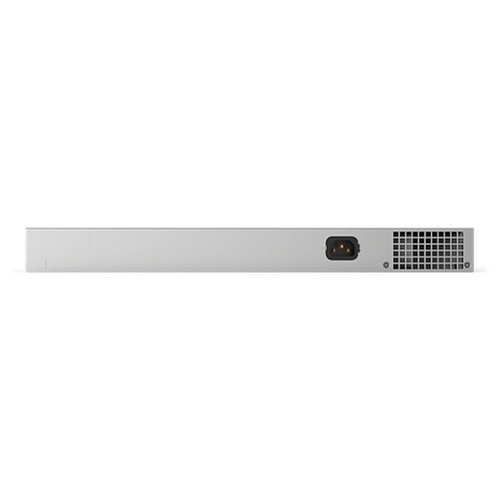
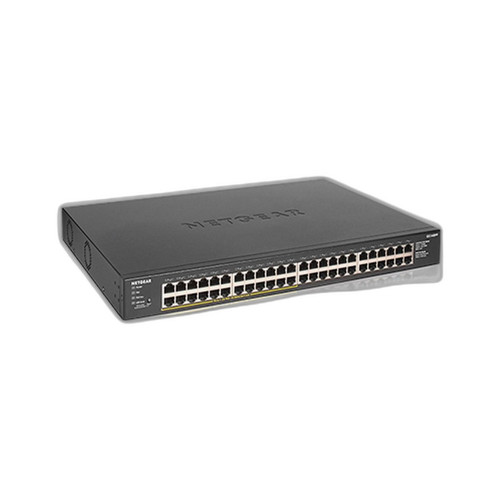
In This Guide
- Which switch delivers more PoE headroom for high-density camera deployments?
- Which switch is rated for outdoor or harsh-environment installation?
- Which switch offers deeper network management and security-platform integration?
- Which should you choose: the GS980M/52PS-10 or the GS348PP-100NAS?
- Side-by-Side Specs
- FAQ
Which switch delivers more PoE headroom for high-density camera deployments?
The Hanwha HV-GS980M/52PS-10 provides a total PoE power budget of 740W across its 48 ports, supporting PoE++ (802.3bt) per the listed spec. This headroom is substantial for mixed deployments combining PTZ cameras, multi-sensor units, and PoE-powered access control readers that may individually draw up to 90W under 802.3bt.
The NETGEAR GS348PP-100NAS specifies a 380W PoE budget. Its spec sheet lists both PoE++ (802.3bt) under the '_Poe Power' field and PoE+ (802.3at) under the '_PoE' field — these are contradictory entries in the provided data, so buyers should verify the per-port maximum wattage directly against the manufacturer datasheet before assuming 802.3bt capability.
On raw budget alone, the Hanwha delivers 360W more total PoE power — effectively allowing roughly 94% more powered-device capacity at equivalent per-port draw. For deployments with 48 cameras all requiring sustained PoE+, the NETGEAR's 380W budget averages only ~7.9W per port, which is insufficient for cameras drawing the full 802.3at 30W maximum simultaneously. The Hanwha's 740W averages ~15.4W per port under full-port load, giving meaningful real-world headroom.
Which switch is rated for outdoor or harsh-environment installation?
The Hanwha HV-GS980M/52PS-10 carries an IP66 ingress protection rating, an IK10 impact resistance rating, NEMA 4X enclosure classification, and NEMA-TS 2 traffic-system compliance. It is rated for an operating temperature range of -40°C to +55°C (-40°F to +131°F). These ratings collectively qualify it for direct outdoor installation, exposure to dust and water jets, and high-impact environments such as roadside cabinets or parking structures.
The NETGEAR GS348PP-100NAS specifies a plastic housing and lists mounting options of wall and ceiling. The provided spec data does not include an IP rating, IK rating, or NEMA classification. Its operating temperature is listed only as 'Industrial' with no numeric range provided in the supplied specs.
For any deployment requiring outdoor exposure, washdown environments, or traffic-cabinet mounting, the Hanwha's verified IP66/IK10/NEMA 4X ratings are determinative. The NETGEAR's environmental credentials cannot be confirmed from the provided specifications — buyers requiring outdoor or harsh-environment use must consult the NETGEAR datasheet directly.
Which switch offers deeper network management and security-platform integration?
The Hanwha HV-GS980M/52PS-10 is a Layer 2/3 managed switch, per the card bullets, supporting VLAN segmentation, QoS prioritization, and port mirroring. The spec also notes a GUI management interface and Telnet terminal access. Additionally, the product listing references a pre-installed WAVE Server with one Pro License, indicating native integration with Hanwha's WAVE VMS platform. Heatmap analytics and people counting are also listed, though these appear to reflect bundled or companion software features rather than switch firmware capabilities.
The NETGEAR GS348PP-100NAS is explicitly specified as an unmanaged switch. No VLAN, QoS, port mirroring, or CLI access is available. The design intent, per the card bullets, is zero-configuration plug-and-play operation.
For enterprise or municipal surveillance networks requiring network segmentation (isolating camera VLANs from corporate traffic), traffic prioritization for 4K streams, or centralized switch monitoring, the Hanwha's managed Layer 2/3 feature set is the only option of the two. The NETGEAR is appropriate where simplicity and low configuration overhead are the priority and network segmentation is handled upstream.
Which should you choose: the GS980M/52PS-10 or the GS348PP-100NAS?
Our take: The HV-GS980M/52PS-10 is the stronger choice when the deployment demands outdoor-rated enclosures, high PoE power density, or managed network control. Concretely: it provides a 740W PoE budget versus the NETGEAR's 380W — a 360W advantage that is decisive for high-camera-count or multi-sensor installations; it carries verified IP66, IK10, and NEMA 4X ratings versus no confirmed environmental rating on the NETGEAR; and it delivers Layer 2/3 management with VLAN and QoS versus the NETGEAR's unmanaged design. The NETGEAR GS348PP-100NAS fits scenarios where budget, simplicity, and indoor installation are the governing constraints and a 380W PoE pool is sufficient. Note that the NETGEAR spec data contains a PoE standard conflict (802.3bt vs 802.3at listed simultaneously); verify per-port wattage limits with NETGEAR before specifying high-draw devices.
Side-by-Side Comparison
Spec-for-spec, from manufacturer data.
| Specification | Hanwha GS980M/52PS-10 | NETGEAR GS348PP-100NAS |
|---|---|---|
| Product Type | Managed PoE Switch | Unmanaged PoE Switch |
| Total Ports | 48 + 4 SFP uplinks | 48 |
| PoE Standard | PoE++ (802.3bt) | PoE++ (802.3bt) listed; PoE+ (802.3at) also listed — verify with mfg |
| Total PoE Budget | 740W | 380W |
| Port Speed | 1000 Mbps (Gigabit) all ports | 1 Gbps all ports |
| Uplink Ports | 4 SFP fiber uplinks | — |
| Management | Layer 2/3 managed (GUI, Telnet, VLAN, QoS, port mirroring) | Unmanaged — no configuration |
| Operating Temp | -40°C to +55°C | Listed as 'Industrial'; no numeric range in provided specs |
| IP Rating | IP66 | — |
| IK Rating | IK10 | — |
| NEMA Rating | NEMA 4X, NEMA-TS 2 | — |
| Housing / Enclosure | — | Plastic |
| Mount Type | Rack | Wall; Ceiling |
| VMS Integration | Pre-installed WAVE Server, 1 Pro License | — |
| Warranty | 5 years | 5 years |
| Datasheet | /content/product-datasheets/HV-GS980M_52PS-10.pdf | /content/product-datasheets/GS348PP-100NAS.pdf |
Frequently Asked Questions
Which should you choose: the GS980M/52PS-10 or the GS348PP-100NAS?
The HV-GS980M/52PS-10 is the stronger choice when the deployment demands outdoor-rated enclosures, high PoE power density, or managed network control. Concretely: it provides a 740W PoE budget versus the NETGEAR's 380W — a 360W advantage that is decisive for high-camera-count or multi-sensor installations; it carries verified IP66, IK10, and NEMA 4X ratings versus no confirmed environmental rating on the NETGEAR; and it delivers Layer 2/3 management with VLAN and QoS versus the NETGEAR's unmanaged design. The NETGEAR GS348PP-100NAS fits scenarios where budget, simplicity, and indoor installation are the governing constraints and a 380W PoE pool is sufficient. Note that the NETGEAR spec data contains a PoE standard conflict (802.3bt vs 802.3at listed simultaneously); verify per-port wattage limits with NETGEAR before specifying high-draw devices.
Is the HV-GS980M/52PS-10 or GS348PP-100NAS better for larger deployments?
The HV-GS980M/52PS-10 is the better fit for larger deployments. Its 740W PoE budget is 360W higher than the GS348PP-100NAS's 380W, and its Layer 2/3 managed feature set — including VLAN, QoS, and port mirroring — is necessary for segmenting and prioritizing traffic across dozens of cameras. The NETGEAR's unmanaged design and lower PoE budget are better suited to smaller, simpler installations.
Can the GS348PP-100NAS be installed outdoors or in a roadside cabinet?
Based on the provided specifications, the GS348PP-100NAS has a plastic housing and no listed IP, IK, or NEMA rating, so its suitability for outdoor or harsh-environment installation cannot be confirmed from the available data. The HV-GS980M/52PS-10 explicitly carries IP66, IK10, NEMA 4X, and NEMA-TS 2 ratings with an operating range of -40°C to +55°C, making it the verified choice for outdoor or traffic-cabinet use.
Does either switch support VLAN segmentation to isolate camera traffic from the corporate network?
Yes — the HV-GS980M/52PS-10 supports VLAN segmentation as part of its Layer 2/3 managed feature set, along with QoS and port mirroring. The NETGEAR GS348PP-100NAS is an unmanaged switch and provides no VLAN, QoS, or any other configurable network feature. If camera-to-IT network isolation is a security or compliance requirement, the Hanwha is the only option of the two.
More Network Switch Comparisons
- NETGEAR GS748PP-100NAS vs Ubiquiti USW-48-POE
- NETGEAR GS748PP-100NAS vs Ubiquiti USW-PRO-MAX-48-POE
- NETGEAR GS748PP-100NAS vs Ubiquiti USW-ENTERPRISE-48-POE
- NETGEAR GS748PP-100NAS vs Ubiquiti ES-48-500W
- NETGEAR GS748PP-100NAS vs NETGEAR GS348PP-100NAS
- Ubiquiti USW-48-POE vs NETGEAR GS348PP-100NAS
Network Switch Buying Guides
Get a Second Opinion on Your Camera Choice
Share your site layout, coverage goals, and budget. Our team will validate the camera selection, flag anything we would change, and recommend products that match the use case.