
CyberPower PR1000RTXL2UC vs CyberPower PR1000LCD: Specification Comparison
Both the CyberPower PR1000RTXL2UC and PR1000LCD are 1000VA/1000W line-interactive sine wave UPS units targeting small-to-medium IT and security infrastructure loads. They share identical VA/watt ratings, output waveform type, outlet count and layout, USB/Serial/SNMP connectivity, and the same PowerPanel Business management software. The key differentiators lie in physical form factor (2U rack/tower vs. mini-tower), runtime performance, battery capacity, surge suppression rating, communication options, and connected-equipment guarantee value—dimensions that matter most when matching a UPS to a specific deployment environment.
In This Guide
Which unit delivers more runtime and battery capacity for your critical load?
The PR1000RTXL2UC specifies a full-load runtime of 8 minutes and a half-load runtime of 20 minutes, backed by four 12V/7Ah batteries (total 336Wh of rated cell capacity). The PR1000LCD specifies a full-load runtime of only 3.1 minutes and a half-load runtime of 10.5 minutes, backed by two 12V/12Ah batteries (total 288Wh). On both full-load and half-load metrics the PR1000RTXL2UC delivers more runtime: approximately 158% longer at full load (8 min vs. 3.1 min) and approximately 90% longer at half load (20 min vs. 10.5 min). The PR1000LCD notes its batteries are user-replaceable; the PR1000RTXL2UC spec does not explicitly state user-replaceability. Recharge time is specified as 3 hours for the PR1000RTXL2UC; the PR1000LCD lists 3 hours for quick charge and 8 hours for eco mode.
Which unit fits your physical installation and rack environment?
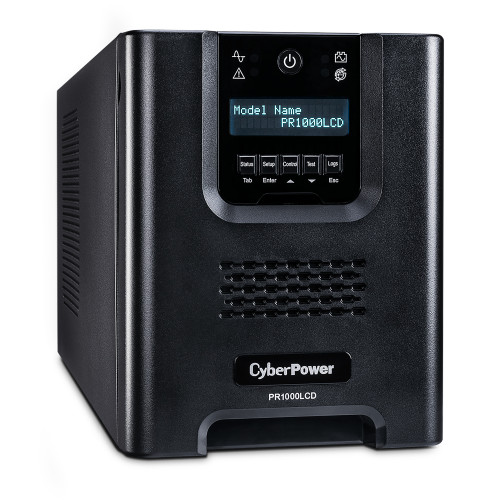
The PR1000RTXL2UC is a 2U rack/tower convertible unit measuring 434 × 86 × 411 mm (17.1 × 3.4 × 16.2 in.) and weighing 55.3 lbs. It ships with a 10 ft. input cord (NEMA 5-15P) and is constructed of metal. This form factor is designed for standard 19-inch equipment racks alongside servers, NVRs, and network infrastructure. The PR1000LCD is a mini-tower unit measuring 6.7 × 8.7 × 17 inches and weighing 44 lbs., intended for floor or desktop placement. It ships with a 6 ft. input cord. The PR1000LCD's removable LCD panel connects via a 4.5 ft. cable, allowing display repositioning; the PR1000RTXL2UC's LCD is integrated on the chassis front. Buyers with rack-mounted deployments should note the PR1000RTXL2UC's 2U footprint; buyers with standalone desktop/closet setups may find the PR1000LCD's mini-tower profile more practical.
Surge suppression also differs by deployment priority: the PR1000RTXL2UC is rated at 2,430 J vs. the PR1000LCD's 1,030 J—a meaningful difference for environments with higher transient-voltage exposure.
Which unit offers broader monitoring, management, and integration options?
Both units provide USB, Serial, and SNMP connectivity and include PowerPanel Business Edition software. The PR1000RTXL2UC adds two communication interfaces not listed for the PR1000LCD: a Relay (dry contact) port and EPO (Emergency Power Off) support. It explicitly lists 1 Serial port and 1 Dry Contact port as discrete specs. EPO is essential in data-center and security-operations environments where a single shutdown signal must de-energize multiple devices simultaneously. The PR1000LCD's spec does not reference EPO or a dry-contact/relay port.
On certification and compliance, the PR1000RTXL2UC carries UL1778, CSA C22.2 No 107.3, FCC Class B, VCCI, RoHS, and DOE Compliant. The PR1000LCD carries UL1778, cUL 107.3, FCC DOC Class A, Energy Star, and RoHS. The FCC Class B rating on the PR1000RTXL2UC indicates lower radiated emissions, relevant in mixed office/residential environments. The PR1000LCD carries Energy Star certification, which the PR1000RTXL2UC spec does not claim.
The connected-equipment guarantee is $400,000 for the PR1000RTXL2UC vs. $375,000 for the PR1000LCD. Both carry a 3-Year Limited Warranty.
Which should you choose: the PR1000RTXL2UC or the PR1000LCD?
Our take: The PR1000RTXL2UC is the stronger choice when the deployment is rack-mounted, runtime is a priority, or EPO/dry-contact integration is required. At full load it delivers 8 minutes of runtime vs. the PR1000LCD's 3.1 minutes—a 158% advantage—and at half load 20 minutes vs. 10.5 minutes. Its surge suppression rating of 2,430 J is more than double the PR1000LCD's 1,030 J, offering greater transient protection. It also adds EPO and relay/dry-contact ports absent from the PR1000LCD spec, enabling emergency shutdown integration critical in data-center and security-operations environments. The PR1000LCD, by contrast, suits desktop or closet deployments where rack mounting is unavailable, user-replaceable batteries are a priority, a lighter 44 lb. unit is preferred, or Energy Star certification is required. Its removable LCD on a 4.5 ft. cable also provides installation flexibility the integrated-display PR1000RTXL2UC does not offer.
Side-by-Side Comparison
Spec-for-spec, from manufacturer data.
| Specification | CyberPower PR1000RTXL2UC | CyberPower PR1000LCD |
|---|---|---|
| Capacity (VA / W) | 1000 VA / 1000 W | 1000 VA / 1000 W |
| Topology | Line Interactive | Line Interactive with AVR |
| Waveform | Sine Wave | Pure Sine Wave (AC and Battery) |
| Form Factor | 2U Rack/Tower | Mini-Tower |
| Dimensions (W × H × D) | 17.1 × 3.4 × 16.2 in. | 6.7 × 8.7 × 17.0 in. |
| Weight | 55.3 lbs. | 44 lbs. |
| Input Cord Length | 10 ft. | 6 ft. |
| Runtime at Full Load (1000W) | 8 min | 3.1 min |
| Runtime at Half Load (500W) | 20 min | 10.5 min |
| Battery Configuration | 4 × 12V/7Ah | 2 × 12V/12Ah |
| User-Replaceable Battery | — | Yes |
| Surge Suppression | 2,430 J | 1,030 J |
| Outlets (Total / Battery / Critical) | 8 / 8 / 4 NEMA 5-15R | 8 / 8 / 4 NEMA 5-15R |
| Communication Ports | USB, Serial, SNMP, Relay, EPO | USB, Serial, SNMP |
| LCD Display | Integrated multifunction LCD | Removable LCD, 4.5 ft. cable |
| Connected Equipment Guarantee | $400,000 | $375,000 |
| Certifications | UL1778, CSA C22.2 No 107.3, FCC Class B, VCCI, RoHS, DOE | UL1778, cUL 107.3, FCC Class A, Energy Star, RoHS |
| Warranty | 3-Year Limited | 3-Year Limited |
Frequently Asked Questions
Which should you choose: the PR1000RTXL2UC or the PR1000LCD?
The PR1000RTXL2UC is the stronger choice when the deployment is rack-mounted, runtime is a priority, or EPO/dry-contact integration is required. At full load it delivers 8 minutes of runtime vs. the PR1000LCD's 3.1 minutes—a 158% advantage—and at half load 20 minutes vs. 10.5 minutes. Its surge suppression rating of 2,430 J is more than double the PR1000LCD's 1,030 J, offering greater transient protection. It also adds EPO and relay/dry-contact ports absent from the PR1000LCD spec, enabling emergency shutdown integration critical in data-center and security-operations environments. The PR1000LCD, by contrast, suits desktop or closet deployments where rack mounting is unavailable, user-replaceable batteries are a priority, a lighter 44 lb. unit is preferred, or Energy Star certification is required. Its removable LCD on a 4.5 ft. cable also provides installation flexibility the integrated-display PR1000RTXL2UC does not offer.
Is the PR1000RTXL2UC or PR1000LCD better for a rack-mounted NVR or server deployment?
The PR1000RTXL2UC is purpose-built for rack mounting at 2U (434 × 86 × 411 mm) with a 10 ft. input cord, whereas the PR1000LCD is a mini-tower unit designed for floor or desktop placement. For a standard 19-inch rack alongside NVRs or servers, the PR1000RTXL2UC is the appropriate choice. The PR1000LCD's spec does not indicate rack compatibility.
Which UPS gives more battery runtime to ride through a power outage?
The PR1000RTXL2UC provides 8 minutes at full 1000W load and 20 minutes at half load (500W), backed by four 12V/7Ah batteries. The PR1000LCD provides 3.1 minutes at full load and 10.5 minutes at half load, backed by two 12V/12Ah batteries. If extended runtime is a priority, the PR1000RTXL2UC holds a significant advantage at both load levels per the published specs.
Does either model support Emergency Power Off (EPO) for data-center or large security installations?
Yes—the PR1000RTXL2UC lists EPO (Emergency Power Off) and a dry-contact/relay port among its communication interfaces, making it compatible with facility-level shutdown circuits. The PR1000LCD's published spec does not list EPO or a relay/dry-contact port. If EPO integration is required by your installation design or local code, the PR1000RTXL2UC is the only option between these two based on available specifications.
More UPS Comparisons
- CyberPower PR1000RTXL2UC vs APC by Schneider Electric SURT1000RMXLI
- CyberPower PR1000RTXL2UC vs APC by Schneider Electric SMT1000CUS
- CyberPower PR1000RTXL2UC vs Vertiv GXT5-1000LVRT2UXL
- CyberPower PR1000RTXL2UC vs APC by Schneider Electric SMT1000J
- CyberPower PR1000RTXL2UC vs CyberPower CP1000PFCLCD
- CyberPower CP1000PFCLCD vs APC by Schneider Electric SURT1000RMXLI
UPS Buying Guides
Get a Second Opinion on Your Camera Choice
Share your site layout, coverage goals, and budget. Our team will validate the camera selection, flag anything we would change, and recommend products that match the use case.