
CyberPower CP1000PFCLCD vs APC by Schneider Electric SURT1000RMXLI: Specification Comparison
Both the CyberPower CP1000PFCLCD and the APC SURT1000RMXLI are 1000 VA uninterruptible power supplies aimed at protecting critical loads from power disruptions. Despite sharing the same VA rating and a pure sine wave output, they differ fundamentally in topology, voltage region, form factor, and target deployment context — making this a comparison of a North American line-interactive mini-tower against a 230 V double-conversion online rack unit. Buyers evaluating these side-by-side must weigh topology-driven protection depth, physical integration requirements, and regional voltage compatibility against their specific site constraints.
In This Guide
- Which UPS topology and protection architecture better matches the load's sensitivity requirements?
- How does each unit's usable capacity, runtime, and battery management compare at rated load?
- Which unit's physical format, regional voltage, and management capabilities better suit the target installation environment?
- Which should you choose: the CP1000PFCLCD or the SURT1000RMXLI?
- Side-by-Side Specs
- FAQ
Which UPS topology and protection architecture better matches the load's sensitivity requirements?
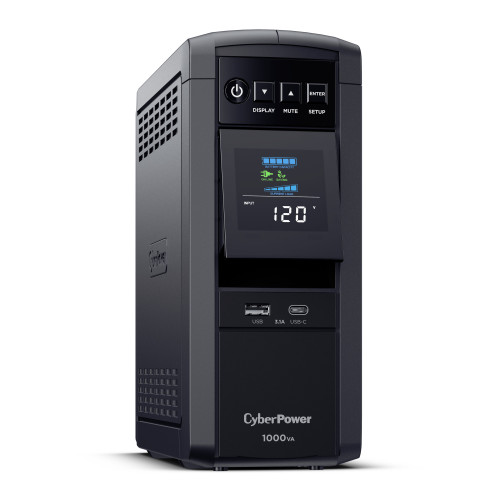
The CP1000PFCLCD uses a line-interactive topology with automatic voltage regulation (AVR) via a buck-boost transformer. In normal operation, utility power feeds the load directly through the AVR stage, with the battery only engaging during outages or when input voltage falls outside the 88–144 VAC operating window. Transfer to battery takes 4 milliseconds per spec. Output waveform is pure sine wave with THD under 3% at full load. Surge protection is rated at 1020 joules, and the unit includes full-time AVR without switching to battery for minor voltage deviations.
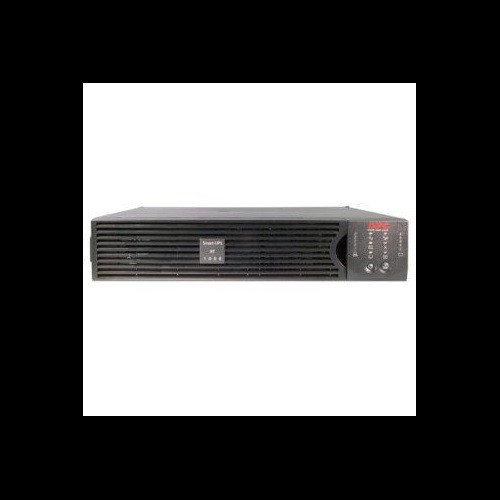
The SURT1000RMXLI uses a double-conversion online topology. In this architecture, incoming AC is continuously rectified to DC to charge the battery and simultaneously inverted back to AC for the load — meaning the load never draws directly from raw utility power. Transfer time to battery is effectively zero, as the inverter is always active. Output is a sine wave with harmonic distortion specified at less than 3%. Surge energy rating is 420 joules, and the unit includes full-time multi-pole noise filtering with IEEE surge let-through rated at zero. A built-in bypass is included.
For loads tolerant of minor voltage fluctuations and brief transfer gaps, the CP1000PFCLCD's line-interactive design is adequate. For loads requiring seamless, zero-transfer-time power conditioning — such as servers, medical equipment, or precision instrumentation — the SURT1000RMXLI's online double-conversion topology provides a materially higher protection level. The SURT1000RMXLI's crest factor is specified at 3:1, indicating headroom for non-linear loads; the CP1000PFCLCD does not spec a crest factor.
How does each unit's usable capacity, runtime, and battery management compare at rated load?
The CP1000PFCLCD is rated at 1000 VA / 600 W. At full load (600 W), the specified runtime is 2 minutes; at half load (300 W), runtime extends to 6 minutes. The battery is a sealed lead-acid unit at 12 V / 9 Ah and is user-replaceable (RB1270X2C). Automatic self-test runs every two weeks; the battery charger capacity is not specified. USB charging ports (Type-A and Type-C) are integrated, though these do not contribute to UPS output capacity per the specs.
The SURT1000RMXLI is rated at 1000 VA / 700 W — a 100 W higher real-power rating than the CP1000PFCLCD at the same VA. Runtime figures at specific load levels are not provided in the supplied specifications. The battery recharge time is specified at 3 hours, with a charger rated at 109 W. Battery type is lead-acid with a rated life of 3–5 years. Battery capacity (Ah) and user-replaceability are not specified in the provided data.
On raw power capacity, the SURT1000RMXLI's 700 W rating versus the CP1000PFCLCD's 600 W gives it a 17% advantage in watts at the same VA. The CP1000PFCLCD provides explicit runtime figures and a confirmed user-replaceable battery. The SURT1000RMXLI provides a recharge time figure but no runtime data in the supplied specs — buyers requiring confirmed runtime data for the SURT1000RMXLI must consult APC's runtime curves.
Which unit's physical format, regional voltage, and management capabilities better suit the target installation environment?
The CP1000PFCLCD is a mini-tower unit (3.94 × 9.7 × 10.24 in, 15.39 lb) designed for desktop or floor placement. It is built for 120 VAC North American environments (88–144 VAC input range). Outlets are 10 × NEMA 5-15R. Management interfaces include USB (HID-compliant) and serial (dry-contact relay), with an integrated multifunction color LCD displaying load, voltage, battery, runtime, and fault conditions. CyberPower PowerPanel software supports Windows, macOS, and Linux. Network line protection is provided via RJ45 (1 in / 1 out). The unit carries UL1778 and cUL 107.3 certifications and is ENERGY STAR certified.
The SURT1000RMXLI is a 2U rack-mounted unit (43.2 × 8.5 × 48.3 cm, 23 kg) designed for installation in standard 19-inch equipment racks. It is built for 230 VAC environments (160–280 VAC input range), covering European and international single-phase voltages. Input connection is IEC 60320 C14; output provides 6 × IEC 60320 outlets plus 2 IEC jumper outlets. The unit includes 1 free expansion slot. Acoustic level is rated at 50 dBA; heat dissipation is 324 Btu/h. Certifications include CE, VDE, C-Tick, GOST, and UK PSTI. Management interface specifics beyond the physical form are not provided in the supplied specs. IP protection is IP20.
These two units are not interchangeable from a deployment standpoint: the CP1000PFCLCD targets North American 120 V desktop or small-office environments, while the SURT1000RMXLI targets 230 V international rack environments. An installer must confirm regional voltage and outlet/inlet compatibility before cross-shopping these units.
Which should you choose: the CP1000PFCLCD or the SURT1000RMXLI?
Our take: The CP1000PFCLCD is the stronger choice when the installation site is North American 120 VAC, the load fits a desktop or floor-standing form factor, and explicit runtime data and user-serviceable batteries are required. The SURT1000RMXLI is the stronger choice when the site operates on 230 VAC, rack integration is mandatory, and the load demands zero-transfer-time double-conversion protection. Three concrete spec deltas drive the distinction: topology (line-interactive with 4 ms transfer vs. double-conversion online with zero transfer), real-power capacity (600 W vs. 700 W at the same 1000 VA), and form factor (mini-tower 15.39 lb vs. 2U rack 23 kg). Neither unit is suitable for the other's target voltage region — 120 V vs. 230 V is a hard boundary. Buyers in North America protecting workstations or network gear should evaluate the CP1000PFCLCD; those racking servers in 230 V environments and requiring continuous online conditioning should evaluate the SURT1000RMXLI.
Side-by-Side Comparison
Spec-for-spec, from manufacturer data.
| Specification | CyberPower CP1000PFCLCD | APC by Schneider Electric SURT1000RMXLI |
|---|---|---|
| UPS Topology | Line Interactive | Double Conversion Online |
| Rated Capacity (VA) | 1000 VA | 1000 VA |
| Rated Capacity (W) | 600 W | 700 W |
| Output Waveform | Pure Sine Wave | Sine Wave |
| Output THD | <3% at full load | <3% |
| Transfer Time | 4 ms | Zero (online) |
| Input Voltage (Nominal) | 120 VAC | 230 VAC |
| Input Voltage Range | 88–144 VAC | 160–280 VAC |
| Form Factor | Mini-Tower | 2U Rack |
| Dimensions (W × H × D) | 3.94 × 9.7 × 10.24 in | 43.2 × 8.5 × 48.3 cm |
| Weight | 15.39 lb | 23 kg |
| Outlet Type | 10 × NEMA 5-15R | 6 × IEC 60320 C13 + 2 IEC Jumpers |
| Surge Protection | 1020 J | 420 J |
| Battery Type | Sealed Lead-Acid, 12V / 9Ah | Lead-Acid (capacity not specified) |
| Battery Recharge Time | Not specified | 3 hours |
| Management Interface | USB (HID), Serial, LCD Display | Not specified in provided data |
| Certifications | UL1778, cUL 107.3, FCC DOC Class B, RoHS, ENERGY STAR | CE, VDE, C-Tick, GOST, UK PSTI |
| Warranty | 3 Year Limited | Not specified in provided data |
Frequently Asked Questions
Which should you choose: the CP1000PFCLCD or the SURT1000RMXLI?
The CP1000PFCLCD is the stronger choice when the installation site is North American 120 VAC, the load fits a desktop or floor-standing form factor, and explicit runtime data and user-serviceable batteries are required. The SURT1000RMXLI is the stronger choice when the site operates on 230 VAC, rack integration is mandatory, and the load demands zero-transfer-time double-conversion protection. Three concrete spec deltas drive the distinction: topology (line-interactive with 4 ms transfer vs. double-conversion online with zero transfer), real-power capacity (600 W vs. 700 W at the same 1000 VA), and form factor (mini-tower 15.39 lb vs. 2U rack 23 kg). Neither unit is suitable for the other's target voltage region — 120 V vs. 230 V is a hard boundary. Buyers in North America protecting workstations or network gear should evaluate the CP1000PFCLCD; those racking servers in 230 V environments and requiring continuous online conditioning should evaluate the SURT1000RMXLI.
Which unit provides better protection for sensitive server loads?
The SURT1000RMXLI's double-conversion online topology provides materially higher protection for sensitive server loads: the load is continuously powered by the inverter, so transfer time is zero and incoming power quality irregularities are fully isolated. The CP1000PFCLCD's line-interactive design transfers to battery in 4 milliseconds and passes conditioned utility power through the AVR stage during normal operation — adequate for most commercial equipment, but not equivalent to continuous online conditioning.
Can either UPS be used outside North America?
The CP1000PFCLCD is specified for 120 VAC input (88–144 VAC operating range) with NEMA 5-15R outlets, making it suitable for North American deployments only. The SURT1000RMXLI is specified for 230 V input (160–280 VAC range) with IEC 60320 outlets and carries CE, VDE, and related international certifications, making it suitable for European and other 230 V regions. Neither unit is specified for dual-voltage or universal-input operation based on the provided specs.
Which unit is easier to service and maintain in the field?
The CP1000PFCLCD specifies a user-replaceable battery (part RB1270X2C) and includes an automatic self-test every two weeks with LCD-based fault reporting, lowering on-site service burden. The SURT1000RMXLI specifies a battery life of 3–5 years and a recharge time of 3 hours, but user-replaceability of the battery and field-service procedures are not described in the provided specifications — buyers should consult APC documentation before committing to a serviceability decision.
More UPS Comparisons
- CyberPower PR1000RTXL2UC vs APC by Schneider Electric SURT1000RMXLI
- CyberPower PR1000RTXL2UC vs APC by Schneider Electric SMT1000CUS
- CyberPower PR1000RTXL2UC vs Vertiv GXT5-1000LVRT2UXL
- CyberPower PR1000RTXL2UC vs APC by Schneider Electric SMT1000J
- CyberPower PR1000RTXL2UC vs CyberPower CP1000PFCLCD
- CyberPower PR1000RTXL2UC vs CyberPower PR1000LCD
UPS Buying Guides
Get a Second Opinion on Your Camera Choice
Share your site layout, coverage goals, and budget. Our team will validate the camera selection, flag anything we would change, and recommend products that match the use case.