
CyberPower PR1000RTXL2UC vs CyberPower CP1000PFCLCD: Specification Comparison
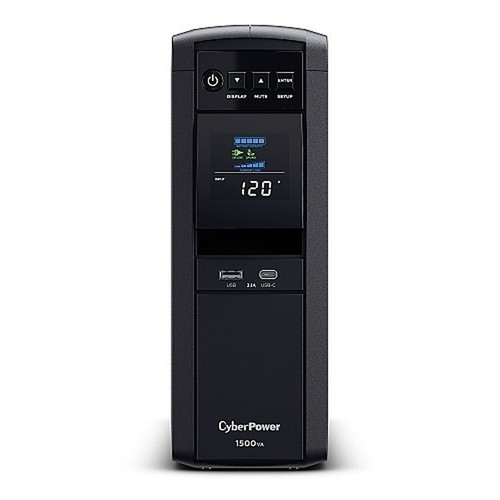
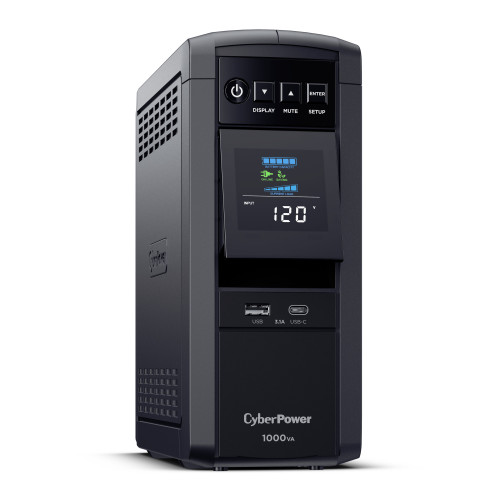
Both units are CyberPower 1000 VA line-interactive, pure sine wave UPS systems targeting small IT and network closet deployments. The PR1000RTXL2UC is a 2U rack/tower model rated at 1000 VA/1000 W with enterprise communication options, while the CP1000PFCLCD is a mini-tower rated at 1000 VA/600 W with USB charging ports and ENERGY STAR certification. Despite sharing a VA rating and waveform type, they differ significantly in true watt output, form factor, outlet count, and management depth — making this a meaningful cross-shop for IT buyers deciding between a rack-mount workhorse and a desktop-adjacent tower.
In This Guide
- How much real load can each UPS actually support, and how long will it keep equipment running?
- Which physical installation environments and enclosure types does each model support?
- What monitoring, communication, and software management capabilities does each unit offer?
- Which should you choose: the PR1000RTXL2UC or the CP1000PFCLCD?
- Side-by-Side Specs
- FAQ
How much real load can each UPS actually support, and how long will it keep equipment running?
The PR1000RTXL2UC is rated at 1000 VA and 1000 W, yielding an output power factor of 1.0. At full load (1000 W) it delivers 8 minutes of runtime; at half load (500 W) it extends to 20 minutes. Its four 12 V/7 Ah batteries (total 28 Ah) back all 8 outlets with battery power, including 4 designated as critical-load outlets.
The CP1000PFCLCD is also rated 1000 VA but only 600 W, reflecting a 0.6 power factor. At its defined full load of 600 W it provides just 2 minutes of runtime; at half load (300 W) it offers 6 minutes. Its single 12 V/9 Ah battery backs 5 of its 10 outlets, with the remaining 5 providing surge protection only. Buyers powering active PoE switches, servers, or NVRs drawing close to 600 W will exhaust the CP1000PFCLCD's runtime almost immediately.
Which physical installation environments and enclosure types does each model support?
The PR1000RTXL2UC occupies 2U of rack space (17.1 × 3.4 × 16.2 in) and is constructed of metal, weighing 55.30 lbs. Its rack/tower convertible form factor suits server rooms, IDF/MDF closets, and any standard 19-inch rack. The 10 ft. cord provides reach flexibility within a rack environment. A 15 A internal circuit breaker is included.
The CP1000PFCLCD is a mini-tower (3.94 × 9.7 × 10.24 in) weighing 15.39 lbs — less than one-third the weight of the PR1000RTXL2UC. It is designed for desktop or floor placement, not rack mounting. Its compact footprint suits workstation setups, small offices, or under-desk deployments where rack infrastructure does not exist. No rack-mount kit or rack-height rating is specified in the provided data.
What monitoring, communication, and software management capabilities does each unit offer?
The PR1000RTXL2UC provides USB, serial (1 dedicated serial port), SNMP, relay, and EPO (Emergency Power Off) interfaces. It includes 1 dry-contact port and is managed by PowerPanel® Business software. SNMP support enables integration with NMS platforms for remote monitoring, trap generation, and agent-based management — a requirement in most enterprise and multi-site deployments. The multifunction LCD displays operational status locally.
The CP1000PFCLCD offers USB (HID-compliant) and serial (dry-contact relay) interfaces, managed by PowerPanel software supporting Windows, macOS, and Linux. It adds two USB charging ports (Type-A and Type-C) not present on the PR1000RTXL2UC. SNMP is not listed in the provided specifications. It also includes RJ45 network surge protection (1 in/1 out) and a GreenPower Bypass high-efficiency mode with fewer than 10 W idle draw. The CP1000PFCLCD carries an ENERGY STAR certification; the PR1000RTXL2UC does not list this certification.
Which should you choose: the PR1000RTXL2UC or the CP1000PFCLCD?
Our take: The PR1000RTXL2UC is the stronger choice when protecting rack-mounted equipment in an IT closet or server room that requires deep management integration and maximum watt capacity. Its 1000 W true output versus the CP1000PFCLCD's 600 W ceiling is the most consequential delta — a buyer running a PoE switch and NVR drawing 700 W cannot use the CP1000PFCLCD at all. Runtime at half load also favors the PR1000RTXL2UC at 20 minutes versus 6 minutes, buying significantly more time for a graceful shutdown. SNMP support on the PR1000RTXL2UC enables enterprise NMS integration absent from the CP1000PFCLCD's listed specs. Conversely, the CP1000PFCLCD fits a desktop or small-office context: it is 40 lbs lighter, ENERGY STAR certified, adds USB-A/C device charging, and lists a higher connected equipment guarantee of $500,000 versus $400,000. Choose the PR1000RTXL2UC for rack deployments with high watt loads; choose the CP1000PFCLCD for lightweight, energy-conscious workstation protection.
Side-by-Side Comparison
Spec-for-spec, from manufacturer data.
| Specification | CyberPower PR1000RTXL2UC | CyberPower CP1000PFCLCD |
|---|---|---|
| Capacity (VA) | 1000 VA | 1000 VA |
| Capacity (Watts) | 1000 W | 600 W |
| Output Power Factor | 1.0 | 0.6 (derived) |
| Topology | Line Interactive | Line Interactive |
| Waveform | Sine Wave | Pure Sine Wave |
| Form Factor | Rack/Tower 2U | Mini-Tower |
| Total Outlets | 8 × NEMA 5-15R | 10 × NEMA 5-15R |
| Battery-Backed Outlets | 8 | 5 |
| Surge-Only Outlets | — | 5 |
| Runtime at Full Load | 8 min (1000 W) | 2 min (600 W) |
| Runtime at Half Load | 20 min (500 W) | 6 min (300 W) |
| Battery | 4 × 12 V / 7 Ah | 1 × 12 V / 9 Ah |
| Transfer Time | 4 ms | 4 ms |
| Surge Suppression | 2430 J | 1020 J |
| Communication Interfaces | USB, Serial, SNMP, Relay, EPO | USB (HID), Serial (dry contact) |
| USB Charging Ports | — | Type-A and Type-C |
| Network (RJ45) Protection | — | 1 in / 1 out |
| Management Software | PowerPanel Business | PowerPanel (Win/macOS/Linux) |
| AVR | Double Boost, Single Buck | Buck-Boost Transformer |
| ENERGY STAR | — | Certified |
| Connected Equipment Guarantee | $400,000 | $500,000 |
| Warranty | 3-Year Limited | 3-Year Limited |
| Weight | 55.30 lbs | 15.39 lbs |
| Dimensions (W × H × D in.) | 17.1 × 3.4 × 16.2 | 3.94 × 9.7 × 10.24 |
| Certifications | UL1778, CSA C22.2 No 107.3, FCC Class B, RoHS, DOE | UL1778, cUL 107.3, FCC DOC Class B, RoHS, ENERGY STAR |
Frequently Asked Questions
Which should you choose: the PR1000RTXL2UC or the CP1000PFCLCD?
The PR1000RTXL2UC is the stronger choice when protecting rack-mounted equipment in an IT closet or server room that requires deep management integration and maximum watt capacity. Its 1000 W true output versus the CP1000PFCLCD's 600 W ceiling is the most consequential delta — a buyer running a PoE switch and NVR drawing 700 W cannot use the CP1000PFCLCD at all. Runtime at half load also favors the PR1000RTXL2UC at 20 minutes versus 6 minutes, buying significantly more time for a graceful shutdown. SNMP support on the PR1000RTXL2UC enables enterprise NMS integration absent from the CP1000PFCLCD's listed specs. Conversely, the CP1000PFCLCD fits a desktop or small-office context: it is 40 lbs lighter, ENERGY STAR certified, adds USB-A/C device charging, and lists a higher connected equipment guarantee of $500,000 versus $400,000. Choose the PR1000RTXL2UC for rack deployments with high watt loads; choose the CP1000PFCLCD for lightweight, energy-conscious workstation protection.
Is the PR1000RTXL2UC or CP1000PFCLCD better for protecting a network switch and NVR in a rack cabinet?
The PR1000RTXL2UC is the appropriate choice for that scenario. It is designed for rack mounting (2U, metal construction), supports a true 1000 W load, provides 8 minutes of runtime at full load and 20 minutes at half load, and offers SNMP management for remote monitoring. The CP1000PFCLCD is a mini-tower with a 600 W ceiling and no listed SNMP support, making it unsuitable for rack-mounted infrastructure under moderate to heavy load.
Which UPS has better runtime when the power goes out?
The PR1000RTXL2UC provides longer runtime in both scenarios specified: 8 minutes at full load (1000 W) and 20 minutes at half load (500 W). The CP1000PFCLCD delivers 2 minutes at its full load of 600 W and 6 minutes at half load (300 W). Note that the CP1000PFCLCD's half-load runtime is measured at 300 W, not 500 W, so direct per-watt comparison favors the PR1000RTXL2UC's four-battery configuration.
Does either UPS include a connected equipment guarantee, and which is higher?
Both models include a connected equipment guarantee. The CP1000PFCLCD lists $500,000, and the PR1000RTXL2UC lists $400,000. Buyers for whom the guarantee amount is a deciding factor should note the $100,000 difference in favor of the CP1000PFCLCD, though the specific terms and conditions of each guarantee are not provided in the available specifications and should be verified directly with CyberPower.
More UPS Comparisons
- CyberPower PR1000RTXL2UC vs APC by Schneider Electric SURT1000RMXLI
- CyberPower PR1000RTXL2UC vs APC by Schneider Electric SMT1000CUS
- CyberPower PR1000RTXL2UC vs Vertiv GXT5-1000LVRT2UXL
- CyberPower PR1000RTXL2UC vs APC by Schneider Electric SMT1000J
- CyberPower PR1000RTXL2UC vs CyberPower PR1000LCD
- CyberPower CP1000PFCLCD vs APC by Schneider Electric SURT1000RMXLI
UPS Buying Guides
Get a Second Opinion on Your Camera Choice
Share your site layout, coverage goals, and budget. Our team will validate the camera selection, flag anything we would change, and recommend products that match the use case.