
CyberPower OL1000RTXL2U vs CyberPower CP1000PFCLCD: Specification Comparison
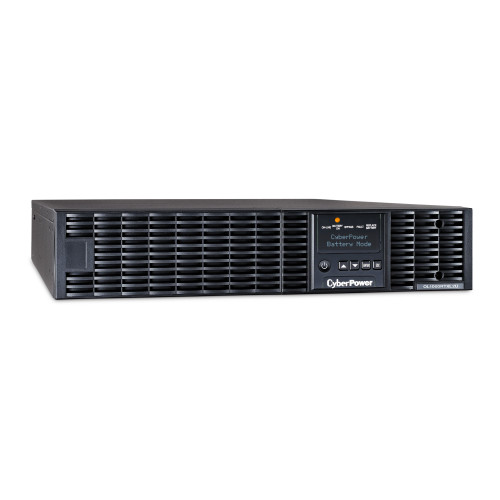
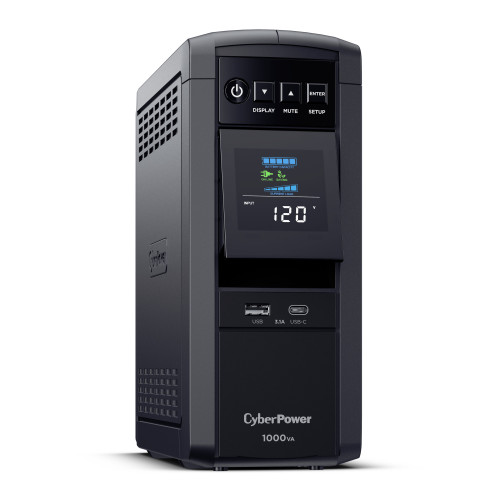
Both the CyberPower OL1000RTXL2U and CP1000PFCLCD are 1000 VA pure sine wave UPS units targeting small-to-midsize IT loads — a class where buyers routinely cross-shop on topology, runtime, and form factor. The OL1000RTXL2U is a 2U rack/tower double-conversion online unit aimed at rack-mounted infrastructure, while the CP1000PFCLCD is a mini-tower line-interactive unit suited to desktop or open-floor deployments. Same voltage class, same waveform type, meaningfully different topologies and physical formats — a legitimate cross-shop for a buyer deciding between rackmount infrastructure-grade protection and a desktop-friendly efficiency-focused solution.
In This Guide
- Which UPS topology and runtime better protect your critical load?
- Does each unit's real power output and outlet configuration match the intended load?
- Which unit's physical format, monitoring interfaces, and certifications suit your deployment environment?
- Which should you choose: the OL1000RTXL2U or the CP1000PFCLCD?
- Side-by-Side Specs
- FAQ
Which UPS topology and runtime better protect your critical load?
Topology is the most consequential difference between these two units. The OL1000RTXL2U uses double-conversion online architecture: the load runs continuously off the inverter, meaning there is zero transfer time and utility power anomalies — surges, sags, frequency drift — never reach the connected equipment. The CP1000PFCLCD uses line-interactive topology with AVR (buck-boost transformer), which corrects voltage in-range but does transfer to battery on severe events, with a specified 4 ms switchover time.
Runtime compounds the topology gap. The OL1000RTXL2U delivers 8 minutes at full 900 W load and 21 minutes at half load (450 W), backed by three 12V/9Ah batteries (324 Wh total). The CP1000PFCLCD is rated 2 minutes at its 600 W full load and 6 minutes at 300 W, from a single 12V/9Ah battery (108 Wh). For applications where sustained runtime during an outage is required — allowing an orderly shutdown of a server or NVR cluster — the OL1000RTXL2U provides substantially more energy reserve. Note that the OL1000RTXL2U's battery is hot-swappable in the field; the CP1000PFCLCD specifies user-replaceable batteries (model RB1270X2C) but does not claim hot-swap capability.
Does each unit's real power output and outlet configuration match the intended load?
Although both units share a 1000 VA nameplate, their watt ratings diverge significantly. The OL1000RTXL2U is rated 900 W — a 0.90 power factor — while the CP1000PFCLCD is rated 600 W, a 0.60 power factor. In practice this means the OL1000RTXL2U can sustain 50% more real power delivery before overloading. Buyers should size against watts, not VA, so a 700 W load that fits the OL1000RTXL2U's envelope would overload the CP1000PFCLCD.
Outlet configuration also differs. The OL1000RTXL2U provides 8 × NEMA 5-15R, all battery-backed. The CP1000PFCLCD provides 10 × NEMA 5-15R total, but splits them: 5 battery-backed and 5 surge-only. The CP1000PFCLCD adds 1,020 J surge protection on all outlets plus RJ45 Ethernet pass-through protection (1-in/1-out), and includes both USB Type-A and Type-C charging ports — none of which are specified for the OL1000RTXL2U. Output voltage regulation also differs: the OL1000RTXL2U holds ±2% across a configurable 100–125 VAC nominal range; the CP1000PFCLCD holds ±5% at a fixed 120 VAC nominal.
Which unit's physical format, monitoring interfaces, and certifications suit your deployment environment?
Form factor is a hard constraint. The OL1000RTXL2U occupies 2U of rack space (17 × 3.5 × 16.9 in, 39.6 lb) and can also stand as a tower, making it native to rack-mounted IT closets. The CP1000PFCLCD is a mini-tower (3.94 × 9.7 × 10.24 in, 15.39 lb) with no rack-mount option specified — it is intended for floor or desk placement. Weight difference (39.6 lb vs 15.39 lb) is relevant for installations where a single technician must position the unit.
Management connectivity is similar in breadth but differs in detail. Both provide USB and serial interfaces and LCD displays. The OL1000RTXL2U specifies USB, Serial, and optional Network card support; the CP1000PFCLCD specifies USB (HID-compliant) and serial, with PowerPanel software for Windows, macOS, and Linux. The CP1000PFCLCD is ENERGY STAR certified and specifies a GreenPower bypass mode with under 10 W idle draw; no equivalent efficiency certification is listed for the OL1000RTXL2U (it claims up to 94% in ECO mode but no ENERGY STAR designation). The CP1000PFCLCD carries a stated $500,000 connected equipment policy and a 3-year limited warranty; the OL1000RTXL2U's warranty is listed only as 'Manufacturer Warranty' — duration not specified in the provided data. Both carry UL1778, FCC, and RoHS.
Which should you choose: the OL1000RTXL2U or the CP1000PFCLCD?
Our take: The OL1000RTXL2U is the stronger choice when zero-transfer-time protection, higher real-power capacity, and extended runtime are non-negotiable — specifically for rack-mounted servers, NVRs, or network infrastructure where even a 4 ms switchover is unacceptable. Three concrete deltas: the OL1000RTXL2U delivers 900 W vs the CP1000PFCLCD's 600 W (50% more real power); its battery bank (3 × 12V/9Ah) yields 21 minutes at half load vs 6 minutes for the CP1000PFCLCD; and its double-conversion topology eliminates transfer time entirely vs the 4 ms line-interactive switchover. Conversely, the CP1000PFCLCD is the rational pick for desktop or open-floor workstation protection where rack space is unavailable, loads stay under 600 W, a 3-year stated warranty and ENERGY STAR certification matter, and the lower 15.39 lb weight aids placement. Platform qualifier: rack-mount infrastructure deployments should default to the OL1000RTXL2U; workstation or edge-node environments suit the CP1000PFCLCD.
Side-by-Side Comparison
Spec-for-spec, from manufacturer data.
| Specification | CyberPower OL1000RTXL2U | CyberPower CP1000PFCLCD |
|---|---|---|
| Topology | Double-Conversion Online | Line Interactive with AVR |
| Capacity (VA) | 1000 VA | 1000 VA |
| Capacity (Watts) | 900 W | 600 W |
| Output Power Factor | 0.90 | 0.60 |
| Output Waveform | Pure Sine Wave | Pure Sine Wave |
| Transfer Time | 0 ms (online) | 4 ms |
| Output Voltage Regulation | ±2% (configurable 100-125 VAC) | ±5% (120 VAC nominal) |
| Input Voltage Range | 96-150 VAC (full load) | 88-144 VAC |
| Outlets (Total) | 8 × NEMA 5-15R (all battery-backed) | 10 × NEMA 5-15R (5 battery + 5 surge only) |
| Surge Protection (Joules) | — | 1,020 J |
| Runtime at Full Load | 8 min at 900 W | 2 min at 600 W |
| Runtime at Half Load | 21 min at 450 W | 6 min at 300 W |
| Battery | 3 × 12V/9Ah SLA (hot-swappable) | 1 × 12V/9Ah SLA (user-replaceable) |
| Form Factor | 2U Rack/Tower | Mini-Tower |
| Weight | 39.6 lb (17.96 kg) | 15.39 lb |
| Warranty | Manufacturer Warranty (duration not specified) | 3-Year Limited + $500,000 equipment policy |
| Management Interfaces | USB, Serial, Network (optional) | USB (HID), Serial; PowerPanel software |
| Energy Certification | Up to 94% (ECO mode; no ENERGY STAR listed) | ENERGY STAR certified |
| USB Charging Ports | — | Type-A and Type-C |
| Network Port Protection | — | RJ45 (1-in / 1-out) |
Frequently Asked Questions
Which should you choose: the OL1000RTXL2U or the CP1000PFCLCD?
The OL1000RTXL2U is the stronger choice when zero-transfer-time protection, higher real-power capacity, and extended runtime are non-negotiable — specifically for rack-mounted servers, NVRs, or network infrastructure where even a 4 ms switchover is unacceptable. Three concrete deltas: the OL1000RTXL2U delivers 900 W vs the CP1000PFCLCD's 600 W (50% more real power); its battery bank (3 × 12V/9Ah) yields 21 minutes at half load vs 6 minutes for the CP1000PFCLCD; and its double-conversion topology eliminates transfer time entirely vs the 4 ms line-interactive switchover. Conversely, the CP1000PFCLCD is the rational pick for desktop or open-floor workstation protection where rack space is unavailable, loads stay under 600 W, a 3-year stated warranty and ENERGY STAR certification matter, and the lower 15.39 lb weight aids placement. Platform qualifier: rack-mount infrastructure deployments should default to the OL1000RTXL2U; workstation or edge-node environments suit the CP1000PFCLCD.
Is the OL1000RTXL2U or CP1000PFCLCD better for protecting a rackmount NVR or server?
The OL1000RTXL2U is the appropriate choice for rackmount equipment. It occupies 2U and can also stand as a tower, delivers 900 W vs the CP1000PFCLCD's 600 W, uses double-conversion topology with no transfer time, and provides 21 minutes of runtime at half load from its three hot-swappable batteries. The CP1000PFCLCD is a mini-tower with no rack-mount option listed in its specifications and is rated to only 600 W real power.
Which unit has a longer or more clearly stated warranty?
The CP1000PFCLCD carries an explicitly stated 3-year limited warranty and a $500,000 connected equipment policy per the provided specifications. The OL1000RTXL2U's warranty is listed only as 'Manufacturer Warranty' — no duration is stated in the provided spec data. Buyers requiring a known warranty term should confirm the OL1000RTXL2U's warranty length directly with CyberPower before purchasing.
Can either UPS support a load above 600 W, such as a high-draw workstation or edge server?
Only the OL1000RTXL2U supports loads above 600 W — it is rated to 900 W continuous output. The CP1000PFCLCD has a maximum real-power output of 600 W; loads exceeding that rating would trigger an overload condition regardless of the 1000 VA nameplate. If your connected equipment draws between 600 W and 900 W, the OL1000RTXL2U is the only viable option of these two.
More UPS Comparisons
- CyberPower PR1000RTXL2UC vs APC by Schneider Electric SURT1000RMXLI
- CyberPower PR1000RTXL2UC vs APC by Schneider Electric SMT1000CUS
- CyberPower PR1000RTXL2UC vs Vertiv GXT5-1000LVRT2UXL
- CyberPower PR1000RTXL2UC vs APC by Schneider Electric SMT1000J
- CyberPower PR1000RTXL2UC vs CyberPower CP1000PFCLCD
- CyberPower PR1000RTXL2UC vs CyberPower PR1000LCD
UPS Buying Guides
Get a Second Opinion on Your Camera Choice
Share your site layout, coverage goals, and budget. Our team will validate the camera selection, flag anything we would change, and recommend products that match the use case.