
CyberPower CP1500PFCLCD vs APC by Schneider Electric SMTL1500RM3UCUS: Specification Comparison
Both the CyberPower CP1500PFCLCD and APC SMTL1500RM3UCUS are 1500VA-class line-interactive UPS units delivering pure sine wave output at 120V, targeting small-to-medium IT closets, network racks, and workstation deployments. The comparison spans battery chemistry, form factor, runtime behaviour, management interfaces, and regulatory compliance — the axes that most directly drive total cost of ownership and integration decisions for installers and IT buyers choosing between these two units.
In This Guide
- Which unit delivers longer runtime and how does battery chemistry affect replacement cost and lifespan?
- How do form factor, outlet count, and physical installation requirements differ between these two units?
- What management interfaces, certifications, and TAA / regulatory compliance distinctions apply to each unit?
- Which should you choose: the CP1500PFCLCD or the SMTL1500RM3UCUS?
- Side-by-Side Specs
- FAQ
Which unit delivers longer runtime and how does battery chemistry affect replacement cost and lifespan?
The CP1500PFCLCD uses sealed lead-acid (SLA) chemistry — two 12V/9Ah batteries — with a rated half-load runtime of 10 minutes at 500W and 2.5 minutes at full 1000W load. SLA batteries typically carry a 3–5 year service life under normal cycling; the spec does not state an expected battery life figure.
The SMTL1500RM3UCUS uses a lithium-ion battery pack with an APC-stated expected life of 5–10 years and a 2-hour typical recharge time. Its rated capacity is 310 Wh (VAh), and battery charge draw is listed at 154W. No half-load or full-load runtime minutes are provided in the supplied specifications — buyers must consult APC's runtime curves for load-specific figures.
For deployments where battery replacement labour and downtime cost are significant, the lithium-ion chemistry in the SMTL1500RM3UCUS offers a meaningful service-life advantage. For sites with tighter upfront budget constraints and predictable swap schedules, the CP1500PFCLCD's SLA pack is a known, widely-stocked commodity. Neither runtime figure can be directly compared without APC's runtime data for the SMTL1500RM3UCUS under equivalent loads.
How do form factor, outlet count, and physical installation requirements differ between these two units?
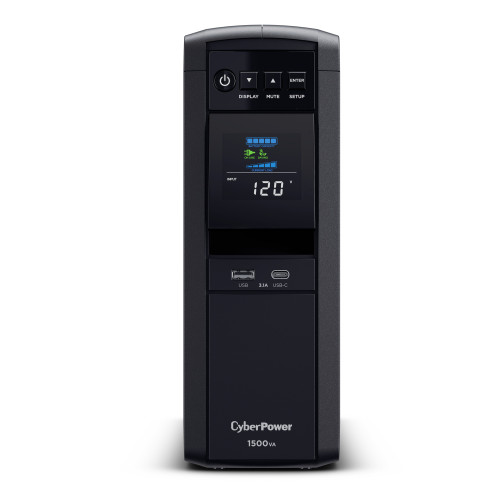
The CP1500PFCLCD ships as a mini-tower (3.9 × 11.0 × 14.0 in, 24.9 lb) with 12 NEMA 5-15R outlets: 6 battery-backed plus surge-protected and 6 surge-only. This layout suits desktop or shelf installations adjacent to workstations or small network closets. The unit also provides two USB charging ports (Type-A + Type-C, 5V/2.4A combined) and RJ45 Ethernet data-line surge protection.
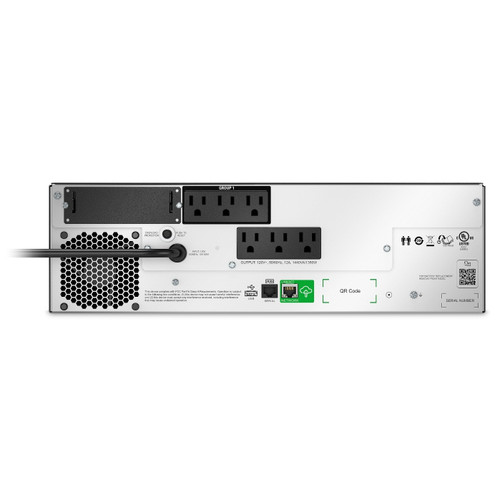
The SMTL1500RM3UCUS is a short-depth 3U rackmount unit (5.14 × 17.25 × 11.89 in, 43 lb) and ships with rack mounting support rails. Its maximum depth of 11.89 in is explicitly designed for shallow rack bays. Outlet count and outlet types are not enumerated in the supplied specifications; buyers must verify receptacle count and layout from APC documentation. Surge energy rating is specified at 680 joules.
The two units target fundamentally different physical environments. The CP1500PFCLCD is a standalone tower for floor or desk use; the SMTL1500RM3UCUS is a rack-integrated appliance. An installer choosing between them should first confirm the rack vs. tower requirement before evaluating any other dimension.
What management interfaces, certifications, and TAA / regulatory compliance distinctions apply to each unit?
The CP1500PFCLCD provides USB and DB9 serial management natively; SNMP/HTTP management requires the optional RMCARD205 accessory card. It carries UL 1778, cUL 107.3, FCC Class B, RoHS, and ENERGY STAR certifications. The 3-year limited warranty includes a $500,000 connected equipment guarantee.
The SMTL1500RM3UCUS offers RJ-45 serial, USB, and a Smart-Slot expansion port natively — the Smart-Slot accepts APC network management cards without an additional SKU purchase for basic NMC capability. Its approvals list includes UL 1778, CSA C22.2 No. 107.3, FCC Part 15 Class A, NOM, UL 1973 (the lithium-ion battery standard), RoHS, and Battery Directive compliance. Critically, the 'UCUS' suffix in the SKU denotes TAA (Trade Agreements Act) compliance, which is a hard procurement requirement for US federal, state, and many institutional contracts. The SMTL1500RM3UCUS is FCC Class A rated; the CP1500PFCLCD is FCC Class B.
TAA compliance and the built-in Smart-Slot are structural differentiators for the SMTL1500RM3UCUS in government and enterprise procurement. The CP1500PFCLCD's ENERGY STAR certification and FCC Class B rating (tighter residential/light-commercial EMI limit) are relevant for mixed-use or LEED-sensitive deployments. Neither unit lists warranty duration for the SMTL1500RM3UCUS in the supplied specifications.
Which should you choose: the CP1500PFCLCD or the SMTL1500RM3UCUS?
Our take: The CP1500PFCLCD is the stronger choice when the installation site requires a tower form factor, ENERGY STAR compliance, USB charging ports, or the lowest upfront acquisition cost for a 1500VA pure-sine-wave UPS. Conversely, the SMTL1500RM3UCUS is the correct selection for rack-mount environments, TAA-required procurement, or sites where battery longevity drives total cost of ownership — its lithium-ion pack carries a 5–10 year expected life versus the SLA chemistry in the CP1500PFCLCD, its Smart-Slot supports network management cards without an add-on SKU, and its 680-joule surge rating and UL 1973 approval address lithium-specific safety standards. The CP1500PFCLCD delivers 12 documented NEMA 5-15R outlets (6 battery-backed) and a $500,000 connected equipment guarantee; equivalent outlet data is absent from the SMTL1500RM3UCUS spec sheet provided. Platform qualifier: federal, state, or institutional buyers with TAA mandates must select the SMTL1500RM3UCUS.
Side-by-Side Comparison
Spec-for-spec, from manufacturer data.
| Specification | CyberPower CP1500PFCLCD | APC by Schneider Electric SMTL1500RM3UCUS |
|---|---|---|
| Product Type | UPS — Line Interactive, Mini-Tower | UPS — Line Interactive, Rackmount (3U) |
| Capacity (VA) | 1500 VA | 1440 VA (1.44 kVA) |
| Capacity (Watts) | 1000 W | 1350 W (1.35 kW) |
| Output Waveform | Pure Sine Wave | Sine Wave |
| Battery Chemistry | Sealed Lead-Acid (2 × 12V/9Ah) | Lithium-Ion |
| Expected Battery Life | Not specified | 5–10 years |
| Battery Recharge Time | Not specified | 2 hours typical |
| Runtime @ 50% Load | 10 min (500W) | Not specified in provided specs |
| Runtime @ 100% Load | 2.5 min (1000W) | Not specified in provided specs |
| Outlets — Total | 12 × NEMA 5-15R | Not specified in provided specs |
| Outlets — Battery Backed | 6 × NEMA 5-15R | Not specified in provided specs |
| Management Interfaces | USB, DB9 Serial; SNMP/HTTP via optional RMCARD205 | USB, RJ-45 Serial, Smart-Slot (NMC-ready) |
| Surge Energy Rating | Not specified | 680 Joules |
| Transfer Time | Not specified | 6ms typical / 10ms maximum |
| Form Factor / Dimensions | Mini-Tower: 3.9 × 11.0 × 14.0 in | 3U Rack: 5.14 × 17.25 × 11.89 in |
| Weight | 24.9 lb | 43 lb |
| TAA Compliance | Not listed | Yes (UCUS SKU designation) |
| FCC Classification | FCC Class B | FCC Part 15 Class A |
| ENERGY STAR | Yes | Not listed |
| Key Certifications | UL 1778, cUL 107.3, FCC Class B, RoHS, ENERGY STAR | UL 1778, UL 1973, CSA C22.2 No. 107.3, FCC Class A, NOM, RoHS |
| Connected Equipment Guarantee | $500,000 | Not specified in provided specs |
| Warranty | 3 Year Limited | Not specified in provided specs |
| USB Charging Ports | 2 (Type-A + Type-C, 5V/2.4A combined) | Not listed |
| Data Line Protection | RJ45 Ethernet (10/100/1000 Mbps) | Not listed |
| Operating Temperature | 32–104°F (0–40°C) | 32–104°F (0–40°C) |
Frequently Asked Questions
Which should you choose: the CP1500PFCLCD or the SMTL1500RM3UCUS?
The CP1500PFCLCD is the stronger choice when the installation site requires a tower form factor, ENERGY STAR compliance, USB charging ports, or the lowest upfront acquisition cost for a 1500VA pure-sine-wave UPS. Conversely, the SMTL1500RM3UCUS is the correct selection for rack-mount environments, TAA-required procurement, or sites where battery longevity drives total cost of ownership — its lithium-ion pack carries a 5–10 year expected life versus the SLA chemistry in the CP1500PFCLCD, its Smart-Slot supports network management cards without an add-on SKU, and its 680-joule surge rating and UL 1973 approval address lithium-specific safety standards. The CP1500PFCLCD delivers 12 documented NEMA 5-15R outlets (6 battery-backed) and a $500,000 connected equipment guarantee; equivalent outlet data is absent from the SMTL1500RM3UCUS spec sheet provided. Platform qualifier: federal, state, or institutional buyers with TAA mandates must select the SMTL1500RM3UCUS.
Which unit is better suited for a government or federal agency purchase?
The SMTL1500RM3UCUS carries TAA (Trade Agreements Act) compliance as indicated by the 'UCUS' suffix in its SKU. The CP1500PFCLCD spec sheet does not list TAA compliance. Federal, state, and many institutional procurement vehicles require TAA-compliant products, making the SMTL1500RM3UCUS the only viable option in those scenarios.
How long will the batteries last before I need to replace them, and which unit costs less to maintain long-term?
The SMTL1500RM3UCUS uses lithium-ion chemistry with an APC-stated expected battery life of 5–10 years and a 2-hour recharge time. The CP1500PFCLCD uses sealed lead-acid batteries (2 × 12V/9Ah); no expected battery life figure is provided in its spec sheet, though SLA batteries in UPS applications commonly require replacement every 3–5 years. Sites with high replacement labour costs or limited maintenance windows may find the lithium-ion pack's longer service interval reduces total cost of ownership despite higher initial price.
Can I manage either unit over the network without buying extra accessories?
The SMTL1500RM3UCUS includes a built-in Smart-Slot expansion port, which accepts APC network management cards directly — basic NMC capability is therefore one card insertion away, with no additional UPS SKU required. The CP1500PFCLCD provides USB and DB9 serial natively but requires purchase and installation of the optional CyberPower RMCARD205 accessory to enable SNMP/HTTP network management. Both units support USB-connected PowerChute or PowerPanel software for local single-host shutdown.
More UPS Comparisons
- APC by Schneider Electric SMX1500RMI2U vs CyberPower PRL1500RT2UC
- APC by Schneider Electric SMX1500RMI2U vs CyberPower BRG1500AVRLCD2
- APC by Schneider Electric SMX1500RMI2U vs CyberPower PR1500LCD
- APC by Schneider Electric SMX1500RMI2U vs APC by Schneider Electric BR1500MS2
- APC by Schneider Electric SMX1500RMI2U vs APC by Schneider Electric SMTL1500RM3UCUS
- CyberPower PRL1500RT2UC vs APC by Schneider Electric BR1500MS2
UPS Buying Guides
Get a Second Opinion on Your Camera Choice
Share your site layout, coverage goals, and budget. Our team will validate the camera selection, flag anything we would change, and recommend products that match the use case.