
CyberPower CP1000PFCLCD vs CyberPower PR1000LCD: Specification Comparison
Both the CyberPower CP1000PFCLCD and PR1000LCD are 1000VA line-interactive pure sine wave UPS units in mini-tower form factors, targeting small-to-midsize installations requiring clean power for sensitive AC-powered equipment. The comparison covers three decision-critical axes for UPS buyers: true power capacity and runtime, outlet configuration and load management, and management interface depth including SNMP capability and connected equipment protection. Both share the same nominal VA rating, but differ meaningfully in watts, battery size, and IT management features.
In This Guide
- Which unit delivers more usable power and runtime for my load?
- How do the outlet counts, surge protection, and load-management features compare?
- Which unit offers deeper IT management, monitoring, and infrastructure integration?
- Which should you choose: the CP1000PFCLCD or the PR1000LCD?
- Side-by-Side Specs
- FAQ
Which unit delivers more usable power and runtime for my load?
Despite identical 1000VA ratings, the two units diverge sharply on true watt capacity. The CP1000PFCLCD is rated at 600W, while the PR1000LCD is rated at 1000W — a 67% difference in usable real power. This matters directly when powering loads with low power factors, such as modern switching power supplies in servers and workstations.
Runtime reflects this gap. At full load, the PR1000LCD runs 3.1 minutes at its full 1000W; the CP1000PFCLCD runs 2 minutes at its full 600W. At half load, the PR1000LCD delivers 10.5 minutes at 500W versus the CP1000PFCLCD's 6 minutes at 300W. The PR1000LCD also carries a significantly larger battery: 2 × 12V/12Ah (24Ah total) versus the CP1000PFCLCD's single 12V/9Ah. The PR1000LCD additionally specifies a 3-hour quick-charge recharge time; no recharge time specification is provided for the CP1000PFCLCD.
The PR1000LCD's wider input voltage range (78–149 VAC) versus the CP1000PFCLCD's (88–144 VAC) also provides greater tolerance for utility sag and swell before the unit transfers to battery — relevant in electrically noisy environments.
How do the outlet counts, surge protection, and load-management features compare?
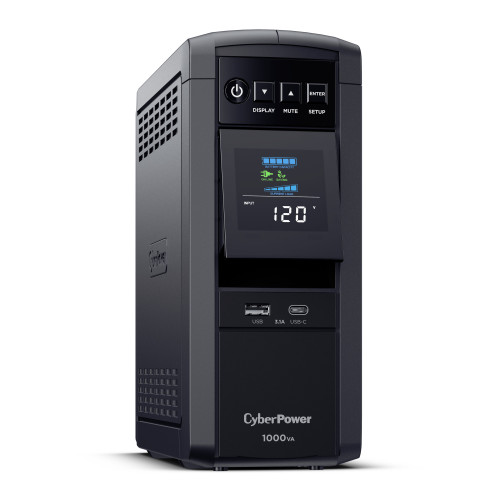
The CP1000PFCLCD provides 10 NEMA 5-15R outlets: 5 with battery backup and surge protection, and 5 with surge protection only. This higher outlet count suits desktop or small-office environments with multiple peripheral devices needing surge coverage but not necessarily battery runtime.
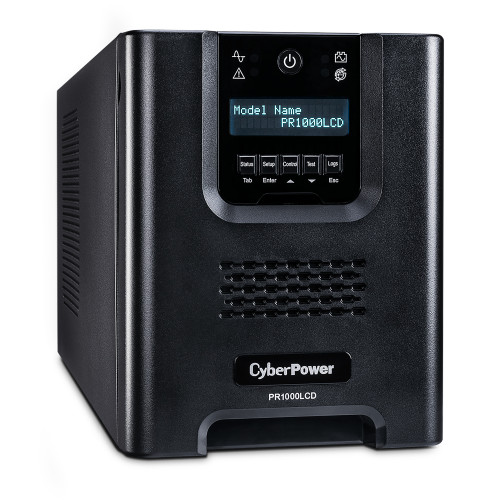
The PR1000LCD offers 8 NEMA 5-15R outlets, all of which are battery-backed and surge-protected. Notably, the PR1000LCD designates 4 of these as 'critical load priority' outlets — a segmentation feature not present on the CP1000PFCLCD. This allows administrators to shed non-critical loads during an outage to extend runtime for priority equipment.
Surge energy absorption is nearly identical: 1020 joules for the CP1000PFCLCD and 1030 joules for the PR1000LCD. The CP1000PFCLCD adds RJ45 Ethernet (1-in/1-out) network line protection; no equivalent network port protection is specified for the PR1000LCD. The CP1000PFCLCD also includes integrated USB Type-A and Type-C charging ports; these are not listed in the PR1000LCD specifications.
The CP1000PFCLCD specifies a GreenPower Bypass high-efficiency mode drawing under 10W idle; no equivalent efficiency mode specification is provided for the PR1000LCD.
Which unit offers deeper IT management, monitoring, and infrastructure integration?
Both units provide USB (HID) and serial connectivity, multifunction LCD displays, and PowerPanel management software. The PR1000LCD, however, adds native SNMP connectivity — enabling integration with network management systems (NMS), datacenter infrastructure management (DCIM) platforms, and remote monitoring tools over the network. The CP1000PFCLCD does not list SNMP as a supported interface.
The PR1000LCD's LCD panel is notably remote-mountable via a 4.5-foot removable cable, allowing display placement on a rack front panel separate from the unit itself. The CP1000PFCLCD features an integrated color LCD on the unit body. The PR1000LCD specifies PowerPanel Business Edition software, which supports more advanced monitoring and scheduling features than the standard PowerPanel edition listed for the CP1000PFCLCD.
FCC emissions class also differs: the PR1000LCD is certified Class A (commercial/industrial environments), while the CP1000PFCLCD is FCC Class B (residential and light commercial). The PR1000LCD is built with metal construction; no chassis material specification is stated for the CP1000PFCLCD.
The connected equipment guarantee diverges: the CP1000PFCLCD carries a $500,000 connected equipment policy, while the PR1000LCD's guarantee is $375,000 — a meaningful difference for high-value connected hardware.
Which should you choose: the CP1000PFCLCD or the PR1000LCD?
Our take: The CP1000PFCLCD is the stronger choice when protecting a larger number of peripherals on a tighter real-power budget in a residential or light-commercial setting, while the PR1000LCD is the stronger choice for IT infrastructure deployments requiring full watt-for-watt capacity, SNMP network management, and priority load segmentation. Concretely: the PR1000LCD delivers 1000W true power versus the CP1000PFCLCD's 600W — a 67% capacity advantage — and carries 24Ah of battery versus 9Ah, yielding 10.5 minutes at half load versus 6 minutes. The PR1000LCD adds SNMP integration and PowerPanel Business Edition software absent from the CP1000PFCLCD. Conversely, the CP1000PFCLCD offers 10 outlets (5 surge-only) versus 8, includes RJ45 network port protection and USB charging ports not listed on the PR1000LCD, and carries a higher $500,000 equipment guarantee. Buyers powering servers or network gear needing full-wattage protection and NMS integration should select the PR1000LCD; buyers needing a higher outlet count for desktop peripherals with light IT management requirements should consider the CP1000PFCLCD.
Side-by-Side Comparison
Spec-for-spec, from manufacturer data.
| Specification | CyberPower CP1000PFCLCD | CyberPower PR1000LCD |
|---|---|---|
| Capacity (VA) | 1000 VA | 1000 VA |
| Capacity (Watts) | 600 W | 1000 W |
| Topology | Line Interactive with AVR | Line Interactive with AVR |
| Output Waveform | Pure Sine Wave | Pure Sine Wave |
| Input Voltage Range | 88–144 VAC | 78–149 VAC |
| Transfer Time | 4 ms | 4 ms typical |
| Outlets (Total) | 10 × NEMA 5-15R | 8 × NEMA 5-15R |
| Battery-Backed Outlets | 5 | 8 (4 critical load priority) |
| Surge-Only Outlets | 5 | 0 |
| Surge Protection | 1020 J | 1030 J |
| Battery | 1 × 12V/9Ah (user replaceable) | 2 × 12V/12Ah (user replaceable) |
| Runtime at Half Load | 6 min at 300W | 10.5 min at 500W |
| Runtime at Full Load | 2 min at 600W | 3.1 min at 1000W |
| Management Interfaces | USB, Serial | USB, Serial, SNMP |
| LCD Display | Integrated color LCD | Removable LCD (4.5 ft cable) |
| Network Port Protection | RJ45 (1 in / 1 out) | — |
| USB Charging Ports | Type-A and Type-C | — |
| FCC Class | Class B | Class A |
| Connected Equipment Guarantee | $500,000 | $375,000 |
| Management Software | PowerPanel (Win/macOS/Linux) | PowerPanel Business Edition |
| Certifications | UL1778, cUL 107.3, FCC Class B, RoHS, ENERGY STAR | UL1778, cUL 107.3, FCC Class A, RoHS, Energy Star |
| Weight | 15.39 lb | 44 lb |
| Dimensions (W×H×D) | 3.94 × 9.7 × 10.24 in | 6.7 × 8.7 × 17 in |
| Warranty | 3 Year Limited | 3 Year Limited |
Frequently Asked Questions
Which should you choose: the CP1000PFCLCD or the PR1000LCD?
The CP1000PFCLCD is the stronger choice when protecting a larger number of peripherals on a tighter real-power budget in a residential or light-commercial setting, while the PR1000LCD is the stronger choice for IT infrastructure deployments requiring full watt-for-watt capacity, SNMP network management, and priority load segmentation. Concretely: the PR1000LCD delivers 1000W true power versus the CP1000PFCLCD's 600W — a 67% capacity advantage — and carries 24Ah of battery versus 9Ah, yielding 10.5 minutes at half load versus 6 minutes. The PR1000LCD adds SNMP integration and PowerPanel Business Edition software absent from the CP1000PFCLCD. Conversely, the CP1000PFCLCD offers 10 outlets (5 surge-only) versus 8, includes RJ45 network port protection and USB charging ports not listed on the PR1000LCD, and carries a higher $500,000 equipment guarantee. Buyers powering servers or network gear needing full-wattage protection and NMS integration should select the PR1000LCD; buyers needing a higher outlet count for desktop peripherals with light IT management requirements should consider the CP1000PFCLCD.
Can either UPS handle a full 1000W server load?
Only the PR1000LCD is rated for 1000W true power output and can sustain a full 1000W load. The CP1000PFCLCD is rated at 600W despite its 1000VA rating; connecting a 1000W load to the CP1000PFCLCD would exceed its watt capacity and trigger an overload condition.
Which unit integrates with a network management system or DCIM platform?
The PR1000LCD lists SNMP as a supported connectivity option, enabling integration with NMS and DCIM platforms over the network. SNMP is not listed in the CP1000PFCLCD specifications; it supports USB and serial interfaces only.
Is the CP1000PFCLCD or PR1000LCD better for a mixed desktop environment with many peripherals?
The CP1000PFCLCD provides 10 NEMA 5-15R outlets (5 battery-backed, 5 surge-only) versus the PR1000LCD's 8 outlets (all battery-backed). For environments needing to protect a larger number of peripherals — some requiring only surge coverage — the CP1000PFCLCD's higher outlet count and dedicated surge-only bank offer more flexibility, provided total load stays within its 600W capacity.
More UPS Comparisons
- CyberPower PR1000RTXL2UC vs APC by Schneider Electric SURT1000RMXLI
- CyberPower PR1000RTXL2UC vs APC by Schneider Electric SMT1000CUS
- CyberPower PR1000RTXL2UC vs Vertiv GXT5-1000LVRT2UXL
- CyberPower PR1000RTXL2UC vs APC by Schneider Electric SMT1000J
- CyberPower PR1000RTXL2UC vs CyberPower CP1000PFCLCD
- CyberPower PR1000RTXL2UC vs CyberPower PR1000LCD
UPS Buying Guides
Get a Second Opinion on Your Camera Choice
Share your site layout, coverage goals, and budget. Our team will validate the camera selection, flag anything we would change, and recommend products that match the use case.