
Comnet CNGE26FX2TX24MSPOE2 vs Comnet CWG26F4T22M: Specification Comparison
Both the Comnet CNGE26FX2TX24MSPOE2 and CWG26F4T22M are 26-port Gigabit managed Ethernet switches sharing an identical physical footprint and core switching architecture—52 Gbps backplane, 8000-entry MAC table, 9.6K jumbo frames, and a 1-RU 19-inch rack chassis. The critical divergence is deployment class: the CNGE26FX2TX24MSPOE2 is a hardened industrial unit with PoE+ budget of 720 W, while the CWG26F4T22M is a commercial-grade, non-PoE switch rated for standard indoor environments. Buyers are essentially choosing between powered-device support and environmental hardening versus a leaner, TAA-compliant commercial alternative.
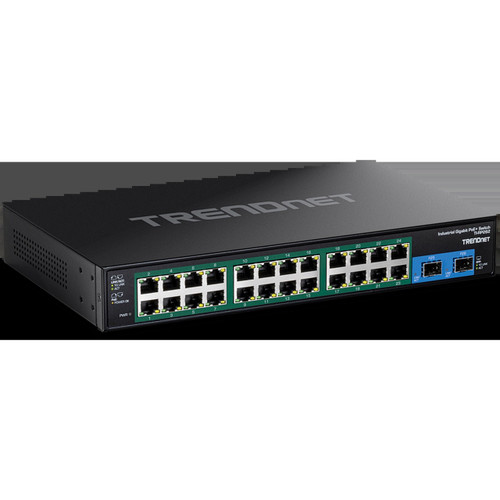
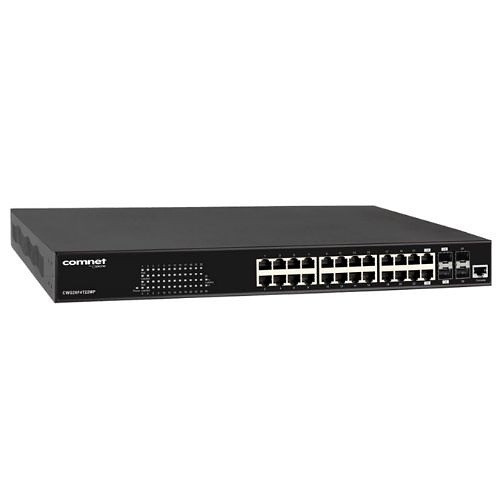
In This Guide
- Which switch can power connected devices, and what is the total PoE budget?
- Which switch tolerates harsher operating environments and non-standard power sources?
- Which switch offers more advanced VLAN segmentation, redundancy protocols, and management depth?
- Which should you choose: the CNGE26FX2TX24MSPOE2 or the CWG26F4T22M?
- Side-by-Side Specs
- FAQ
Which switch can power connected devices, and what is the total PoE budget?
The CNGE26FX2TX24MSPOE2 supports IEEE 802.3at (PoE+) with up to 30 W per port and a total PoE budget of 720 W across its 24 PoE-capable ports—sufficient to simultaneously power cameras, access controllers, and wireless APs without an external injector or midspan.
The CWG26F4T22M provides no PoE capability on any port. All connected devices requiring DC power over Ethernet must be served by separate injectors or PSEs. The spec sheet lists no PoE standard, no per-port wattage, and no PoE power budget.
For installers deploying IP cameras, intercoms, or readers that draw power from the switch, the CNGE26FX2TX24MSPOE2 is the only viable option of the two. The CWG26F4T22M is solely a data-switching device.
Which switch tolerates harsher operating environments and non-standard power sources?
The CNGE26FX2TX24MSPOE2 is rated for -20 °C to +60 °C operating and -40 °C to +85 °C storage, with humidity tolerance of 5–95% non-condensing. It is powered by 50–57 VDC—a range common in telecom and industrial DC bus systems—and carries IEC 60068-2-27/32/6 certifications for shock, free fall, and vibration, plus the full EN 61000-4-x suite for ESD, radiated susceptibility, EFT, surge, conducted susceptibility, and AC mains disturbance.
The CWG26F4T22M is rated for 0 °C to +50 °C operating and -20 °C to +80 °C storage, with humidity of 10–90% non-condensing. It accepts standard 100–240 VAC, 50–60 Hz input, making it compatible with any commercial outlet or UPS without a DC converter. Its EMC coverage includes EN 61000-4-2 through -4-11 (ESD, RS, EFT, surge, CS, magnetic field, voltage dips) and the same IEC 60068-2-27/32/6 mechanical ratings.
The CNGE26FX2TX24MSPOE2 outperforms on both temperature floor (-20 °C vs. 0 °C) and ceiling (+60 °C vs. +50 °C), making it the correct choice for outdoor enclosures, transportation cabinets, or unheated utility rooms. The CWG26F4T22M's universal AC input is more convenient for standard data-center or office IDF deployments with existing AC power.
Which switch offers more advanced VLAN segmentation, redundancy protocols, and management depth?
The CWG26F4T22M supports up to 4,000 VLANs—a significant advantage over the CNGE26FX2TX24MSPOE2's 256-VLAN limit—and adds L3 static routing, LACP link aggregation, static trunk, and 8 priority queues per port. It also declares TAA compliance, which is a procurement requirement for U.S. federal and government-funded projects.
The CNGE26FX2TX24MSPOE2 supports 256 VLANs and adds Comnet's proprietary C-Ring redundancy, ERPS (ITU-T G.8032), and RSTP/STP/MSTP—three ring-protection mechanisms versus the CWG26F4T22M's RSTP/STP/MSTP only. Management is exposed via SNMP V1/V2c/V3, RMON, web GUI, Telnet, and CLI, with security hardened by 802.1x port authentication, ACLs, device binding, HTTPS, and SSH. The CWG26F4T22M's management depth is not detailed in the provided specifications.
For ring topologies requiring sub-50ms failover—typical in industrial Ethernet and transportation systems—the CNGE26FX2TX24MSPOE2's C-Ring and ERPS are decisive. For large campus or enterprise segmentation requiring thousands of VLANs, L3 routing, or TAA compliance, the CWG26F4T22M has the edge.
Which should you choose: the CNGE26FX2TX24MSPOE2 or the CWG26F4T22M?
Our take: The CNGE26FX2TX24MSPOE2 is the stronger choice when the installation requires powered edge devices, sub-zero or high-heat environments, or industrial ring redundancy. It delivers 720 W of IEEE 802.3at PoE budget (versus zero on the CWG26F4T22M), operates down to -20 °C versus the CWG26F4T22M's 0 °C floor, and adds C-Ring plus ERPS ring recovery on top of shared RSTP/STP/MSTP—critical for continuous uptime in loop topologies. The CWG26F4T22M counters with 4,000 VLANs (versus 256), L3 static routing, LACP aggregation, TAA compliance, and universal 100–240 VAC input—making it the correct pick for commercial IDF closets, government procurement, or high-segmentation campus networks where PoE and DC power buses are not factors. Both share identical backplane speed, MAC table size, jumbo frame support, and chassis dimensions.
Side-by-Side Comparison
Spec-for-spec, from manufacturer data.
| Specification | Comnet CNGE26FX2TX24MSPOE2 | Comnet CWG26F4T22M |
|---|---|---|
| Total Ports | 26 | 26 |
| RJ-45 Copper Ports | 22 x 10/100/1000BASE-T(x) | 22 x RJ-45 10/100/1000 |
| Combo Ports | 2 x Gigabit Combo RJ-45/SFP | 2 x Combo RJ-45/SFP |
| SFP Uplink Ports | 2 x 100/1000BASE-Fx SFP | 2 x SFP |
| PoE Standard | IEEE 802.3at (PoE+) | — |
| PoE Per Port | Up to 30 W | — |
| Total PoE Budget | 720 W | — |
| Switching Bandwidth | 52 Gbps | 52 Gbps |
| Switching Latency | 7 μs | 7 μs |
| MAC Table Size | 8,000 | 8,000 |
| VLANs Supported | 256 | 4,000 |
| Jumbo Frame Support | Up to 9.6K Bytes | Up to 9.6K Bytes |
| L3 Static Routing | — | Yes |
| Link Aggregation | — | LACP, Static Trunk |
| Redundancy Protocols | C-Ring, ERPS (G.8032), RSTP/STP/MSTP | RSTP/STP/MSTP |
| Operating Temperature | -20 °C to +60 °C | 0 °C to +50 °C |
| Storage Temperature | -40 °C to +85 °C | -20 °C to +80 °C |
| Humidity (Operating) | 5–95% non-condensing | 10–90% non-condensing |
| Power Input | 50–57 VDC | 100–240 VAC, 50–60 Hz |
| Power Consumption (no PoE) | 36 W | 25 W max |
| Enclosure | 1-RU 19-inch rack | 1-RU 19-inch rack |
| Dimensions | 13.46 x 16.97 x 1.73 in | 13.46 x 16.97 x 1.73 in |
| Weight | <13 lbs / 6 kg | 13.1 lbs / 5.9 kg |
| MTBF | >100,000 hours | — |
| TAA Compliance | — | Yes |
| Security Features | 802.1x, ACL, Device Binding, HTTPS/SSH | — |
Frequently Asked Questions
Which should you choose: the CNGE26FX2TX24MSPOE2 or the CWG26F4T22M?
The CNGE26FX2TX24MSPOE2 is the stronger choice when the installation requires powered edge devices, sub-zero or high-heat environments, or industrial ring redundancy. It delivers 720 W of IEEE 802.3at PoE budget (versus zero on the CWG26F4T22M), operates down to -20 °C versus the CWG26F4T22M's 0 °C floor, and adds C-Ring plus ERPS ring recovery on top of shared RSTP/STP/MSTP—critical for continuous uptime in loop topologies. The CWG26F4T22M counters with 4,000 VLANs (versus 256), L3 static routing, LACP aggregation, TAA compliance, and universal 100–240 VAC input—making it the correct pick for commercial IDF closets, government procurement, or high-segmentation campus networks where PoE and DC power buses are not factors. Both share identical backplane speed, MAC table size, jumbo frame support, and chassis dimensions.
Can the CWG26F4T22M power IP cameras or access control readers directly?
No. The CWG26F4T22M has no PoE capability—no PoE standard, per-port wattage, or total power budget is listed in its specifications. Powering IP cameras or readers directly from this switch would require separate PoE injectors or midspan devices. The CNGE26FX2TX24MSPOE2 supports IEEE 802.3at with up to 30 W per port and 720 W total budget, making it the appropriate choice for powered-device deployments.
Which switch is better suited for outdoor or unconditioned-space enclosures?
The CNGE26FX2TX24MSPOE2 is rated for -20 °C to +60 °C operating temperature versus the CWG26F4T22M's 0 °C to +50 °C. The 20-degree wider cold tolerance and 10-degree higher heat ceiling make the CNGE26FX2TX24MSPOE2 the correct choice for outdoor cabinets, unheated plant rooms, or transportation environments. The CWG26F4T22M is designed for conditioned commercial spaces.
Does either switch qualify for U.S. federal or government-funded projects requiring TAA compliance?
Only the CWG26F4T22M is listed as TAA Compliant in the provided specifications. No TAA compliance claim appears in the CNGE26FX2TX24MSPOE2 specification sheet as provided. Buyers with federal procurement requirements should verify current TAA status directly with Comnet, but based on available specs, the CWG26F4T22M is the declared-compliant option.
More Network Switch Comparisons
- TP-Link SX6632YF vs Comnet CWG26F4T22M
- TP-Link SX6632YF vs Comnet CWGE26FX2TX24MSPOE
- TP-Link SX6632YF vs Comnet CNGE26FX2TX24MSPOE2
- Comnet CWG26F4T22MP vs Comnet CWG26F4T22M
- Comnet CWG26F4T22MP vs Comnet CWGE26FX2TX24MSPOE
- Comnet CWG26F4T22M vs Comnet CWGE26FX2TX24MSPOE
Network Switch Buying Guides
Get a Second Opinion on Your Camera Choice
Share your site layout, coverage goals, and budget. Our team will validate the camera selection, flag anything we would change, and recommend products that match the use case.