
Axis D8004 vs Altronix NETWAY4EWPX: Specification Comparison
Both the Axis D8004 and the Altronix NETWAY4EWPX are 4-port PoE+ gigabit switches aimed at IP security camera deployments. The D8004 is a compact, unmanaged indoor unit designed for simple plug-and-play installations, while the NETWAY4EWPX is a managed Layer 2+ switch built into a hardened outdoor enclosure with fiber uplink and integrated battery charging. Buyers cross-shopping these units are typically weighing simplicity and form factor against environmental resilience, PoE budget, and advanced network management for edge or perimeter deployments.

In This Guide
- How do the PoE port count, power budget, and uplink options compare?
- Which switch is rated for outdoor or harsh-environment installation, and what are the physical and power specs?
- What network management and platform integration features does each switch offer?
- Which should you choose: the D8004 or the NETWAY4EWPX?
- Side-by-Side Specs
- FAQ
How do the PoE port count, power budget, and uplink options compare?
Both switches provide four PoE/PoE+ (802.3af/at) downlink ports and one gigabit uplink, but they diverge sharply on power budget and uplink medium. The Axis D8004 delivers a maximum combined PoE output of 60W across all four ports, with the uplink provided via a copper RJ45 10BASE-T/100BASE-TX interface. The Altronix NETWAY4EWPX provides a 120W total PoE budget—double that of the D8004—including dual 60W Hi-PoE capable ports, making it suitable for power-hungry PTZ cameras or multi-sensor units. The NETWAY4EWPX's gigabit uplink is an SFP fiber port (transceiver sold separately), enabling electrical isolation and long-distance fiber runs, whereas the D8004's copper uplink is limited to standard Ethernet distance constraints. For deployments requiring more than 15W per port or distances beyond copper limits, the NETWAY4EWPX has a decisive advantage on this dimension.
Which switch is rated for outdoor or harsh-environment installation, and what are the physical and power specs?
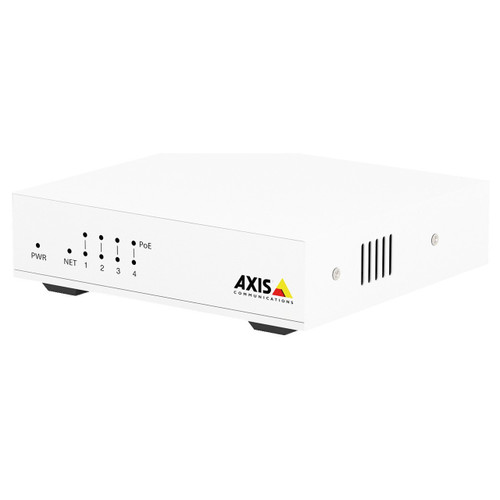
The Axis D8004 is rated for indoor use only, with an operating temperature range of 0°C to 50°C and humidity tolerance of 5–95% RH non-condensing. Its metal white enclosure measures 90 × 80 × 21 mm and weighs 172 g, making it highly compact for inside-cabinet or ceiling-mount use. It accepts 100–240V AC, 50–60 Hz input directly, drawing up to 62.4W total.
The Altronix NETWAY4EWPX is rated for outdoor installation, carrying NEMA 4/4X and IP66 certifications, which protect against water jets and windblown rain. Its storage temperature range extends from –40°C to 85°C. The enclosure is substantially larger at 17.53" × 15.3" × 6.67" and supports wall, pole, and rack mounting. Critically, it integrates a battery charger supporting Altronix backup modules, adding power continuity capability absent from the D8004. The D8004's approvals include CE, FCC Part 15 Class B, RoHS, and WEEE; the NETWAY4EWPX's listed approvals are IP66 and NEMA 4/4X—regulatory certifications (FCC, CE) are not stated in the provided specs for the NETWAY4EWPX.
What network management and platform integration features does each switch offer?
The Axis D8004 is fully unmanaged—no CLI, no SNMP, no VLAN, no QoS configuration is available or required. This is by design: the unit is intended for zero-configuration deployments where an installer plugs in power and an uplink and walks away. It carries no supervision or remote monitoring capability per the provided specifications.
The Altronix NETWAY4EWPX is a Layer 2+ managed switch supporting VLAN segmentation, QoS prioritization, and Spanning Tree Protocol. It also includes Altronix LINQ supervision, which enables remote monitoring and management through the Altronix ecosystem. These features are critical for larger or segmented security networks where traffic isolation, camera prioritization, and fault detection matter. For a network administrator who needs visibility into switch health or must enforce network segmentation between cameras and corporate infrastructure, the NETWAY4EWPX provides capabilities the D8004 fundamentally cannot match.
Which should you choose: the D8004 or the NETWAY4EWPX?
Our take: The D8004 is the stronger choice when the installation is indoors, the camera load fits within 60W total PoE, and zero-configuration simplicity is the priority. The NETWAY4EWPX is the appropriate selection for every other scenario examined here. Three concrete spec deltas illustrate the gap: PoE budget is 120W vs. 60W, giving the Altronix twice the headroom for high-power PTZ or multi-sensor devices; the NETWAY4EWPX carries NEMA 4/4X and IP66 ratings for outdoor deployment whereas the D8004 is indoor-only; and the NETWAY4EWPX adds Layer 2+ management with VLAN, QoS, Spanning Tree, and LINQ supervision versus the D8004's unmanaged design. The D8004 suits small, sheltered indoor camera clusters on Axis or mixed platforms where simplicity is valued and budget is limited. The NETWAY4EWPX suits perimeter and outdoor edge deployments, fiber-extended runs, and installations requiring network segmentation, power redundancy via battery backup, or centralized supervision.
Side-by-Side Comparison
Spec-for-spec, from manufacturer data.
| Specification | Axis D8004 | Altronix NETWAY4EWPX |
|---|---|---|
| PoE Standard | PoE/PoE+ (802.3af/at) | PoE/PoE+ (802.3af/at) |
| PoE Downlink Ports | 4 | 4 |
| Uplink Port | 1× RJ45 Gigabit (copper) | 1× SFP Gigabit (fiber; transceiver not included) |
| Total PoE Budget | 60W | 120W |
| Hi-PoE / Per-Port Max | 30W (802.3at) | Dual 60W Hi-PoE capable |
| Switch Management | Unmanaged | Layer 2+ Managed (VLAN, QoS, Spanning Tree) |
| Supervision | — | Altronix LINQ |
| Environment Rating | Indoor | Outdoor |
| Enclosure Rating | — | NEMA 4/4X, IP66 |
| Operating Temperature | 0°C to 50°C | — |
| Storage Temperature | –10°C to 50°C | –40°C to 85°C |
| Battery Backup | — | Integrated charger; supports Altronix backup modules |
| Dimensions | 90 × 80 × 21 mm (3.54" × 3.15" × 0.83") | 17.53" × 15.3" × 6.67" |
| Weight | 172 g (0.38 lb) | Not specified |
| Input Power | 100–240V AC, 50–60 Hz | Not specified |
| Certifications / Approvals | CE, FCC Part 15 Class B, RoHS, WEEE | IP66, NEMA 4/4X |
| Warranty | 3 years | Lifetime |
| Mount Options | — | Wall, Pole, Rack |
Frequently Asked Questions
Which should you choose: the D8004 or the NETWAY4EWPX?
The D8004 is the stronger choice when the installation is indoors, the camera load fits within 60W total PoE, and zero-configuration simplicity is the priority. The NETWAY4EWPX is the appropriate selection for every other scenario examined here. Three concrete spec deltas illustrate the gap: PoE budget is 120W vs. 60W, giving the Altronix twice the headroom for high-power PTZ or multi-sensor devices; the NETWAY4EWPX carries NEMA 4/4X and IP66 ratings for outdoor deployment whereas the D8004 is indoor-only; and the NETWAY4EWPX adds Layer 2+ management with VLAN, QoS, Spanning Tree, and LINQ supervision versus the D8004's unmanaged design. The D8004 suits small, sheltered indoor camera clusters on Axis or mixed platforms where simplicity is valued and budget is limited. The NETWAY4EWPX suits perimeter and outdoor edge deployments, fiber-extended runs, and installations requiring network segmentation, power redundancy via battery backup, or centralized supervision.
Can either switch power a PTZ camera that requires more than 30W?
The Altronix NETWAY4EWPX specifies dual 60W Hi-PoE capable ports, making it suitable for high-power PTZ cameras that exceed standard PoE+ (30W). The Axis D8004 is rated for PoE/PoE+ (802.3af/at) with a maximum combined budget of 60W across all four ports; its per-port maximum under 802.3at is 30W. If a single PTZ camera requires more than 30W, the D8004 cannot supply it.
Is the D8004 or NETWAY4EWPX suitable for mounting on an exterior wall or pole?
Only the Altronix NETWAY4EWPX is rated for outdoor installation. It carries NEMA 4/4X and IP66 certifications and supports wall, pole, and rack mounting per its specifications. The Axis D8004 is rated for indoor use only with no weatherproof enclosure rating stated; installing it in an exposed outdoor location would be outside its specified operating environment.
Does either switch support battery backup in the event of a power outage?
Yes, the Altronix NETWAY4EWPX includes an integrated battery charger that supports Altronix backup modules, providing power continuity capability. The Axis D8004 has no battery backup or integrated charging capability specified; it requires a continuous 100–240V AC supply and would lose operation during a power outage unless an external UPS is installed upstream.
More Network Switch Comparisons
- Vivotek GET-083A-120 vs TP-Link SG1005P
- Vivotek GET-083A-120 vs Axis T8504-E
- Vivotek GET-083A-120 vs Axis D8004
- Vivotek GET-083A-120 vs Ubiquiti N-SW
- TP-Link SG1005P vs Axis T8504-E
- TP-Link SG1005P vs Axis D8004
Network Switch Buying Guides
Get a Second Opinion on Your Camera Choice
Share your site layout, coverage goals, and budget. Our team will validate the camera selection, flag anything we would change, and recommend products that match the use case.