
APC by Schneider Electric SURT1000RMXLI vs APC by Schneider Electric SMT1000CUS: Specification Comparison
Both the SURT1000RMXLI and SMT1000CUS are APC Smart-UPS 1000VA uninterruptible power supplies rated at 1000 VA / 700 W, placing them in the same capacity class. However, they differ significantly in UPS topology, input voltage, form factor, and target market. The SURT1000RMXLI is a 230 V rack-mount double-conversion online unit aimed at international data centre and rack deployments, while the SMT1000CUS is a 120 V tower line-interactive unit for North American office or light IT environments. This comparison focuses on topology, power environment, and physical integration.
In This Guide
- Which UPS topology delivers cleaner, more reliable power output?
- Which unit fits your regional power infrastructure and installation environment?
- Which unit offers better runtime extensibility, connectivity, and management options?
- Which should you choose: the SURT1000RMXLI or the SMT1000CUS?
- Side-by-Side Specs
- FAQ
Which UPS topology delivers cleaner, more reliable power output?
The SURT1000RMXLI uses double-conversion online topology, meaning the load is continuously powered from the inverter rather than from mains. This delivers a pure sine wave output with harmonic distortion of less than 3 % and a crest factor of 3:1, with zero transfer time to battery. APC specifies IEEE surge let-through as zero and a clamping response time that meets UL 1449. Full-time multi-pole noise filtering and 420 J of surge energy absorption are also listed.
The SMT1000CUS uses line-interactive topology, which means the inverter only engages during a power event. It also produces a sine wave output and synchronises output frequency to mains (50/60 Hz ±3 Hz). Surge energy absorption rating and IEEE let-through figures are not provided in the supplied specifications for this model. Line-interactive topology does introduce a finite transfer time to battery, though APC does not quantify it in the provided specs.
For loads that are sensitive to power quality variations — such as servers, storage arrays, or precision instruments — the double-conversion design of the SURT1000RMXLI eliminates mains-borne noise and transients continuously. The SMT1000CUS provides adequate protection for office IT loads but cannot match the continuous isolation from mains disturbances.
Which unit fits your regional power infrastructure and installation environment?
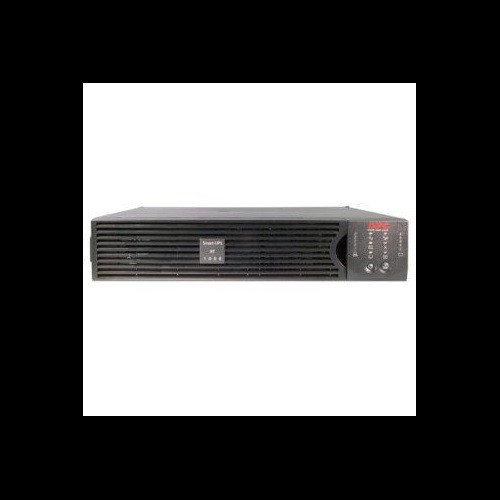
The SURT1000RMXLI is designed for 230 V single-phase environments (accepting 220 V and 240 V as well), with an input voltage range of 160–280 V and an IEC 60320 C14 inlet. It carries certifications for C-Tick, CE, GOST, VDE, UK PSTI and complies with EN/IEC 62040-1:2019/A11:2021 and EN/IEC 62040-2. It is a 2U rack-mount chassis measuring 8.5 cm H × 43.2 cm W × 48.3 cm D and weighing 23 kg, suitable for standard 19-inch equipment racks.
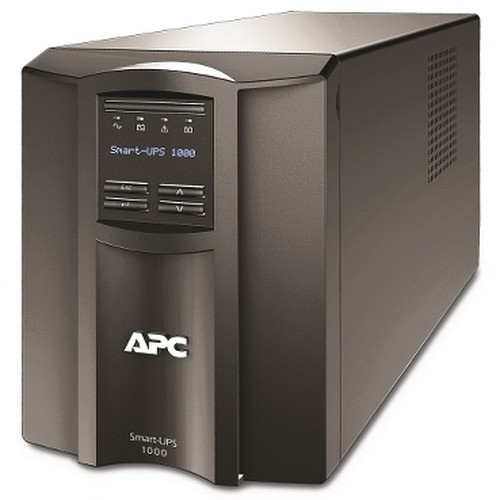
The SMT1000CUS is designed exclusively for 120 V AC North American single-phase environments, accepting 110 V and 125 V as well, with a NEMA 5-15P input plug and eight NEMA 5-15R output receptacles. It is rated 0U and is tower-mounted, with a height of 219 mm and a weight of 20.1 kg. Certifications include cULus, ENERGY STAR V2.0 (USA), and TAA compliance.
These two units cannot be used interchangeably: the SURT1000RMXLI requires 230 V infrastructure and rack space, while the SMT1000CUS requires 120 V North American outlets and floor or shelf space. Buyers must select based on their regional voltage standard and physical installation constraints before any other comparison is relevant.
Which unit offers better runtime extensibility, connectivity, and management options?
The SURT1000RMXLI specifies a battery recharge time of 3 hours, a battery charger power of 109 W rated, and a projected battery life of 3–5 years. It has 1 free expansion slot and supports the IEC 60320 output connection standard (6 IEC 60320 outlets plus 2 IEC jumpers). No connectivity interfaces (USB, serial, network) are listed in the provided specifications. Operating temperature range is 0–40 °C, operating relative humidity is 0–95 % non-condensing, and acoustic level is specified at 50 dBA.
The SMT1000CUS specifies a battery charger power of 99 W rated and names the replacement battery as RBC6. Runtime and efficiency figures are not quantified in the provided specs (listed as 'View Runtime Graph' and 'View Efficiency Graph'). Connectivity includes a serial port, USB port, SmartConnect port, and one available expansion slot. Operating relative humidity is 0–95 %; no operating temperature range or acoustic level is provided in the supplied specs. Included software is noted.
The SMT1000CUS has a documented advantage in connectivity, listing four interface options (serial, USB, SmartConnect, expansion slot) versus the SURT1000RMXLI for which no connectivity interfaces are listed in the provided specs. The SURT1000RMXLI's 109 W charger exceeds the SMT1000CUS's 99 W charger, which may support faster recovery after a discharge event, though runtime data for neither unit is quantified in the provided specs.
Which should you choose: the SURT1000RMXLI or the SMT1000CUS?
Our take: The SURT1000RMXLI is the stronger choice when continuous power quality, 230 V rack infrastructure, and zero transfer time are required. Its double-conversion online topology isolates the load from mains at all times, delivering less than 3 % harmonic distortion and IEEE surge let-through of zero — standards the line-interactive SMT1000CUS does not match. Its 109 W battery charger exceeds the SMT1000CUS's 99 W rating, and it fits a standard 2U rack slot. Conversely, the SMT1000CUS is the correct choice for North American 120 V environments: it cannot operate on 230 V mains, and its NEMA 5-15R outlets are incompatible with IEC-equipped rack gear. The SMT1000CUS also lists documented management interfaces (USB, serial, SmartConnect) that are absent from the SURT1000RMXLI's provided specs. These two units serve different regional markets and installation form factors and should be selected accordingly rather than cross-shopped on performance alone.
Side-by-Side Comparison
Spec-for-spec, from manufacturer data.
| Specification | APC by Schneider Electric SURT1000RMXLI | APC by Schneider Electric SMT1000CUS |
|---|---|---|
| UPS Topology | Double-conversion online | Line-interactive |
| Rated Power (VA) | 1000 VA | 1000 VA |
| Rated Power (W) | 700 W | 700 W |
| Main Input Voltage | 230 V | 120 V AC |
| Input Voltage Range | 160–280 V | 75–154 V adjustable |
| Input Connection | IEC 60320 C14 | NEMA 5-15P |
| Output Connection | 6× IEC 60320 + 2× IEC Jumpers | 8× NEMA 5-15R |
| Output Waveform | Sine wave | Sine wave |
| Harmonic Distortion | < 3 % | — |
| IEEE Surge Let-through | Zero | — |
| Surge Energy Absorption | 420 J | — |
| Mounting / Form Factor | Rack-mount, 2U | Tower, 0U |
| Dimensions (H × W × D) | 8.5 cm × 43.2 cm × 48.3 cm | 219 mm (height only listed) |
| Weight | 23 kg | 20.1 kg |
| Battery Charger Power | 109 W rated | 99 W rated |
| Connectivity | — | Serial, USB, SmartConnect, expansion slot |
Frequently Asked Questions
Which should you choose: the SURT1000RMXLI or the SMT1000CUS?
The SURT1000RMXLI is the stronger choice when continuous power quality, 230 V rack infrastructure, and zero transfer time are required. Its double-conversion online topology isolates the load from mains at all times, delivering less than 3 % harmonic distortion and IEEE surge let-through of zero — standards the line-interactive SMT1000CUS does not match. Its 109 W battery charger exceeds the SMT1000CUS's 99 W rating, and it fits a standard 2U rack slot. Conversely, the SMT1000CUS is the correct choice for North American 120 V environments: it cannot operate on 230 V mains, and its NEMA 5-15R outlets are incompatible with IEC-equipped rack gear. The SMT1000CUS also lists documented management interfaces (USB, serial, SmartConnect) that are absent from the SURT1000RMXLI's provided specs. These two units serve different regional markets and installation form factors and should be selected accordingly rather than cross-shopped on performance alone.
Can I use the SMT1000CUS in a rack cabinet alongside my servers?
No. The SMT1000CUS is specified as a 0U tower unit with no rack-mount form factor listed. It also requires 120 V AC North American power. The SURT1000RMXLI is the rack-mount option here, occupying 2U and requiring 230 V input.
Does the SURT1000RMXLI or SMT1000CUS provide better protection against power disturbances?
Based on the provided specifications, the SURT1000RMXLI's double-conversion online topology provides continuous isolation from mains, with harmonic distortion below 3 % and IEEE surge let-through of zero. The SMT1000CUS uses line-interactive topology; no equivalent distortion or surge let-through figures are listed in its provided specs.
Which unit is easier to monitor and manage remotely?
The SMT1000CUS lists serial port, USB port, SmartConnect port, and an expansion slot in the provided specifications. The SURT1000RMXLI's provided specifications do not list any connectivity interfaces, though it does have 1 free expansion slot noted. Buyers requiring documented out-of-box connectivity should verify the SURT1000RMXLI's interface options against APC's full datasheet before purchasing.
More UPS Comparisons
- CyberPower PR1000RTXL2UC vs APC by Schneider Electric SURT1000RMXLI
- CyberPower PR1000RTXL2UC vs APC by Schneider Electric SMT1000CUS
- CyberPower PR1000RTXL2UC vs Vertiv GXT5-1000LVRT2UXL
- CyberPower PR1000RTXL2UC vs APC by Schneider Electric SMT1000J
- CyberPower PR1000RTXL2UC vs CyberPower CP1000PFCLCD
- CyberPower PR1000RTXL2UC vs CyberPower PR1000LCD
UPS Buying Guides
Get a Second Opinion on Your Camera Choice
Share your site layout, coverage goals, and budget. Our team will validate the camera selection, flag anything we would change, and recommend products that match the use case.