
APC by Schneider Electric SUA5000RMT5U vs Vertiv GXT5LI-5KL630RT3UXLN: Specification Comparison
Both the APC Smart-UPS SUA5000RMT5U and the Vertiv Liebert GXT5LI-5KL630RT3UXLN are 5000VA rackmount UPS units designed for data center and critical infrastructure applications in the same VA class and voltage range. The primary structural difference is topology: the APC uses line-interactive technology while the Vertiv uses online (double-conversion) topology. This comparison evaluates runtime and battery chemistry, output quality and topology, and physical/environmental fit to help installers and IT buyers select the right unit for their specific load and uptime requirements.
In This Guide
- Which UPS delivers better runtime and what does the battery technology mean for long-term ownership?
- How does each unit's topology and output spec affect power quality and suitability for sensitive loads?
- How do the two units compare on physical footprint, weight, and environmental operating envelope?
- Which should you choose: the SUA5000RMT5U or the GXT5LI-5KL630RT3UXLN?
- Side-by-Side Specs
- FAQ
Which UPS delivers better runtime and what does the battery technology mean for long-term ownership?
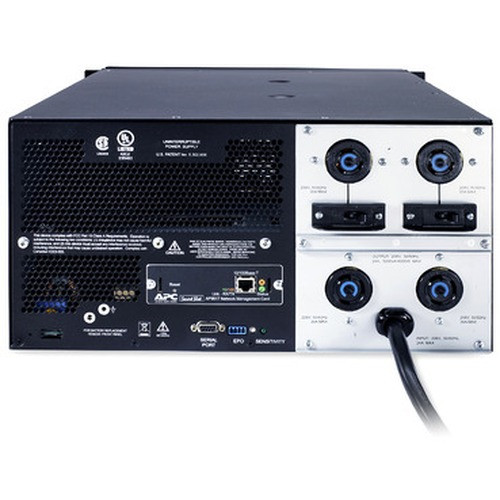
The APC SUA5000RMT5U uses sealed lead acid (VRLA) battery technology. At full load (4000W) it provides 9.4 minutes of backup; at half load (2000W) that extends to 26.7 minutes. Battery recharge time is rated at 3 hours. Hot-swap battery replacement is supported, allowing battery maintenance without powering down the load.
The Vertiv GXT5LI-5KL630RT3UXLN uses lithium-ion battery technology, as indicated by the 'LI' in its model designation. Runtime figures at full or half load are not provided in the supplied specifications. Lithium-ion chemistry typically offers longer calendar life, lower weight per capacity, and faster recharge relative to VRLA, but no quantitative runtime or recharge figures are available in the provided specs to make a direct numerical comparison.
Buyers prioritizing known, published runtime figures can confirm the APC's 9.4-minute full-load and 26.7-minute half-load numbers from spec. The Vertiv's lithium-ion advantage in longevity and weight is architecturally meaningful but cannot be quantified from the provided data.
How does each unit's topology and output spec affect power quality and suitability for sensitive loads?
The APC SUA5000RMT5U is a line-interactive UPS rated at 5000VA / 4000W, yielding a power factor of 0.80. Line-interactive topology corrects voltage sags and surges via an autotransformer but switches to battery on true power failures, introducing a brief transfer time. The unit supports 208V input and output. Input frequency is 50/60 Hz. No transfer time figure is provided in the supplied specs.
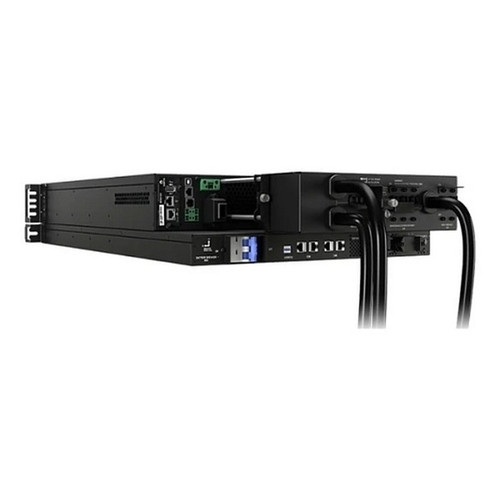
The Vertiv GXT5LI-5KL630RT3UXLN is an online (double-conversion) UPS rated at 5000VA / 4900W, yielding a power factor of 0.98. Online topology continuously regenerates output from the inverter, providing zero transfer time and isolating the load from all input power anomalies including frequency variation. Output voltage is 208VAC by default, adjustable 200–240VAC. Input voltage range is 200V–240V via an L6-30P plug.
For loads that are sensitive to transfer time, frequency variation, or input power quality — such as medical equipment, financial transaction servers, or precision industrial controllers — the Vertiv's online topology and 0.98 power factor are architecturally superior. For standard IT rack loads tolerant of brief transfer events, the APC's line-interactive design is a proven and well-documented approach. The Vertiv also carries formal agency approvals (UL 1778, IEC 62040-1, IEC 62040-2, FCC Part 15 Class A, IEC 62619 for lithium-ion) listed in spec; equivalent certifications for the APC are not included in the provided specifications.
How do the two units compare on physical footprint, weight, and environmental operating envelope?
The APC SUA5000RMT5U occupies 5U of rack space. Physical dimensions and weight are not provided in the supplied specifications. Operating temperature is 0–40°C; storage temperature is –15–45°C. Operating altitude is 0–3000 m; non-operating altitude is 0–15,000 m. The unit produces 53 dB of audible noise and includes LED indicators and audible alarms. Cable length is 2.44 m. Color is black.
The Vertiv GXT5LI-5KL630RT3UXLN also occupies 5.25 inches (approximately 3U) of rack height with a width of 16.9 inches and depth of 35 inches. It weighs 103 lbs. Operating temperature is 0–40°C with a 10% derating at 50°C. No altitude, noise level, or storage temperature figures are provided in the supplied specifications.
Both units share the same 0–40°C operating range. The Vertiv provides precise physical dimensions (16.9 in × 35 in × 5.25 in) and a confirmed 103 lb weight, which is critical for rack load planning. The APC's 5U form factor is stated but no weight or depth is available in the provided specs, making direct rack-space and floor-load comparison incomplete. The APC's 53 dB noise spec is relevant for space-constrained or personnel-occupied environments; equivalent noise data for the Vertiv is not in the provided specs.
Which should you choose: the SUA5000RMT5U or the GXT5LI-5KL630RT3UXLN?
Our take: The GXT5LI-5KL630RT3UXLN is the stronger choice when load sensitivity, power quality, and long-term battery ownership cost are the primary criteria. Its online double-conversion topology eliminates transfer time entirely and its 0.98 power factor (4900W from 5000VA) versus the SUA5000RMT5U's 0.80 power factor (4000W from 5000VA) means 22.5% more usable wattage from the same VA rating. Its lithium-ion chemistry addresses the recurring replacement cost of VRLA batteries. Conversely, the SUA5000RMT5U is the stronger choice when published runtime data is required at procurement: 9.4 minutes at full load and 26.7 minutes at half load are confirmed in spec, whereas no runtime figures are available for the Vertiv in the provided data. The APC is also appropriate for installations with altitude requirements up to 3000 m, where the Vertiv provides no equivalent figure. Buyers running sensitive or continuously critical loads in a controlled data center environment will favor the Vertiv; those needing documented runtime guarantees or high-altitude deployment should confirm those specs before committing.
Side-by-Side Comparison
Spec-for-spec, from manufacturer data.
| Specification | APC by Schneider Electric SUA5000RMT5U | Vertiv GXT5LI-5KL630RT3UXLN |
|---|---|---|
| Topology | Line-Interactive | Online (Double-Conversion) |
| VA Rating | 5000 VA | 5000 VA |
| Watt Rating | 4000 W | 4900 W |
| Power Factor | 0.80 | 0.98 |
| Battery Technology | Sealed Lead Acid (VRLA) | Lithium-Ion |
| Hot-Swap Battery | Yes | — |
| Runtime at Full Load | 9.4 min | — |
| Runtime at Half Load | 26.7 min | — |
| Battery Recharge Time | 3 h | — |
| Input Voltage | 208 V | 200V–240V |
| Output Voltage | 208 V | 208VAC default; 200–240VAC adjustable |
| Input Frequency | 50/60 Hz | — |
| Form Factor | 5U Rackmount/Tower | 3U Rackmount (5.25 in) |
| Weight | — | 103 lbs |
| Depth | — | 35 in |
| Operating Temperature | 0–40°C | 0–40°C (10% derate at 50°C) |
| Operating Altitude | 0–3000 m | — |
| Noise Level | 53 dB | — |
| Agency Approvals | — | UL 1778, IEC 62040-1, IEC 62040-2, IEC 62619, FCC Part 15 Class A |
| Input Connector | — | L6-30P |
| EPO Support | Yes | — |
| LED Indicators | Yes | — |
Frequently Asked Questions
Which should you choose: the SUA5000RMT5U or the GXT5LI-5KL630RT3UXLN?
The GXT5LI-5KL630RT3UXLN is the stronger choice when load sensitivity, power quality, and long-term battery ownership cost are the primary criteria. Its online double-conversion topology eliminates transfer time entirely and its 0.98 power factor (4900W from 5000VA) versus the SUA5000RMT5U's 0.80 power factor (4000W from 5000VA) means 22.5% more usable wattage from the same VA rating. Its lithium-ion chemistry addresses the recurring replacement cost of VRLA batteries. Conversely, the SUA5000RMT5U is the stronger choice when published runtime data is required at procurement: 9.4 minutes at full load and 26.7 minutes at half load are confirmed in spec, whereas no runtime figures are available for the Vertiv in the provided data. The APC is also appropriate for installations with altitude requirements up to 3000 m, where the Vertiv provides no equivalent figure. Buyers running sensitive or continuously critical loads in a controlled data center environment will favor the Vertiv; those needing documented runtime guarantees or high-altitude deployment should confirm those specs before committing.
Does the SUA5000RMT5U or GXT5LI-5KL630RT3UXLN offer better protection for sensitive servers and network equipment?
The GXT5LI-5KL630RT3UXLN uses online (double-conversion) topology, which continuously regenerates clean power from the inverter and provides zero transfer time to battery — making it the stronger choice for loads sensitive to any power interruption or input anomaly. The SUA5000RMT5U is line-interactive, which corrects voltage fluctuations but does have a brief transfer time on true outages. This distinction is spec-confirmed; no transfer time figure for the APC is provided in the available specs.
Which unit gives me more usable wattage for the same 5000VA rating?
The Vertiv GXT5LI-5KL630RT3UXLN delivers 4900W (0.98 power factor) from its 5000VA rating. The APC SUA5000RMT5U delivers 4000W (0.80 power factor). The Vertiv provides 900W more usable power from the same VA class — a meaningful difference when sizing for high-density compute loads. Both figures are taken directly from the provided specifications.
How do the battery types differ between these two UPS units and why does it matter?
The APC SUA5000RMT5U uses sealed lead acid (VRLA) batteries, which are mature, widely serviceable, and support hot-swap replacement per spec. The Vertiv GXT5LI-5KL630RT3UXLN uses lithium-ion batteries, which typically offer a longer service life and lighter weight but at higher upfront cost. The APC's VRLA recharge time is confirmed at 3 hours in spec; no equivalent recharge figure is provided for the Vertiv in the available specifications.
More UPS Comparisons
- APC by Schneider Electric SRT5KRMXLIM vs Vertiv GXT5LI-5000MVRT3UXLN
- APC by Schneider Electric SRT5KRMXLIM vs CyberPower PR5000LCDRTXL5U
- APC by Schneider Electric SRT5KRMXLIM vs Vertiv GXT5LI-5KL630RT3UXLN
- APC by Schneider Electric SRT5KRMXLIM vs APC by Schneider Electric SRT5KRMXLT-IEC
- APC by Schneider Electric SRT5KRMXLIM vs APC by Schneider Electric SRT5KXLT-IEC
- APC by Schneider Electric SRT5KRMXLT-IEC vs Vertiv GXT5LI-5000MVRT3UXLN
UPS Buying Guides
Get a Second Opinion on Your Camera Choice
Share your site layout, coverage goals, and budget. Our team will validate the camera selection, flag anything we would change, and recommend products that match the use case.