
APC by Schneider Electric SUA5000RMT5U vs Vertiv GXT5LI-5000MVRT3UXLN: Specification Comparison
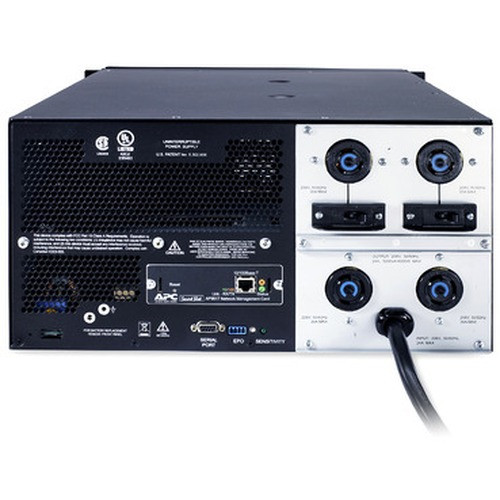
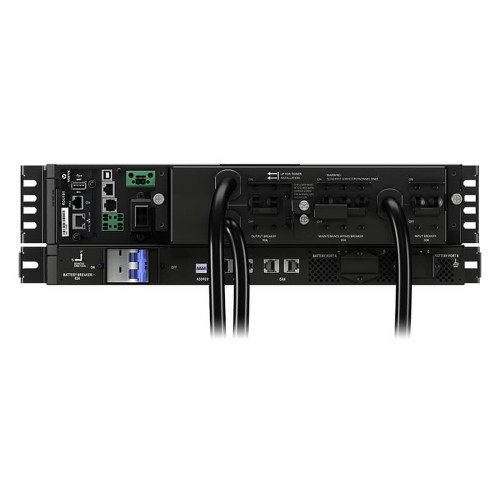
Both the APC Smart-UPS SUA5000RMT5U and the Vertiv GXT5 GXT5LI-5000MVRT3UXLN are 5000VA rackmount UPS units targeting the same data center and server-room power-protection market. The comparison pits a mature line-interactive design with sealed lead-acid chemistry against a double-conversion online unit built around lithium-ion cells — two fundamentally different topologies at identical VA ratings, making this a meaningful cross-shop for IT buyers evaluating runtime, battery technology, output quality, and total cost of ownership at the 5 kVA tier.
In This Guide
- Which UPS topology delivers cleaner, more reliable output power — and what does that mean for connected equipment?
- How do battery chemistry, runtime, and recharge time compare between sealed lead-acid and lithium-ion designs?
- What are the installation footprint, connectivity options, environmental ratings, and certifications for each unit?
- Which should you choose: the SUA5000RMT5U or the GXT5LI-5000MVRT3UXLN?
- Side-by-Side Specs
- FAQ
Which UPS topology delivers cleaner, more reliable output power — and what does that mean for connected equipment?
The SUA5000RMT5U uses line-interactive topology, which means it actively regulates voltage through an automatic voltage regulator (AVR) but only switches to battery when line voltage falls outside a defined window. It delivers 5000VA / 4000W (0.80 power factor). The GXT5LI-5000MVRT3UXLN uses double-conversion online topology, which continuously regenerates a clean sine wave from the inverter regardless of input conditions — connected loads are always running from conditioned power with zero transfer time. It is rated at 5000VA / 5000W, implying a unity (1.00) power factor. For sites with dirty, unstable, or generator-sourced utility power — or for loads that are sensitive to frequency and voltage transients — the double-conversion architecture of the Vertiv provides a materially higher degree of output isolation. The APC's line-interactive design is adequate for stable utility environments and reduces heat and energy conversion losses compared to double-conversion.
How do battery chemistry, runtime, and recharge time compare between sealed lead-acid and lithium-ion designs?
The SUA5000RMT5U uses sealed lead-acid (VRLA) chemistry. At full load (4000W), APC specifies 9.4 minutes of backup time; at half load (~2000W) that extends to 26.7 minutes. Battery recharge time is stated at 3 hours. Hot-swap battery replacement is supported, allowing runtime extension modules or in-service swap without a maintenance window.
The GXT5LI-5000MVRT3UXLN uses lithium-ion (Li-Ion) chemistry, certified under UL 1642 (cells) and UL 1973 (battery pack with UPS). Vertiv's provided specs do not list a specific runtime figure, recharge time, or hot-swap battery status for this model. Lithium-ion chemistry generally offers longer cycle life, lighter weight per watt-hour, faster recharge, and a wider operating temperature range than VRLA, but none of those advantages can be confirmed from the available spec sheet. Buyers requiring a published runtime guarantee should request Vertiv's runtime curves before purchasing.
What are the installation footprint, connectivity options, environmental ratings, and certifications for each unit?
The SUA5000RMT5U occupies 5U of rack space and ships in black. Operating temperature is 0–40 °C; storage temperature is –15 to 45 °C. It operates at altitudes up to 3000 m and non-operating up to 15,000 m. Cable length is 2.44 m. EPO (Emergency Power Off) is included. The spec sheet does not list physical dimensions, weight, or communications interfaces for this model.
The GXT5LI-5000MVRT3UXLN measures 5.2 in H × 16.9 in W × 35 in D and weighs 104.9 lbs. Input wiring is NEMA L14-30P. Output voltage is user-configurable between 120V/208V and 120V/240V. Interface options include a serial port, USB, and an RJ-45 network port (RDU101 card implied). Operating temperature matches at 0–40 °C, with a 10% derating at 50 °C noted. Certifications include UL 1778, c-UL, CSA 22.2 No. 107.3, FCC Part 15 Class A, and Energy Star 2.0. The APC spec sheet does not list comparable certifications or network interface options.
Which should you choose: the SUA5000RMT5U or the GXT5LI-5000MVRT3UXLN?
Our take: The GXT5LI-5000MVRT3UXLN is the stronger choice when output power quality, lithium-ion battery longevity, and network manageability are priorities; the SUA5000RMT5U is the stronger choice when a known runtime, EPO support, and lower acquisition cost on stable utility power are the primary drivers. Key spec deltas: (1) Topology — the Vertiv's double-conversion online design provides zero-transfer-time, continuously conditioned output; the APC's line-interactive design transfers to battery only on excursions. (2) Output power — the Vertiv delivers 5000W at unity power factor vs. 4000W at 0.80 PF for the APC, a 25% higher real-power ceiling. (3) Runtime transparency — the APC publishes 9.4 min at full load and 26.7 min at half load; Vertiv provides no runtime figures in the available spec sheet. For mission-critical or generator-backed data centers, the Vertiv's topology and Li-Ion chemistry are advantageous. For stable-utility IT closets with budget constraints and EPO requirements, the APC remains a practical fit.
Side-by-Side Comparison
Spec-for-spec, from manufacturer data.
| Specification | APC by Schneider Electric SUA5000RMT5U | Vertiv GXT5LI-5000MVRT3UXLN |
|---|---|---|
| VA Rating | 5000 VA | 5000 VA |
| Watt Rating | 4000 W | 5000 W |
| Power Factor | 0.80 | 1.00 (implied) |
| Topology | Line-Interactive | Double-Conversion Online |
| Battery Chemistry | Sealed Lead Acid (VRLA) | Lithium-Ion (Li-Ion) |
| Runtime at Full Load | 9.4 min | — |
| Runtime at Half Load | 26.7 min | — |
| Battery Recharge Time | 3 h | — |
| Hot-Swap Battery | Yes | — |
| Input Voltage | 208 V | 120V / 240V |
| Output Voltage | 208 V | 120V/208V or 120V/240V (configurable) |
| Input Wiring | — | NEMA L14-30P |
| Form Factor / Rack Height | 5U Rackmount/Tower | Rackmount (5.2 in H) |
| Dimensions (H×W×D) | — | 5.2 in × 16.9 in × 35 in |
| Weight | — | 104.9 lbs |
| Operating Temperature | 0–40 °C | 0–40 °C (10% derate at 50 °C) |
| EPO | Yes | — |
| Network Interface | — | RJ-45 (RDU101), Serial, USB |
| Certifications | — | UL 1778, UL 1642, UL 1973, CSA, FCC Pt 15 Cl A, Energy Star 2.0 |
| Noise Level | 53 dB | — |
| Operating Altitude | 0–3000 m | — |
Frequently Asked Questions
Which should you choose: the SUA5000RMT5U or the GXT5LI-5000MVRT3UXLN?
The GXT5LI-5000MVRT3UXLN is the stronger choice when output power quality, lithium-ion battery longevity, and network manageability are priorities; the SUA5000RMT5U is the stronger choice when a known runtime, EPO support, and lower acquisition cost on stable utility power are the primary drivers. Key spec deltas: (1) Topology — the Vertiv's double-conversion online design provides zero-transfer-time, continuously conditioned output; the APC's line-interactive design transfers to battery only on excursions. (2) Output power — the Vertiv delivers 5000W at unity power factor vs. 4000W at 0.80 PF for the APC, a 25% higher real-power ceiling. (3) Runtime transparency — the APC publishes 9.4 min at full load and 26.7 min at half load; Vertiv provides no runtime figures in the available spec sheet. For mission-critical or generator-backed data centers, the Vertiv's topology and Li-Ion chemistry are advantageous. For stable-utility IT closets with budget constraints and EPO requirements, the APC remains a practical fit.
Is the SUA5000RMT5U or GXT5LI-5000MVRT3UXLN better for a server room running on generator power?
The GXT5LI-5000MVRT3UXLN is better suited for generator-backed environments. Its double-conversion online topology continuously regenerates clean output power from the inverter, so generator frequency variations and voltage sags never reach connected loads. The SUA5000RMT5U's line-interactive design passes conditioned but not fully regenerated utility power during normal operation and may transfer to battery more frequently in unstable generator scenarios.
Which unit gives me more backup runtime at full load?
Only the APC SUA5000RMT5U provides a published runtime figure: 9.4 minutes at full load (4000W) and 26.7 minutes at half load. Vertiv's available spec sheet for the GXT5LI-5000MVRT3UXLN does not include runtime data. Before purchasing the Vertiv, request the manufacturer's runtime curves to compare directly, especially if your load profile is close to the 5000W ceiling.
Can I monitor and manage either UPS over the network?
The GXT5LI-5000MVRT3UXLN specifies an RJ-45 network interface (RDU101), serial port, and USB as standard interface options per its spec sheet. The SUA5000RMT5U spec sheet does not list any network or communications interfaces for this model. Buyers who require SNMP or web-based UPS management should verify APC's available add-on SmartSlot card compatibility for the SUA5000RMT5U separately, as that data is not present in the provided specifications.
More UPS Comparisons
- APC by Schneider Electric SRT5KRMXLIM vs Vertiv GXT5LI-5000MVRT3UXLN
- APC by Schneider Electric SRT5KRMXLIM vs CyberPower PR5000LCDRTXL5U
- APC by Schneider Electric SRT5KRMXLIM vs Vertiv GXT5LI-5KL630RT3UXLN
- APC by Schneider Electric SRT5KRMXLIM vs APC by Schneider Electric SRT5KRMXLT-IEC
- APC by Schneider Electric SRT5KRMXLIM vs APC by Schneider Electric SRT5KXLT-IEC
- APC by Schneider Electric SRT5KRMXLT-IEC vs Vertiv GXT5LI-5000MVRT3UXLN
UPS Buying Guides
Get a Second Opinion on Your Camera Choice
Share your site layout, coverage goals, and budget. Our team will validate the camera selection, flag anything we would change, and recommend products that match the use case.