
APC by Schneider Electric SRT6KRMXLT-IEC vs APC by Schneider Electric SRT6KRMXLI: Specification Comparison
Both the SRT6KRMXLT-IEC and SRT6KRMXLI are rack-mount, double-conversion online UPS units from APC's Smart-UPS SRT line, each rated at 6000VA / 6000W. The key differentiator is output voltage configuration: the SRT6KRMXLT-IEC targets 208V environments with IEC outlet complement, while the SRT6KRMXLI is configured for 230V single-phase distribution common in international and European installations. Buyers choosing between these two are primarily selecting based on local power infrastructure voltage standards and outlet compatibility requirements.
In This Guide
- Which model matches your facility's output voltage and outlet standard?
- How do the two units compare on efficiency, waveform quality, and output distortion?
- What management interfaces and operational features does each model provide?
- Which should you choose: the SRT6KRMXLT-IEC or the SRT6KRMXLI?
- Side-by-Side Specs
- FAQ
Which model matches your facility's output voltage and outlet standard?
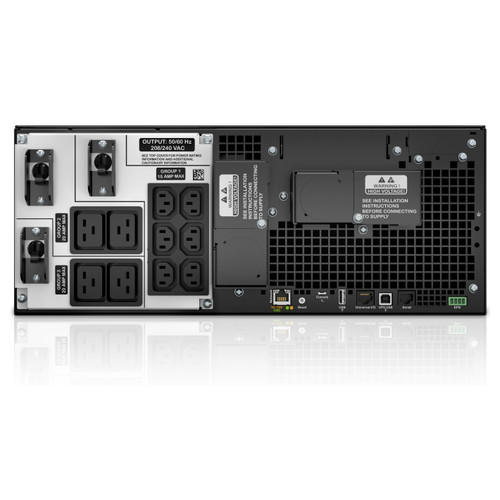
The most critical selection criterion between these two units is output voltage. The SRT6KRMXLT-IEC delivers output in the range of 208V–240V, making it suited for North American 208V three-phase-derived single-phase circuits and dual-voltage 208/240V environments. The SRT6KRMXLI outputs 220V–240V, targeting standard 230V single-phase mains prevalent in Europe, the Middle East, Africa, and Asia-Pacific regions.
The IEC designation in the SRT6KRMXLT-IEC name signals IEC-format output receptacles, directly relevant for equipment with IEC power cords. The SRT6KRMXLI's outlet configuration is not specified in the provided data. Buyers must verify that the output voltage window and physical outlet type match their connected load equipment before selecting either unit.
How do the two units compare on efficiency, waveform quality, and output distortion?
Both units produce a true sine wave output with a 3:1 crest factor and operate across the same wide input voltage range of 100V–275V and input frequency range of 40–70Hz. These shared characteristics confirm equivalent power conditioning capability for sensitive equipment.
The SRT6KRMXLI specification includes a stated efficiency rating of 94.4%. The SRT6KRMXLT-IEC specification does not include an efficiency figure in the provided data, so a direct numerical comparison cannot be made. The SRT6KRMXLT-IEC does specify output voltage Total Harmonic Distortion (THD) at 2%, while no THD figure is provided for the SRT6KRMXLI. Both units share a 480J surge energy rating, identical noise output at 55 dB, and equivalent output frequency of 50/60Hz.
What management interfaces and operational features does each model provide?
The SRT6KRMXLT-IEC specification explicitly lists web-based management as supported, enabling remote monitoring and control via a network interface. This feature is not listed in the provided specifications for the SRT6KRMXLI, so its availability on that model cannot be confirmed from the data at hand.
Both models share Emergency Power Off (EPO) capability and audible alarms, which are standard requirements for data center and critical infrastructure deployments. Surge protection is confirmed on both units. The SRT6KRMXLI specification additionally calls out single-phase output explicitly, while the SRT6KRMXLT-IEC does not state phase count in the provided data. Installers integrating either unit into managed power infrastructure should independently verify network card compatibility and available management software versions with APC.
Which should you choose: the SRT6KRMXLT-IEC or the SRT6KRMXLI?
Our take: The SRT6KRMXLT-IEC is the stronger choice when your facility operates on 208V single-phase circuits and requires IEC-format output receptacles, while the SRT6KRMXLI is the appropriate selection for 220V–240V single-phase environments standard outside North America. Three concrete spec deltas separate them: first, the SRT6KRMXLT-IEC supports a lower output voltage floor of 208V versus 220V on the SRT6KRMXLI, directly determining compatibility with 208V-rated equipment. Second, only the SRT6KRMXLT-IEC lists web-based management in the provided specifications, a meaningful advantage for remote monitoring. Third, only the SRT6KRMXLI provides a confirmed efficiency rating of 94.4%; the SRT6KRMXLT-IEC's THD of 2% is documented but efficiency is absent from its spec sheet. Specify the SRT6KRMXLT-IEC for North American data centers running 208V distribution; specify the SRT6KRMXLI for international 230V single-phase installations.
Side-by-Side Comparison
Spec-for-spec, from manufacturer data.
| Specification | APC by Schneider Electric SRT6KRMXLT-IEC | APC by Schneider Electric SRT6KRMXLI |
|---|---|---|
| UPS Topology | Double-conversion (Online) | Double-conversion (Online) |
| Output Power Capacity | 6 kVA | 6 kVA |
| Output Power (Watts) | 6000 W | 6000 W |
| Waveform | Sine | Sine |
| Input Voltage Min | 100 V | 100 V |
| Input Voltage Max | 275 V | 275 V |
| Input Frequency | 40–70 Hz | 40–70 Hz |
| Output Voltage Min | 208 V | 220 V |
| Output Voltage Max | 240 V | 240 V |
| Output Frequency | 50/60 Hz | 50/60 Hz |
| Surge Energy Rating | 480 J | 480 J |
| Crest Factor | 3:1 | 3:1 |
| Output Voltage THD | 2% | — |
| Efficiency | — | 94.4% |
| Number of Output Phases | — | 1 |
| Noise Level | 55 dB | 55 dB |
| Emergency Power Off (EPO) | Yes | Yes |
| Surge Protection | Yes | Yes |
| Audible Alarms | Yes | Yes |
| Web-Based Management | Yes | — |
Frequently Asked Questions
Which should you choose: the SRT6KRMXLT-IEC or the SRT6KRMXLI?
The SRT6KRMXLT-IEC is the stronger choice when your facility operates on 208V single-phase circuits and requires IEC-format output receptacles, while the SRT6KRMXLI is the appropriate selection for 220V–240V single-phase environments standard outside North America. Three concrete spec deltas separate them: first, the SRT6KRMXLT-IEC supports a lower output voltage floor of 208V versus 220V on the SRT6KRMXLI, directly determining compatibility with 208V-rated equipment. Second, only the SRT6KRMXLT-IEC lists web-based management in the provided specifications, a meaningful advantage for remote monitoring. Third, only the SRT6KRMXLI provides a confirmed efficiency rating of 94.4%; the SRT6KRMXLT-IEC's THD of 2% is documented but efficiency is absent from its spec sheet. Specify the SRT6KRMXLT-IEC for North American data centers running 208V distribution; specify the SRT6KRMXLI for international 230V single-phase installations.
Can I use the SRT6KRMXLT-IEC in a standard 230V European installation?
Based on the provided specifications, the SRT6KRMXLT-IEC outputs 208V–240V and carries IEC receptacles, but it is spec'd for 208V environments. The SRT6KRMXLI with its 220V–240V output range is the model explicitly configured for 230V single-phase infrastructure. Using the SRT6KRMXLT-IEC in a 230V environment would require verification of compatibility with APC directly, as the output voltage floor difference (208V vs 220V) may affect load equipment rated specifically for 220V or 230V.
Does the SRT6KRMXLI support remote or web-based management like the SRT6KRMXLT-IEC?
The provided specification for the SRT6KRMXLT-IEC lists web-based management as a confirmed feature. The provided specification for the SRT6KRMXLI does not include web-based management in the listed attributes, so this cannot be confirmed from the available data. Buyers requiring network management for the SRT6KRMXLI should verify SmartSlot or network management card availability directly with APC.
Are the SRT6KRMXLT-IEC and SRT6KRMXLI the same power capacity and topology?
Yes. Both units are double-conversion (online) UPS systems rated at 6000VA output power capacity and 6000W real power output. They share the same input voltage range (100V–275V), input frequency range (40–70Hz), sine wave output, 3:1 crest factor, 480J surge energy rating, and 55 dB noise level. The distinction between the two models lies in output voltage configuration and regional outlet standards, not in power capacity or UPS topology.
More UPS Comparisons
- APC by Schneider Electric SRT6KXLT vs Vertiv GXT5-6000RT208
- APC by Schneider Electric SRT6KXLT vs Vertiv GXT5LI-6000MVRT3UXLN
- APC by Schneider Electric SRT6KXLT vs Vertiv GXT5LI-6000GVRT3UXLN
- APC by Schneider Electric SRT6KXLT vs APC by Schneider Electric SRT6KRMXLI
- APC by Schneider Electric SRT6KXLT vs APC by Schneider Electric SRT6KRMXLIM
- APC by Schneider Electric SRT6KRMXLI vs Vertiv GXT5-6000RT208
UPS Buying Guides
Get a Second Opinion on Your Camera Choice
Share your site layout, coverage goals, and budget. Our team will validate the camera selection, flag anything we would change, and recommend products that match the use case.