
APC by Schneider Electric SRT6KXLT vs Vertiv GXT5LI-6000MVRT3UXLN: Specification Comparison
Both the APC Smart-UPS On-Line SRT6KXLT and the Vertiv GXT5 GXT5LI-6000MVRT3UXLN are 6000VA / 6000W double-conversion online UPS units designed for hardwired 208V infrastructure deployments in data centers, telecom closets, and critical facility environments. Both support extended runtime via external battery modules and carry UL 1778 certification. This comparison evaluates them across power and electrical architecture, battery technology and runtime extensibility, and management and connectivity — the three axes most relevant to UPS procurement decisions at this power class.
In This Guide
- How do the SRT6KXLT and GXT5LI-6000MVRT3UXLN differ in input/output electrical architecture and efficiency?
- Which unit offers stronger battery technology and runtime extensibility — lead-acid vs. lithium-ion?
- How do the two units compare on remote management, connectivity interfaces, and physical integration?
- Which should you choose: the SRT6KXLT or the GXT5LI-6000MVRT3UXLN?
- Side-by-Side Specs
- FAQ
How do the SRT6KXLT and GXT5LI-6000MVRT3UXLN differ in input/output electrical architecture and efficiency?
Both units are rated at 6000VA / 6000W, delivering a unity (1.0) power factor — confirmed by the matched VA and W figures on each model. The SRT6KXLT accepts input voltages of 208V or 240V AC (single phase, 2PH+G hardwired) with an auto-sensing frequency range of 40–70 Hz, and outputs 208V or 240V at 50/60 Hz ±3 Hz synchronized to mains. Harmonic distortion is specified at less than 2% THD, and crest factor is rated 3:1. APC lists the internal bypass as both automatic and manual.
The GXT5LI-6000MVRT3UXLN accepts 120V/240V input and outputs 120V/208V (with 120V/240V user-configurable), wired L1, L2, N, G — a four-wire configuration that includes a neutral conductor, which the SRT6KXLT's 3-wire (2PH+G) arrangement does not. This distinction matters for loads requiring a neutral reference. Vertiv does not publish THD, crest factor, or output frequency tolerance figures in the provided specifications.
Heat dissipation for the SRT6KXLT is specified at 1402 Btu/h at full load. The GXT5LI-6000MVRT3UXLN does not provide a heat dissipation figure in the supplied specs. Both carry Energy Star 2.0 and FCC Part 15 Class A listings; the SRT6KXLT additionally lists NOM and UL 1778 while the GXT5LI-6000MVRT3UXLN adds UL 1642 and UL 1973 — certifications specific to its lithium-ion battery chemistry.
Which unit offers stronger battery technology and runtime extensibility — lead-acid vs. lithium-ion?
This is the most consequential differentiator between the two units. The SRT6KXLT uses a sealed lead-acid (VRLA) battery at 192V battery bus voltage, with a specified service life of 3–5 years and a typical recharge time of 1.5 hours. Battery charging power is rated at 579W. The replacement battery is the APCRBC140, and the unit accepts one RBC. Runtime is listed as 'View Runtime Graph' — no tabular runtime values are provided in the supplied specifications.
The GXT5LI-6000MVRT3UXLN uses lithium-ion chemistry, as evidenced by its UL 1642 (Li-Ion Battery Cells) and UL 1973 (Li-Ion Battery Pack w/UPS) listings. Lithium-ion chemistry typically delivers longer calendar life (often 8–10 years), faster recharge, lower weight per unit of energy, and tolerance of deeper discharge cycles versus VRLA — however, Vertiv does not publish specific battery voltage, recharge time, battery life years, or runtime figures in the provided specifications, so no numeric comparison can be drawn for those parameters.
The SRT6KXLT is designated 'Extended Runtime' (XLT suffix) and is listed as 'Extendable Runtime: 1,' confirming it accepts APC external battery modules. The GXT5LI-6000MVRT3UXLN model number includes 'XL,' which APC's naming convention for Vertiv typically denotes extended runtime capability, but Vertiv does not explicitly confirm external battery module compatibility or quantity in the provided specifications. Buyers requiring confirmed, spec-backed runtime extensibility have a clearer documented path with the SRT6KXLT.
How do the two units compare on remote management, connectivity interfaces, and physical integration?
The SRT6KXLT ships with a preinstalled Network Management Card 3 (NMC3) with environmental monitoring — this is an embedded card, not an add-on. Connectivity includes USB, serial port, the embedded NMC3 with RJ-45 network port, and one additional expansion slot for a second management card or accessory. Surge energy rating is 480 J. Provided accessories include a temperature probe, USB cable, and CD with software, giving the unit out-of-box IP-addressable SNMP/web management.
The GXT5LI-6000MVRT3UXLN lists interface options of Serial Port, Network RJ-45 (RDU101), and USB. The RDU101 designation suggests the network card may be an included or integrated remote monitoring unit rather than a separately slotted NMC, but Vertiv does not specify whether the RDU101 is preinstalled or optional in the provided specs. No expansion slot count, surge joule rating, or included accessory list is provided for the Vertiv unit.
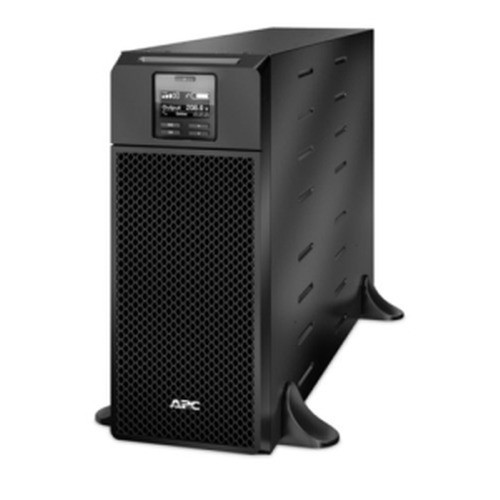
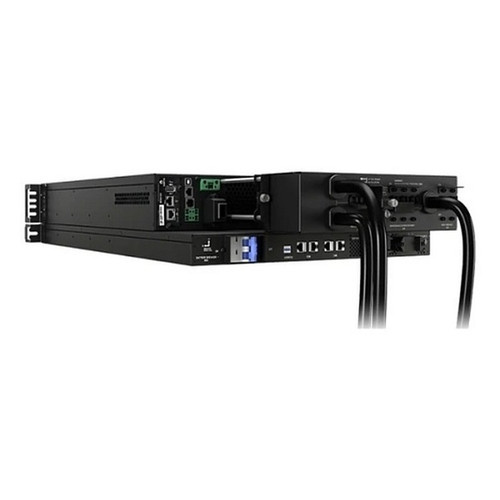
Physically, the SRT6KXLT weighs 134.99 lb and ships in a tower-only configuration (with rack-mount kit included; '2 Post Mountable: 0'). Its dimensions are 17.008 in width; package dimensions are 14.6 × 37.8 × 24.02 in. The GXT5LI-6000MVRT3UXLN is significantly lighter at 100 lb and measures 5.2 in H × 16.9 in W × 35 in D — a rackmount form factor (3U based on height), making it more suitable for rack-dense environments. Acoustic noise is specified only for the SRT6KXLT at 55 dBA; Vertiv does not provide an acoustic rating in the supplied specs.
Which should you choose: the SRT6KXLT or the GXT5LI-6000MVRT3UXLN?
Our take: The SRT6KXLT is the stronger choice when lead-acid runtime extensibility, out-of-box SNMP/IP management, and fully documented electrical specs are the priority; the GXT5LI-6000MVRT3UXLN is the stronger choice when lithium-ion battery chemistry, reduced physical weight, and a rackmount form factor are required. Key spec deltas: the SRT6KXLT weighs 134.99 lb versus 100 lb for the GXT5LI-6000MVRT3UXLN — a 35 lb advantage favoring the Vertiv in rack deployments where floor loading matters. The SRT6KXLT ships with a preinstalled NMC3 network card confirmed in specs; the Vertiv's RDU101 network interface is listed but its preinstall status is unconfirmed. The SRT6KXLT specifies a 3–5 year battery life and 1.5-hour recharge; the GXT5LI-6000MVRT3UXLN provides no numeric battery life or recharge data, though its UL 1973 Li-Ion listing implies longer calendar life. For new rackmount builds where lithium-ion longevity and lighter weight justify the trade-off in documentation completeness, the GXT5LI-6000MVRT3UXLN warrants evaluation. For existing APC ecosystems or installations requiring fully spec-documented management and battery parameters, the SRT6KXLT is the lower-risk selection.
Side-by-Side Comparison
Spec-for-spec, from manufacturer data.
| Specification | APC by Schneider Electric SRT6KXLT | Vertiv GXT5LI-6000MVRT3UXLN |
|---|---|---|
| Topology | Double-Conversion Online | Double-Conversion Online |
| Power Rating | 6000VA / 6000W | 6000VA / 6000W |
| Power Factor | 1.0 (unity) | 1.0 (unity) |
| Input Voltage | 208V or 240V AC (1-phase) | 120V / 240V |
| Input Wiring | Hardwire 3-wire (2PH + G) | Hardwire 4-wire (L1, L2, N, G) |
| Output Voltage | 208V or 240V (1-phase) | 120V/208V (120V/240V user-configurable) |
| Input Frequency | 40–70 Hz auto-sensing | — |
| Output THD | < 2% | — |
| Battery Chemistry | Sealed Lead-Acid (VRLA) | Lithium-Ion |
| Battery Life | 3–5 years | — |
| Recharge Time | 1.5 hours | — |
| Runtime Extensible | Yes (confirmed, XLT) | Implied (XL suffix); not confirmed in specs |
| Network Management | NMC3 preinstalled (confirmed) | RDU101 RJ-45 listed; preinstall status unconfirmed |
| Interfaces | USB, Serial, NMC3 RJ-45, 1 expansion slot | USB, Serial, RJ-45 (RDU101) |
| Surge Energy Rating | 480 J | — |
| Weight | 134.99 lb (61.23 kg) | 100 lb |
| Form Factor | Tower (rack kit included; not 2-post mountable) | Rackmount (5.2 in H / ~3U) |
| Acoustic Noise | 55 dBA | — |
| Heat Dissipation | 1402 Btu/h | — |
| Operating Temp | — | 32°F–104°F (0°C–40°C); 10% derate at 50°C |
| Certifications | UL 1778, ENERGY STAR 2.0, FCC Pt.15 Cl.A, NOM | UL 1778, UL 1642, UL 1973, ENERGY STAR 2.0, FCC Pt.15 Cl.A, CSA 22.2 No.107.3, c-UL |
| IP Rating | IP20 | — |
| Bypass | Internal (Automatic + Manual) | — |
Frequently Asked Questions
Which should you choose: the SRT6KXLT or the GXT5LI-6000MVRT3UXLN?
The SRT6KXLT is the stronger choice when lead-acid runtime extensibility, out-of-box SNMP/IP management, and fully documented electrical specs are the priority; the GXT5LI-6000MVRT3UXLN is the stronger choice when lithium-ion battery chemistry, reduced physical weight, and a rackmount form factor are required. Key spec deltas: the SRT6KXLT weighs 134.99 lb versus 100 lb for the GXT5LI-6000MVRT3UXLN — a 35 lb advantage favoring the Vertiv in rack deployments where floor loading matters. The SRT6KXLT ships with a preinstalled NMC3 network card confirmed in specs; the Vertiv's RDU101 network interface is listed but its preinstall status is unconfirmed. The SRT6KXLT specifies a 3–5 year battery life and 1.5-hour recharge; the GXT5LI-6000MVRT3UXLN provides no numeric battery life or recharge data, though its UL 1973 Li-Ion listing implies longer calendar life. For new rackmount builds where lithium-ion longevity and lighter weight justify the trade-off in documentation completeness, the GXT5LI-6000MVRT3UXLN warrants evaluation. For existing APC ecosystems or installations requiring fully spec-documented management and battery parameters, the SRT6KXLT is the lower-risk selection.
Is the SRT6KXLT or GXT5LI-6000MVRT3UXLN better for rack-mount data center deployments?
Based on the provided specs, the GXT5LI-6000MVRT3UXLN has the advantage for rack-dense environments: it measures 5.2 in H (consistent with a 3U rackmount profile) and weighs 100 lb. The SRT6KXLT is specified as a tower unit with a rack-mount kit included but is flagged '2 Post Mountable: 0' and weighs 134.99 lb — heavier and less rack-native. If rackmount form factor is a hard requirement, the GXT5LI-6000MVRT3UXLN is the more appropriate unit based on available specs.
Which UPS comes with network management included out of the box?
The SRT6KXLT explicitly lists a preinstalled Network Management Card 3 (NMC3) with environmental monitoring as a provided component, along with a temperature probe. The GXT5LI-6000MVRT3UXLN lists an RJ-45 (RDU101) as an interface option, but the provided specifications do not confirm whether this card is preinstalled or a separately purchased accessory. Buyers who require confirmed out-of-box SNMP/web management have a clearer documented answer with the SRT6KXLT.
Does the lithium-ion battery in the GXT5LI-6000MVRT3UXLN offer a meaningful advantage over the lead-acid battery in the SRT6KXLT?
The GXT5LI-6000MVRT3UXLN carries UL 1642 and UL 1973 certifications confirming its lithium-ion chemistry, which in general offers longer calendar service life, faster recharge, and lighter weight than sealed lead-acid. However, Vertiv does not publish battery life years, recharge time, or battery voltage figures in the provided specifications. The SRT6KXLT specifies a 3–5 year VRLA battery life and 1.5-hour recharge. A definitive numeric comparison cannot be made from the supplied data alone; buyers should request Vertiv's full datasheet for battery-specific parameters before making a final decision.
More UPS Comparisons
- APC by Schneider Electric SRT6KXLT vs Vertiv GXT5-6000RT208
- APC by Schneider Electric SRT6KXLT vs Vertiv GXT5LI-6000GVRT3UXLN
- APC by Schneider Electric SRT6KXLT vs APC by Schneider Electric SRT6KRMXLI
- APC by Schneider Electric SRT6KXLT vs APC by Schneider Electric SRT6KRMXLIM
- APC by Schneider Electric SRT6KRMXLI vs Vertiv GXT5-6000RT208
- APC by Schneider Electric SRT6KRMXLI vs Vertiv GXT5LI-6000MVRT3UXLN
UPS Buying Guides
Get a Second Opinion on Your Camera Choice
Share your site layout, coverage goals, and budget. Our team will validate the camera selection, flag anything we would change, and recommend products that match the use case.