
APC by Schneider Electric SRT6KXLT vs Vertiv GXT5LI-6000GVRT3UXLN: Specification Comparison
Both the APC Smart-UPS On-Line SRT6KXLT and the Vertiv Liebert GXT5LI-6000GVRT3UXLN are 6000 VA / 6000 W true online double-conversion UPS units designed for hardwired three-wire input in the 200–240 V range, making them direct cross-shop candidates for data centers, server rooms, and critical infrastructure installations requiring continuous power conditioning with zero transfer time. The comparison covers power architecture and output flexibility, battery technology and runtime expandability, and physical form factor with management and connectivity features.
In This Guide
- How do the two units differ in power architecture, input/output flexibility, and power quality?
- Which unit offers better battery technology, recharge characteristics, and runtime expandability?
- How do the units compare on physical form factor, mounting options, and management/connectivity features?
- Which should you choose: the SRT6KXLT or the GXT5LI-6000GVRT3UXLN?
- Side-by-Side Specs
- FAQ
How do the two units differ in power architecture, input/output flexibility, and power quality?
Both units are true online (double-conversion) UPS systems rated at 6000 VA / 6000 W with a unity power factor, delivering identical kVA-to-kW efficiency in that regard. The SRT6KXLT specifies a sine-wave output with less than 2% total harmonic distortion and a crest factor of 3:1, and its output frequency tracks mains at 50/60 Hz ±3 Hz with automatic bypass (internal, both automatic and manual). The GXT5LI-6000GVRT3UXLN's output waveform type, THD figure, and bypass configuration are not stated in the provided specifications.
On input, the SRT6KXLT accepts 208 V or 240 V single-phase over a 100–275 V adjustable range (at half load) across a wide 40–70 Hz auto-sensing frequency band, connected via hard-wire 3-wire (2PH + G). The GXT5LI-6000GVRT3UXLN accepts 200–240 V hardwired (L1-L2/N-G); its input frequency range is not listed in the provided specs.
Output voltage configurability favors the GXT5LI-6000GVRT3UXLN on paper: its default is 230 VAC but it is user-configurable from 200–240 VAC at ±1% regulation. The SRT6KXLT outputs 208 V or 240 V single-phase; output voltage regulation tolerance is not stated in its provided specs. Surge energy rating for the SRT6KXLT is 480 J; this figure is absent from the GXT5LI-6000GVRT3UXLN's provided specs.
Which unit offers better battery technology, recharge characteristics, and runtime expandability?
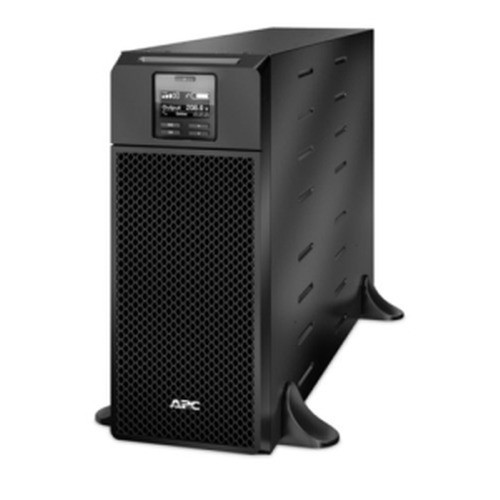
This is the most consequential differentiator between the two models. The SRT6KXLT uses a sealed lead-acid battery chemistry at 192 V battery bus voltage. The specified typical recharge time is 1.5 hours at a rated charging power of 579 W, with an expected battery service life of 3–5 years. The replacement battery cartridge is the APCRBC140. The unit is described as extendable-runtime capable (Extendable Runtime: 1), and the SRT6KXLT designator indicates it is an extended-runtime variant designed to accept external battery modules.
The GXT5LI-6000GVRT3UXLN uses lithium-ion battery chemistry, as stated explicitly in the product name and SKU. Lithium-ion UPS batteries typically offer lower weight, longer calendar life, and faster recharge versus lead-acid, but the provided specifications do not include a stated recharge time, battery voltage, battery life expectancy in years, or runtime extension module compatibility for this unit. Buyers must consult the Vertiv datasheet directly for those figures.
The SRT6KXLT's published weight of 134.99 lb (61.23 kg) versus the GXT5LI-6000GVRT3UXLN's 99 lb is consistent with the lead-acid versus lithium-ion chemistry difference. The lighter Vertiv unit may ease rack installation and reduce floor-loading requirements.
How do the units compare on physical form factor, mounting options, and management/connectivity features?
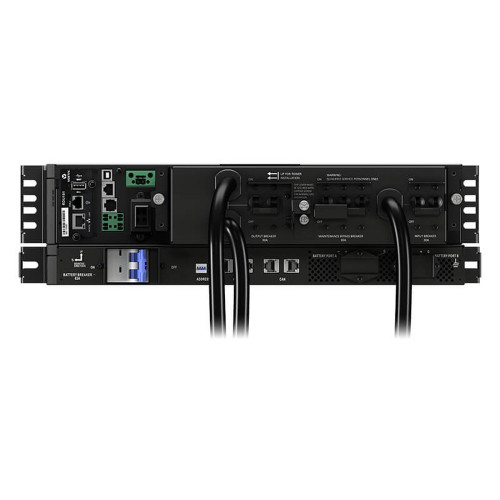
The SRT6KXLT has published dimensions of 17.008 in (W) with package dimensions of 14.6 in H × 37.8 in W × 24.02 in D and weighs 134.99 lb. It ships configured for tower mounting with an included kit; rack mounting details and rack unit height are not provided in the specs. The GXT5LI-6000GVRT3UXLN provides a height of 5.25 in (3U), width of 16.9 in, and depth of 35 in—indicating a rack-mount form factor. Its tower-mounting option is not addressed in the provided specs.
Management connectivity is detailed only for the SRT6KXLT: it ships with a preinstalled Network Management Card 3 with environmental monitoring, plus a serial port, USB port, and one available expansion slot for an additional card. APC's NMC3 enables SNMP, web GUI, and email alerting out of the box. The GXT5LI-6000GVRT3UXLN's management interface, communication ports, and network card options are not described in the provided specifications.
The SRT6KXLT carries ENERGY STAR V2.0, FCC Part 15 Class A, NOM, and UL 1778 certifications. The GXT5LI-6000GVRT3UXLN carries IEC 62040-1:2008+A1 2013, IEC 62619 1st Ed., IEC 62040-2 2nd Ed., IEC 61000-3-2, IEC 61000-3-12, CISPR 22 Class A, FCC Part 15 Class A, and UL 1778. The Vertiv unit has a broader IEC certification set relevant to international deployments. Both carry UL 1778 and FCC Part 15 Class A. Operating temperature for the SRT6KXLT is not explicitly stated in the provided specs; the GXT5LI-6000GVRT3UXLN is rated 32–104°F (0–40°C) with 10% derating at 50°C.
Which should you choose: the SRT6KXLT or the GXT5LI-6000GVRT3UXLN?
Our take: The SRT6KXLT is the stronger choice when out-of-the-box network management, detailed power-quality specifications, and a well-documented extended-runtime ecosystem are priorities. It ships with APC NMC3 already installed, specifies sub-2% THD, a 480 J surge rating, 40–70 Hz auto-sensing input, and a clear 1.5-hour recharge time—all verified from the provided specs. The GXT5LI-6000GVRT3UXLN's lithium-ion chemistry is its decisive differentiator: at 99 lb versus 134.99 lb it is 35 lb lighter, reducing rack and floor-load burden, and Li-ion batteries typically deliver longer service life and faster recharge than lead-acid, though neither the recharge time nor battery life figures are present in the provided specs for the Vertiv unit. Its 3U rack-native form factor also suits high-density installations. Buyers who need confirmed management card functionality and fully published power-quality figures should favor the APC; those for whom battery weight, rack density, and Li-ion longevity are the deciding factors should evaluate the Vertiv against its full published datasheet.
Side-by-Side Comparison
Spec-for-spec, from manufacturer data.
| Specification | APC by Schneider Electric SRT6KXLT | Vertiv GXT5LI-6000GVRT3UXLN |
|---|---|---|
| UPS Topology | Online double-conversion | Online double-conversion |
| Power Rating | 6000 VA / 6000 W | 6000 VA / 6000 W |
| Input Voltage | 208 V / 240 V AC 1-phase | 200–240 V |
| Input Connection | Hard wire 3-wire (2PH + G) | Hardwired (L1-L2/N-G) |
| Input Frequency Range | 40–70 Hz auto-sensing | — |
| Output Voltage | 208 V / 240 V 1-phase | 230 VAC default; 200–240 VAC configurable ±1% |
| Output Waveform | Sine wave | — |
| Total Harmonic Distortion | < 2% | — |
| Crest Factor | 3:1 | — |
| Bypass Type | Internal (automatic and manual) | — |
| Battery Chemistry | Lead-acid | Lithium-ion |
| Battery Voltage | 192 V | — |
| Typical Recharge Time | 1.5 h | — |
| Battery Life | 3–5 years | — |
| Extendable Runtime | Yes | — |
| Weight | 134.99 lb (61.23 kg) | 99 lb |
| Dimensions (H × W × D) | — × 17.008 in × — | 5.25 in × 16.9 in × 35 in |
| Surge Energy Rating | 480 J | — |
| Network Management | NMC3 preinstalled + 1 expansion slot | — |
| Operating Temperature | — | 32–104°F (0–40°C); derate at 50°C |
| Acoustic Level | 55 dBA | — |
| Heat Dissipation | 1402 Btu/h | — |
| Certifications | ENERGY STAR V2.0, FCC Pt 15 Cl A, NOM, UL 1778 | IEC 62040-1, IEC 62619, IEC 62040-2, IEC 61000-3-2, IEC 61000-3-12, CISPR 22 Cl A, FCC Pt 15 Cl A, UL 1778 |
Frequently Asked Questions
Which should you choose: the SRT6KXLT or the GXT5LI-6000GVRT3UXLN?
The SRT6KXLT is the stronger choice when out-of-the-box network management, detailed power-quality specifications, and a well-documented extended-runtime ecosystem are priorities. It ships with APC NMC3 already installed, specifies sub-2% THD, a 480 J surge rating, 40–70 Hz auto-sensing input, and a clear 1.5-hour recharge time—all verified from the provided specs. The GXT5LI-6000GVRT3UXLN's lithium-ion chemistry is its decisive differentiator: at 99 lb versus 134.99 lb it is 35 lb lighter, reducing rack and floor-load burden, and Li-ion batteries typically deliver longer service life and faster recharge than lead-acid, though neither the recharge time nor battery life figures are present in the provided specs for the Vertiv unit. Its 3U rack-native form factor also suits high-density installations. Buyers who need confirmed management card functionality and fully published power-quality figures should favor the APC; those for whom battery weight, rack density, and Li-ion longevity are the deciding factors should evaluate the Vertiv against its full published datasheet.
Does either UPS include a network management card out of the box?
Yes—the SRT6KXLT ships with APC's Network Management Card 3 with environmental monitoring preinstalled, plus a serial port, USB port, and one open expansion slot. The provided specifications for the GXT5LI-6000GVRT3UXLN do not describe any included or available network management card; consult the Vertiv datasheet or contact Vertiv directly to confirm management options.
Which unit is better suited for a high-density rack environment where floor weight loading matters?
The GXT5LI-6000GVRT3UXLN has a stated height of 5.25 in (3U) and weighs 99 lb, versus the SRT6KXLT at 134.99 lb with no explicit rack-unit height given in the provided specs. The Vertiv unit's lithium-ion chemistry accounts for the roughly 36 lb weight advantage, which is meaningful in multi-UPS rack deployments where floor loading and rail weight limits apply.
Is the SRT6KXLT or the GXT5LI-6000GVRT3UXLN better for deployments requiring broad international compliance certifications?
The GXT5LI-6000GVRT3UXLN carries a wider set of IEC certifications (IEC 62040-1, IEC 62619, IEC 62040-2, IEC 61000-3-2, IEC 61000-3-12, CISPR 22 Class A) alongside UL 1778 and FCC Part 15 Class A, making it more readily compliant for international or IEC-governed deployments. The SRT6KXLT is certified to ENERGY STAR V2.0, FCC Part 15 Class A, NOM, and UL 1778—well suited for North American installations but with fewer IEC marks listed in the provided specifications.
More UPS Comparisons
- APC by Schneider Electric SRT6KXLT vs Vertiv GXT5-6000RT208
- APC by Schneider Electric SRT6KXLT vs Vertiv GXT5LI-6000MVRT3UXLN
- APC by Schneider Electric SRT6KXLT vs APC by Schneider Electric SRT6KRMXLI
- APC by Schneider Electric SRT6KXLT vs APC by Schneider Electric SRT6KRMXLIM
- APC by Schneider Electric SRT6KRMXLI vs Vertiv GXT5-6000RT208
- APC by Schneider Electric SRT6KRMXLI vs Vertiv GXT5LI-6000MVRT3UXLN
UPS Buying Guides
Get a Second Opinion on Your Camera Choice
Share your site layout, coverage goals, and budget. Our team will validate the camera selection, flag anything we would change, and recommend products that match the use case.