
APC by Schneider Electric SRT6KXLT vs Vertiv GXT5-6000RT208: Specification Comparison
Both the APC Smart-UPS On-Line SRT6KXLT and the Vertiv Liebert GXT5-6000RT208 are true double-conversion online UPS units rated at 6,000 VA serving the same mid-range critical-power segment — suitable for server rooms, edge deployments, and network closets drawing 208 V hardwired feeds. This comparison evaluates the two on power architecture and output quality, physical form factor and environmental ratings, and connectivity plus management capabilities, drawing exclusively from the provided specifications.
In This Guide
- How do the SRT6KXLT and GXT5-6000RT208 compare on power architecture, output quality, and efficiency?
- What are the physical footprint, mounting options, battery specifications, and runtime extensibility of each unit?
- How do the two units differ in connectivity, remote management, and integration ecosystem?
- Which should you choose: the SRT6KXLT or the GXT5-6000RT208?
- Side-by-Side Specs
- FAQ
How do the SRT6KXLT and GXT5-6000RT208 compare on power architecture, output quality, and efficiency?
Both units employ a true online double-conversion topology with sine-wave output and an internal automatic and manual bypass, so neither product compromises on the fundamental power-conditioning architecture expected in a 6 kVA class device.
The APC SRT6KXLT publishes a harmonic distortion figure of less than 2% and a crest factor of 3:1, giving installers concrete output-quality data points. It also lists a surge energy rating of 480 J. The Vertiv GXT5-6000RT208 specifications as provided do not include a stated harmonic distortion percentage, crest factor, or surge energy rating, so a direct numerical comparison on those axes is not possible from the supplied data.
The SRT6KXLT accepts input voltages of 208 V or 240 V AC single-phase across a wide frequency band of 40–70 Hz (auto-sensing), with an input connection of hard-wire 3-wire (2PH + G). The GXT5-6000RT208 is also specified as a hardwire unit at 208 V, but its input voltage range, accepted frequency band, and power factor are not provided in the supplied specifications, preventing a fuller side-by-side on input flexibility.
What are the physical footprint, mounting options, battery specifications, and runtime extensibility of each unit?
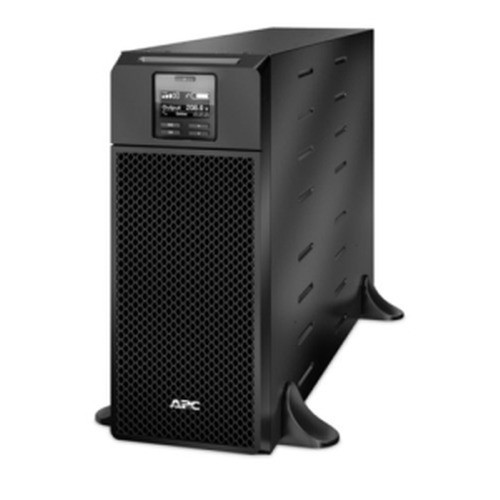
The SRT6KXLT is specified as a tower unit with an included kit, mounting position vertical, and dimensions of 17.008 in (432 mm) on one axis. Its weight is 134.99 lb (61.23 kg) with a shipping weight of 142.00 lb (64.41 kg). The two-post mountable field reads '0', indicating rack mounting in a two-post open frame is not natively supported without additional hardware. The GXT5-6000RT208 product name includes 'RT' (rackmount/tower) and references a 4U rack form factor implicit in the model number suffix, but physical dimensions and weight are not provided in the supplied specifications.
On battery, the SRT6KXLT uses a 192 V lead-acid battery pack (replacement unit APCRBC140), has a typical recharge time of 1.5 hours, and a rated battery charging power of 579 W. Battery life is stated as 3–5 years. Critically, the SRT6KXLT explicitly supports extended runtime via external battery modules (Extendable Runtime: 1), which is directly reflected in the product name ('Extended Run'). The GXT5-6000RT208 product description references 'Pre-installed GXT3/GXT4 Pods,' indicating it ships with battery extension modules already installed, but battery voltage, recharge time, expected battery life, and charging power are not stated in the provided specifications.
Storage and operating environmental ratings: the SRT6KXLT specifies an operating altitude of 0–10,000 ft, storage altitude of 0–50,000 ft, storage temperature of 5–113 °F (−15 to 45 °C), relative humidity of 0–95% non-condensing, and an IP20 ingress-protection rating. None of these environmental parameters are provided in the GXT5-6000RT208 specifications supplied.
How do the two units differ in connectivity, remote management, and integration ecosystem?
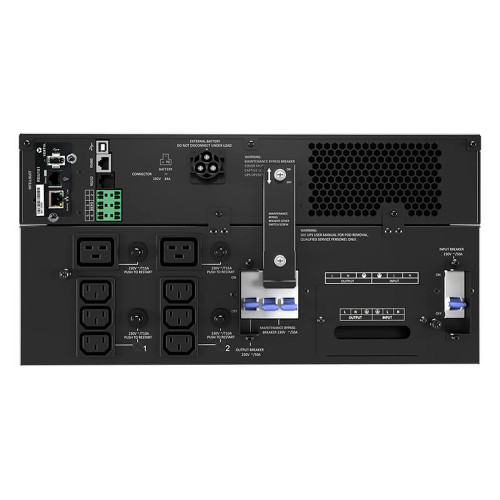
The SRT6KXLT ships with a Network Management Card 3 (NMC3) with environmental monitoring pre-installed, plus a USB port, serial port, and one additional free expansion slot for a second management card or accessory. This means out-of-box SNMP/web-based remote management, environmental sensor support (temperature probe is listed in provided equipment), and a growth path for a second network interface — all without add-on purchases. The provided equipment list also includes a Web/SNMP Management Card and USB cable.
The GXT5-6000RT208 specifications as supplied do not describe any connectivity ports, network management card, or remote-management capability. Whether the unit includes or supports a network card cannot be determined from the provided data, and buyers relying solely on the supplied specs cannot confirm equivalent management features.
The SRT6KXLT also lists audible and visible alarms prioritized by severity, and carries certifications of ENERGY STAR V2.0 (USA), FCC Part 15 Class A, NOM, and UL 1778. Its acoustic noise output is specified at 55 dBA and heat dissipation at 1,402 Btu/h — both useful for data-center thermal and noise planning. Equivalent figures for the GXT5-6000RT208 are absent from the provided specifications.
Which should you choose: the SRT6KXLT or the GXT5-6000RT208?
Our take: The SRT6KXLT is the stronger choice when a verified out-of-box remote management capability, published output-quality metrics, and full environmental ratings are required from the supplied specifications alone. The SRT6KXLT ships with a pre-installed NMC3 network management card (versus no management connectivity confirmed for the GXT5-6000RT208 from the provided data), publishes a harmonic distortion of less than 2% and a crest factor of 3:1 (no equivalent figures available for the GXT5), and documents an operating altitude ceiling of 10,000 ft and IP20 ingress protection (no environmental data provided for the GXT5). The GXT5-6000RT208 arrives with pre-installed battery extension pods, which may offer longer native runtime, but battery voltage, recharge time, and life-expectancy figures are absent, preventing a quantified runtime comparison. Buyers standardized on APC EcoStruxure or requiring SNMP management at day one should favor the SRT6KXLT; those already committed to the Vertiv ecosystem should request full GXT5 spec sheets before purchase.
Side-by-Side Comparison
Spec-for-spec, from manufacturer data.
| Specification | APC by Schneider Electric SRT6KXLT | Vertiv GXT5-6000RT208 |
|---|---|---|
| UPS Topology | Online Double-Conversion | Online Double-Conversion |
| Rated Power (VA) | 6,000 VA | 6,000 VA |
| Rated Power (W) | 6,000 W | 6,000 W (per model table) |
| Input Voltage | 208 V / 240 V AC, 1-phase | 208 V (hardwire); range not specified |
| Input Frequency | 40–70 Hz auto-sensing | — |
| Input Connection | Hard Wire 3-wire (2PH + G) | Hardwire |
| Output Voltage | 208 V / 240 V, 1-phase | 208 V |
| Waveform | Sine wave | — |
| Harmonic Distortion | < 2% | — |
| Crest Factor | 3:1 | — |
| Bypass | Internal (Automatic & Manual) | — |
| Surge Energy Rating | 480 J | — |
| Battery Type | Lead-Acid, 192 V | — |
| Typical Recharge Time | 1.5 hours | — |
| Extended Runtime Support | Yes (external battery modules) | Yes (pre-installed GXT3/GXT4 pods) |
| Network Management (included) | NMC3 with environmental monitoring | — |
| Expansion Slot | 1 free slot | — |
| Connectivity | USB, Serial, NMC3, expansion slot | — |
| Certifications | ENERGY STAR V2.0, FCC Pt.15 Class A, NOM, UL 1778 | — |
| Acoustic Noise | 55 dBA | — |
| Heat Dissipation | 1,402 Btu/h | — |
| Operating Altitude | 0–10,000 ft | — |
| IP Rating | IP20 | — |
| Weight (unit) | 134.99 lb (61.23 kg) | — |
| Mounting | Tower (kit included); 2-post rack: not supported | Rackmount/Tower (RT); dimensions not specified |
| Battery Life | 3–5 years | — |
Frequently Asked Questions
Which should you choose: the SRT6KXLT or the GXT5-6000RT208?
The SRT6KXLT is the stronger choice when a verified out-of-box remote management capability, published output-quality metrics, and full environmental ratings are required from the supplied specifications alone. The SRT6KXLT ships with a pre-installed NMC3 network management card (versus no management connectivity confirmed for the GXT5-6000RT208 from the provided data), publishes a harmonic distortion of less than 2% and a crest factor of 3:1 (no equivalent figures available for the GXT5), and documents an operating altitude ceiling of 10,000 ft and IP20 ingress protection (no environmental data provided for the GXT5). The GXT5-6000RT208 arrives with pre-installed battery extension pods, which may offer longer native runtime, but battery voltage, recharge time, and life-expectancy figures are absent, preventing a quantified runtime comparison. Buyers standardized on APC EcoStruxure or requiring SNMP management at day one should favor the SRT6KXLT; those already committed to the Vertiv ecosystem should request full GXT5 spec sheets before purchase.
Does the SRT6KXLT or the GXT5-6000RT208 include remote network management out of the box?
Based on the provided specifications, the SRT6KXLT ships with a pre-installed APC Network Management Card 3 with environmental monitoring, enabling SNMP and web-based remote management without additional purchases. The GXT5-6000RT208 specifications as supplied do not mention any included network management card or connectivity ports, so out-of-box remote management capability cannot be confirmed for that unit from the available data.
Which unit is better suited for installations that need extended battery runtime?
The SRT6KXLT explicitly supports extended runtime via external battery modules (the 'Extended Run' designation is part of the product name), and its battery architecture (192 V lead-acid, 579 W charging power, 1.5-hour recharge) is fully documented. The GXT5-6000RT208 ships with pre-installed GXT3/GXT4 battery pods, suggesting it already includes extended runtime capacity out of the box; however, battery voltage, recharge time, and expected service life are not stated in the provided specifications, making a direct numerical runtime comparison impossible from the supplied data alone.
Is the SRT6KXLT or GXT5-6000RT208 a better fit for a rack-mounted data-center deployment?
The SRT6KXLT is specified as a tower unit with a vertical mounting position; its two-post mountable field is listed as '0,' indicating two-post open-frame rack mounting is not natively supported. The GXT5-6000RT208 carries an 'RT' (rackmount/tower) designation in its model name, suggesting dual-orientation support, but physical rack dimensions, U-height, and mounting hardware details are not provided in the supplied specifications. Installers targeting a standard EIA 19-inch rack should verify rack-unit requirements and included rail hardware directly with each manufacturer before purchase.
More UPS Comparisons
- APC by Schneider Electric SRT6KXLT vs Vertiv GXT5LI-6000MVRT3UXLN
- APC by Schneider Electric SRT6KXLT vs Vertiv GXT5LI-6000GVRT3UXLN
- APC by Schneider Electric SRT6KXLT vs APC by Schneider Electric SRT6KRMXLI
- APC by Schneider Electric SRT6KXLT vs APC by Schneider Electric SRT6KRMXLIM
- APC by Schneider Electric SRT6KRMXLI vs Vertiv GXT5-6000RT208
- APC by Schneider Electric SRT6KRMXLI vs Vertiv GXT5LI-6000MVRT3UXLN
UPS Buying Guides
Get a Second Opinion on Your Camera Choice
Share your site layout, coverage goals, and budget. Our team will validate the camera selection, flag anything we would change, and recommend products that match the use case.