
APC by Schneider Electric SRT10KXLT vs Vertiv GXT5-10KHVRT5UXLN: Specification Comparison
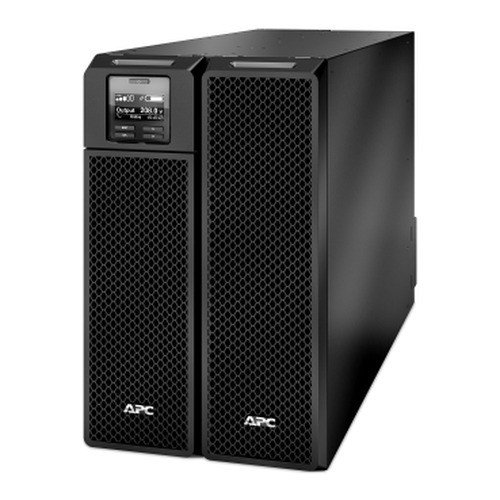
Both the APC Smart-UPS On-Line SRT10KXLT and the Vertiv GXT5-10KHVRT5UXLN are 10 kVA / 10 kW double-conversion online UPS units targeting data centers, server rooms, and critical infrastructure deployments at 208 V. This comparison evaluates their power and input flexibility, physical and environmental characteristics, and management and connectivity capabilities to help installers and IT buyers determine which unit better fits their specific operational requirements.
In This Guide
- Which UPS offers broader input voltage flexibility and more versatile output options?
- What are the physical footprint, environmental operating range, and certification differences between these two units?
- Which unit provides richer remote management, monitoring, and integration options?
- Which should you choose: the SRT10KXLT or the GXT5-10KHVRT5UXLN?
- Side-by-Side Specs
- FAQ
Which UPS offers broader input voltage flexibility and more versatile output options?
The SRT10KXLT accepts an exceptionally wide input voltage range of 100–275 V across a 40–70 Hz frequency window, making it well-suited for environments with unstable utility power or international deployments where voltage can vary significantly. Its output is selectable between 208 V and 240 V. It also specifies a surge energy rating of 480 J and a crest factor of 3:1, with 55 dB of EMI/RFI noise filtering — concrete specs that confirm active power conditioning beyond simple rectification.
The GXT5-10KHVRT5UXLN specifies an input range of 176–288 VAC (typical 208 VAC) and supports user-configurable output voltages of 200, 208, 220, 230, or 240 VAC, providing five discrete output settings versus the SRT10KXLT's two. The Vertiv unit also claims up to 98% efficiency in Active ECO Mode and up to 95% efficiency in online mode — efficiency figures that are not provided for the SRT10KXLT in the supplied specs. Wiring on the GXT5 is hardwired in/out (with supplemental receptacles), which may require licensed electrical work but eliminates plug-rating constraints at 10 kW loads. The SRT10KXLT uses plug-and-play NEMA L6-20R and L6-30R receptacles, which simplifies installation in pre-wired environments.
What are the physical footprint, environmental operating range, and certification differences between these two units?
Physical dimensions and weight are specified only for the GXT5-10KHVRT5UXLN: 8.5 in H × 16.9 in W × 24.8 in D, weighing 166.4 lbs, in a flexible rack/tower form factor (5U rack). The SRT10KXLT does not have physical dimensions or weight listed in the provided specifications, which is a meaningful gap for installers planning rack space and floor loading.
Operating temperature is likewise specified only for the GXT5-10KHVRT5UXLN at +32 to +104 °F (0–40 °C). No operating temperature range is provided for the SRT10KXLT in the supplied specs. On certifications, the GXT5-10KHVRT5UXLN carries ENERGY STAR 2.0, UL1778, c-UL, RoHS2, and REACH listings. No equivalent certification data is provided for the SRT10KXLT. Buyers with regulatory, green-procurement, or RoHS compliance requirements should note this gap and verify APC certifications independently from manufacturer documentation.
Which unit provides richer remote management, monitoring, and integration options?
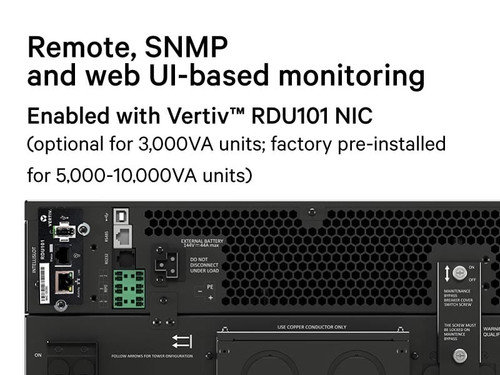
The GXT5-10KHVRT5UXLN ships with a factory pre-installed Vertiv Liebert IntelliSlot RDU120 SNMP/web card as standard equipment, enabling out-of-the-box network monitoring and management via SNMP and a web interface, plus RS485, RS232, USB, terminal block, and external battery connector interfaces. The full-color graphic LCD with gravity-sensing orientation adds on-unit diagnostics. SNMP and web management are live without any add-on card purchase.
The SRT10KXLT provides 2 × RJ-45 Ethernet ports (10/100Base-T) and 1 USB port, along with an audible alarm. However, the supplied specs do not state whether a network management card is included or must be purchased separately — a critical distinction for buyers comparing total out-of-box management capability. The presence of dual Ethernet ports and 10/100Base-T connectivity suggests network management capability, but the specific card inclusion status is not confirmed by the provided data. Buyers should verify with APC whether a NMC is bundled.
Which should you choose: the SRT10KXLT or the GXT5-10KHVRT5UXLN?
Our take: The GXT5-10KHVRT5UXLN is the stronger choice when certified energy efficiency, out-of-box SNMP management, and five-position configurable output voltage are priorities. Key spec deltas: (1) Efficiency — Vertiv specifies up to 98% in ECO Mode and 95% in online mode; APC provides no efficiency figure. (2) Output voltage configurability — Vertiv offers 200/208/220/230/240 VAC user-selectable versus APC's 208–240 V range with no discrete steps listed. (3) Certifications — Vertiv carries ENERGY STAR 2.0, UL1778, c-UL, RoHS2, and REACH; APC certifications are absent from the provided specs. Conversely, the SRT10KXLT's 100–275 V input range significantly exceeds the Vertiv's 176–288 V window, making it the better fit for sites with highly variable or non-standard utility input. The SRT10KXLT also uses NEMA receptacles, easing installation without electricians. Choose the Vertiv for compliance-driven or efficiency-sensitive data centers; choose the APC for wide-input-range flexibility and plug-based installation simplicity.
Side-by-Side Comparison
Spec-for-spec, from manufacturer data.
| Specification | APC by Schneider Electric SRT10KXLT | Vertiv GXT5-10KHVRT5UXLN |
|---|---|---|
| UPS Topology | Double-conversion (Online) | On-line double conversion |
| Power Rating (VA) | 10,000 VA | 10,000 VA |
| Power Rating (W) | 10,000 W | 10,000 W |
| Input Voltage Range | 100–275 V | 176–288 VAC (typical 208 VAC) |
| Input Frequency | 40–70 Hz | — |
| Output Voltage | 208–240 V | 200/208/220/230/240 VAC (user-configurable) |
| Efficiency | — | Up to 98% (ECO Mode); up to 95% (online) |
| Waveform | Sine | — |
| Surge Energy Rating | 480 J | — |
| EMI/RFI Filtering | 55 dB | — |
| Crest Factor | 3:1 | — |
| AC Outlets | 6 (NEMA L6-20R × some, L6-30R × some) | 2× L6-20R, 2× L6-30R (+ hardwired in/out) |
| Network Interface | 2× RJ-45 (10/100Base-T) | Factory pre-installed IntelliSlot RDU120 SNMP/web card |
| Additional Interfaces | USB | USB, RS485, RS232, terminal block, ext. battery connector |
| Certifications | — | ENERGY STAR 2.0, UL1778, c-UL, RoHS2, REACH |
| Operating Temperature | — | +32 to +104 °F (0–40 °C) |
| Weight | — | 166.4 lbs |
| Dimensions (H×W×D) | — | 8.5 × 16.9 × 24.8 in |
Frequently Asked Questions
Which should you choose: the SRT10KXLT or the GXT5-10KHVRT5UXLN?
The GXT5-10KHVRT5UXLN is the stronger choice when certified energy efficiency, out-of-box SNMP management, and five-position configurable output voltage are priorities. Key spec deltas: (1) Efficiency — Vertiv specifies up to 98% in ECO Mode and 95% in online mode; APC provides no efficiency figure. (2) Output voltage configurability — Vertiv offers 200/208/220/230/240 VAC user-selectable versus APC's 208–240 V range with no discrete steps listed. (3) Certifications — Vertiv carries ENERGY STAR 2.0, UL1778, c-UL, RoHS2, and REACH; APC certifications are absent from the provided specs. Conversely, the SRT10KXLT's 100–275 V input range significantly exceeds the Vertiv's 176–288 V window, making it the better fit for sites with highly variable or non-standard utility input. The SRT10KXLT also uses NEMA receptacles, easing installation without electricians. Choose the Vertiv for compliance-driven or efficiency-sensitive data centers; choose the APC for wide-input-range flexibility and plug-based installation simplicity.
Does either UPS include a network management card in the box, or is it an extra purchase?
Based on the provided specifications, the GXT5-10KHVRT5UXLN includes a factory pre-installed Vertiv Liebert IntelliSlot RDU120 SNMP/web card as standard, enabling SNMP and web management without an additional purchase. The SRT10KXLT lists two RJ-45 Ethernet ports but the provided specs do not confirm whether a network management card is bundled or sold separately. Buyers should verify the SRT10KXLT's included accessories with APC before purchasing.
Which unit is better suited for a site with unstable or variable utility power?
The SRT10KXLT specifies a wide input operating voltage range of 100–275 V across 40–70 Hz, which is notably broader than the GXT5-10KHVRT5UXLN's 176–288 VAC range. For sites with significant voltage fluctuation, international deployments, or non-standard utility feeds, the SRT10KXLT's wider input tolerance provides a material advantage. Both are double-conversion online UPS units, so both rectify and re-invert power regardless — but the wider window before the SRT10KXLT transfers to battery gives it more headroom.
Is the GXT5-10KHVRT5UXLN or the SRT10KXLT easier to install in a standard data center rack?
The GXT5-10KHVRT5UXLN specifies a 5U rack/tower form factor with dimensions of 8.5 in H × 16.9 in W × 24.8 in D and a weight of 166.4 lbs. Physical dimensions and weight are not provided for the SRT10KXLT in the available specifications. The GXT5 uses hardwired input/output (with supplemental L6-20R and L6-30R receptacles), which requires electrical rough-in but has no plug ampacity ceiling. The SRT10KXLT uses NEMA L6-20R and L6-30R plug connections, which simplifies installation in pre-wired facilities. Installers should obtain APC's dimensional data sheet for the SRT10KXLT before finalizing rack layout.
More UPS Comparisons
- APC by Schneider Electric SRTL10KRM4UT-5KTF2 vs Panduit U10N32V
- APC by Schneider Electric SRTL10KRM4UT-5KTF2 vs Panduit U10N11V
- APC by Schneider Electric SRTL10KRM4UT-5KTF2 vs Panduit U10N12V
- APC by Schneider Electric SRTL10KRM4UT-5KTF2 vs Vertiv GXT5-10KHVRT5UXLN
- APC by Schneider Electric SRTL10KRM4UT-5KTF2 vs APC by Schneider Electric E3SUPS10KFBS
- APC by Schneider Electric SRTL10KRM4UT-5KTF2 vs APC by Schneider Electric SRT10KRMXLT-10KTF
UPS Buying Guides
Get a Second Opinion on Your Camera Choice
Share your site layout, coverage goals, and budget. Our team will validate the camera selection, flag anything we would change, and recommend products that match the use case.