
APC by Schneider Electric SMTL1500RM3UCUS vs CyberPower PR1500LCD: Specification Comparison
Both the APC SMTL1500RM3UCUS and the CyberPower PR1500LCD are 1500VA line-interactive UPS units designed for North American 120V environments, making them direct cross-shop candidates for IT closets, security head-end rooms, and small server deployments. The comparison spans three decision-relevant axes: power capacity and output quality, battery technology and runtime behavior, and physical form factor with management capabilities. Buyers choosing between these two are weighing APC's rack-mount lithium-ion platform against CyberPower's tower-format sealed lead-acid system.
In This Guide
- Which UPS delivers cleaner, more usable power output at 1500VA?
- How do battery technology and runtime compare between these two units?
- Which unit better fits rack-mount security or IT infrastructure with remote management needs?
- Which should you choose: the SMTL1500RM3UCUS or the PR1500LCD?
- Side-by-Side Specs
- FAQ
Which UPS delivers cleaner, more usable power output at 1500VA?
The APC SMTL1500RM3UCUS is rated at 1,350W / 1,440VA of configurable output power — notably below its 1,500VA nameplate — while the CyberPower PR1500LCD is rated at a full 1,500W / 1,500VA, giving it a higher real-power ceiling by 150W. Both units produce a true sine wave under battery, which is the correct waveform for active PFC power supplies common in servers and NVRs.
On output quality, APC specifies voltage distortion of less than 5% and a transfer time of 6ms typical / 10ms maximum. CyberPower specifies output voltage regulation of 120VAC ±5% and a transfer time of less than 4ms — a measurably faster switchover. CyberPower also explicitly lists Active PFC compatibility and Automatic Voltage Regulation (AVR) as named features; APC's specs do not enumerate AVR as a labeled feature, though its line-interactive topology implies it.
For surge suppression, APC lists a 680-joule surge energy rating with full-time multi-pole noise filtering meeting UL 1449, and specifies 0.3% IEEE surge let-through with zero clamping response time. CyberPower lists EMI/RFI filtration and a $375,000 connected equipment guarantee but does not state a joule rating in the provided specs. APC's surge specification is therefore more granular and verifiable from the provided data.
How do battery technology and runtime compare between these two units?
The battery chemistry differs fundamentally. The APC SMTL1500RM3UCUS uses a Lithium-Ion battery with an expected service life of 5–10 years and a typical recharge time of 2 hours. The CyberPower PR1500LCD uses two sealed lead-acid (SLA) 12V/17Ah batteries; no expected service life is stated in the provided specs, but SLA batteries in comparable UPS units typically require replacement every 3–5 years.
On runtime, CyberPower provides explicit figures: 4.7 minutes at full 1,500W load and 15.1 minutes at half load (750W). APC does not provide runtime figures in the supplied specifications. APC does list a 310 VAh battery capacity and 154W battery charge power, from which runtime can be estimated, but no direct minute-based figures are present for apples-to-apples comparison.
CyberPower's SLA battery is listed as hot-swappable, meaning replacement can occur without powering down connected equipment. APC's spec sheet does not explicitly state hot-swap capability for its lithium-ion pack. APC's longer expected battery life (5–10 years) reduces replacement frequency, which is a total-cost-of-ownership consideration over a multi-year deployment.
Which unit better fits rack-mount security or IT infrastructure with remote management needs?
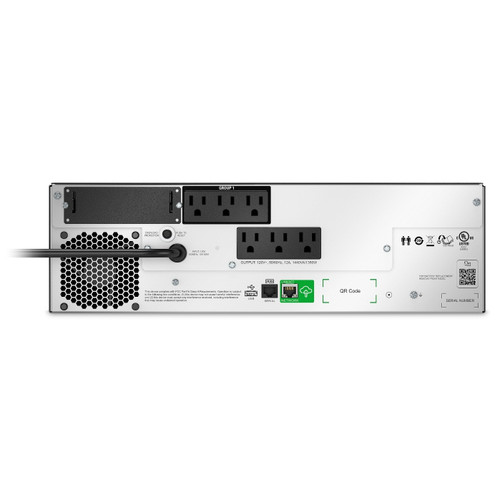
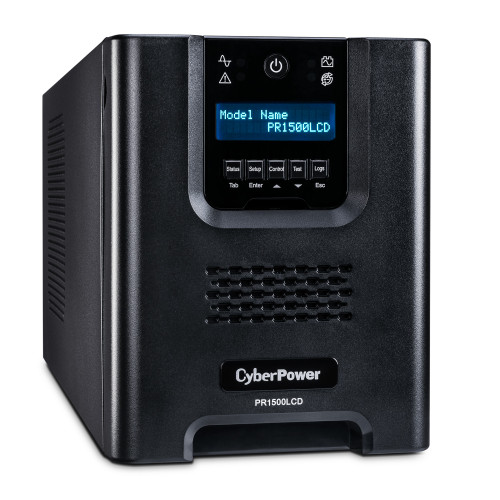
The APC SMTL1500RM3UCUS is a rack-mount unit at 5.14" H × 17.25" W × 11.89" D, weighing 43 lbs, and ships with rack mounting support rails included. Its 11.89" depth qualifies it as a short-depth model, fitting shallow-depth racks common in security head-end cabinets. The CyberPower PR1500LCD is a mini-tower at 6.7" W × 8.7" H × 17" D, weighing 54 lbs — it is not rack-mountable per the provided specs.
For management interfaces, APC provides RJ-45 Serial, a Smart-Slot (for optional network management cards), and USB, plus a multi-function LCD control panel. CyberPower provides USB, Serial, and SNMP connectivity, with an extendable multifunction LCD panel. SNMP is listed explicitly for CyberPower but is not listed in APC's interface specs — APC's Smart-Slot expansion slot would require a separately purchased network management card to achieve SNMP.
APC lists IP20 ingress protection and an operating elevation of up to 10,000 ft (3,000m), with storage elevation to 25,000 ft (7,500m). CyberPower does not list an IP rating or elevation spec in the provided data. Both units share an identical operating temperature range of 32–104°F (0–40°C). APC carries TAA compliance per its product name, relevant for US federal procurement; CyberPower's specs do not mention TAA compliance.
Which should you choose: the SMTL1500RM3UCUS or the PR1500LCD?
Our take: The SMTL1500RM3UCUS is the stronger choice when the deployment is rack-mounted, has shallow-depth cabinet constraints, requires TAA compliance, or prioritizes long battery service life. Three concrete spec differences drive this: APC's lithium-ion battery carries a stated 5–10 year expected life versus no specified life for CyberPower's SLA pack; APC's 11.89" short-depth rack form factor fits cabinets where the CyberPower tower cannot; and APC includes a Smart-Slot for optional network management card expansion, whereas CyberPower delivers SNMP natively but without an expansion path noted in specs. Conversely, the PR1500LCD is the stronger choice when budget and raw watt capacity matter — it delivers a full 1,500W output (150W more than APC's 1,350W ceiling), switches in under 4ms versus APC's 10ms maximum, provides explicit runtime figures (4.7 min full / 15.1 min half load), and includes a hot-swappable SLA battery. Buyers with floor-standing or desktop installations who need documented runtime guarantees will find the CyberPower spec sheet more immediately actionable.
Side-by-Side Comparison
Spec-for-spec, from manufacturer data.
| Specification | APC by Schneider Electric SMTL1500RM3UCUS | CyberPower PR1500LCD |
|---|---|---|
| Rated Capacity (VA) | 1,440 VA | 1,500 VA |
| Rated Capacity (Watts) | 1,350 W | 1,500 W |
| Output Waveform | Sine wave | True Sine Wave |
| Topology | Line Interactive (implied) | Line Interactive with AVR |
| Transfer Time | 6ms typical / 10ms max | < 4 ms |
| Output Voltage Distortion | < 5% | 120VAC ± 5% |
| Battery Type | Lithium-Ion | Sealed Lead-Acid (2 × 12V/17Ah) |
| Expected Battery Life | 5–10 years | — |
| Battery Recharge Time | 2 hours | — |
| Hot-Swappable Battery | — | Yes |
| Runtime at Full Load | — | 4.7 min at 1,500W |
| Runtime at Half Load | — | 15.1 min at 750W |
| Form Factor | Rack-Mount (short depth) | Mini-Tower |
| Unit Dimensions (H×W×D) | 5.14" × 17.25" × 11.89" | 8.7" × 6.7" × 17" |
| Weight | 43 lbs (19.5 kg) | 54 lbs |
| Management Interfaces | RJ-45 Serial, Smart-Slot, USB | USB / Serial / SNMP |
| Surge Energy Rating | 680 Joules | — |
| TAA Compliant | Yes | — |
| IP Rating | IP 20 | — |
| Max Operating Elevation | 10,000 ft (3,000 m) | — |
| Operating Temperature | 32–104°F (0–40°C) | 32–104°F (0–40°C) |
| Certifications | CSA C22.2, FCC Class A, NOM, UL 1778, UL 1973, RoHS | UL1778, cUL 107.3, FCC DOC Class A, Energy Star, RoHS |
| Connected Equipment Guarantee | — | $375,000 |
| Warranty | — | 3 Year Limited |
Frequently Asked Questions
Which should you choose: the SMTL1500RM3UCUS or the PR1500LCD?
The SMTL1500RM3UCUS is the stronger choice when the deployment is rack-mounted, has shallow-depth cabinet constraints, requires TAA compliance, or prioritizes long battery service life. Three concrete spec differences drive this: APC's lithium-ion battery carries a stated 5–10 year expected life versus no specified life for CyberPower's SLA pack; APC's 11.89" short-depth rack form factor fits cabinets where the CyberPower tower cannot; and APC includes a Smart-Slot for optional network management card expansion, whereas CyberPower delivers SNMP natively but without an expansion path noted in specs. Conversely, the PR1500LCD is the stronger choice when budget and raw watt capacity matter — it delivers a full 1,500W output (150W more than APC's 1,350W ceiling), switches in under 4ms versus APC's 10ms maximum, provides explicit runtime figures (4.7 min full / 15.1 min half load), and includes a hot-swappable SLA battery. Buyers with floor-standing or desktop installations who need documented runtime guarantees will find the CyberPower spec sheet more immediately actionable.
Is the SMTL1500RM3UCUS or PR1500LCD better for a security rack with limited cabinet depth?
The SMTL1500RM3UCUS is the purpose-built choice here. It is a rack-mount unit with an 11.89" depth and ships with rack rails included — explicitly designed for short-depth rack cabinets. The PR1500LCD is a mini-tower form factor and is not listed as rack-mountable in the provided specs, so it would need to sit on a shelf or floor rather than mount in a rack.
Which UPS has longer-lasting batteries and lower maintenance overhead?
Based on the provided specs, the SMTL1500RM3UCUS has a stated battery life of 5–10 years for its lithium-ion pack, which is meaningfully longer than the typical 3–5 year cycle of sealed lead-acid batteries like those in the PR1500LCD (no service life is stated in CyberPower's provided specs). The PR1500LCD does list hot-swappable SLA batteries, making field replacement easier when it does occur; APC's spec sheet does not explicitly confirm hot-swap capability for its lithium-ion battery.
Does either UPS support SNMP monitoring out of the box for integration with a network management system?
The PR1500LCD lists SNMP connectivity directly in its spec sheet, suggesting native SNMP capability. The SMTL1500RM3UCUS does not list SNMP in its interface specs — it provides RJ-45 Serial, USB, and a Smart-Slot expansion bay. Achieving SNMP on the APC unit would require purchasing a compatible network management card separately to populate the Smart-Slot. If out-of-box SNMP is required, the PR1500LCD has the advantage based on the provided specifications.
More UPS Comparisons
- APC by Schneider Electric SMX1500RMI2U vs CyberPower PRL1500RT2UC
- APC by Schneider Electric SMX1500RMI2U vs CyberPower BRG1500AVRLCD2
- APC by Schneider Electric SMX1500RMI2U vs CyberPower PR1500LCD
- APC by Schneider Electric SMX1500RMI2U vs APC by Schneider Electric BR1500MS2
- APC by Schneider Electric SMX1500RMI2U vs APC by Schneider Electric SMTL1500RM3UCUS
- CyberPower PRL1500RT2UC vs APC by Schneider Electric BR1500MS2
UPS Buying Guides
Get a Second Opinion on Your Camera Choice
Share your site layout, coverage goals, and budget. Our team will validate the camera selection, flag anything we would change, and recommend products that match the use case.