
APC by Schneider Electric SMTL1500RM3UC vs CyberPower BRG1500AVRLCD2: Specification Comparison
Both the APC SMTL1500RM3UC and the CyberPower BRG1500AVRLCD2 are 1500VA line-interactive UPS units designed for 120V North American environments, making them legitimate cross-shop candidates for anyone sizing backup power for network closets, security appliances, or workstation clusters. The comparison spans three decision axes critical to UPS selection: power capacity and output quality, battery technology and runtime characteristics, and physical form factor with management and interface options.
In This Guide
- Which unit delivers cleaner, higher-capacity output power?
- How do battery technology and runtime characteristics compare?
- How do the two units differ in physical form factor, connectivity, and management capabilities?
- Which should you choose: the SMTL1500RM3UC or the BRG1500AVRLCD2?
- Side-by-Side Specs
- FAQ
Which unit delivers cleaner, higher-capacity output power?
The APC SMTL1500RM3UC is rated at 1,350W / 1,440VA usable output power. Its inverter produces a true sine wave, which is the correct waveform for active PFC power supplies found in modern servers, NVRs, and managed switches. Output voltage distortion is specified at less than 5%, and transfer time is 6ms typical with a 10ms maximum. Surge energy rating is 680 joules, and filtering is described as full-time multi-pole noise filtering meeting the 0.3% IEEE surge let-through threshold with zero clamping response time.
The CyberPower BRG1500AVRLCD2 is rated at 900W / 1,500VA. This is a meaningfully lower watt figure — 450W less than the APC — reflecting a lower power factor. Its inverter produces a simulated sine wave (also called stepped approximation), which is not guaranteed compatible with active PFC supplies. Output voltage is held within ±5%. Surge suppression is rated at 1,500 joules — higher than the APC's 680 joules — and EMI/RFI filtration is listed as present, though no IEEE surge let-through figure is specified. Automatic voltage regulation spans ±10% boost/buck, and the input voltage window is stated as 57–120VAC, which is unusually wide on the low end and implies aggressive AVR engagement on degraded utility lines.
For loads containing active PFC power supplies, the sine wave output of the SMTL1500RM3UC is the specification-supported choice. The CyberPower's higher joule rating is a point in its favor for pure surge suppression duty, but its lower watt capacity and simulated sine wave are material limitations for sensitive or PFC-equipped loads.
How do battery technology and runtime characteristics compare?
The SMTL1500RM3UC uses a Lithium-Ion battery with a rated capacity of 310 VAh and a charge power of 154W. APC specifies a recharge time of 2 hours and projects an expected battery life of 5–10 years. Lithium-Ion chemistry is lighter, tolerates more partial-state-of-charge cycling, and maintains capacity across a wider temperature range than sealed lead-acid. APC does not publish a runtime table in the provided specifications; runtime figures are not available for direct comparison.
The BRG1500AVRLCD2 uses two 12V/9Ah sealed lead-acid (SLA) batteries — a conventional VRLA chemistry. CyberPower specifies runtime as 12 minutes at 450W (half load) and 2 minutes at 900W (full load). Battery recharge time and projected battery life are not stated in the provided specifications. SLA batteries typically require replacement every 3–5 years under normal conditions, though CyberPower does not state a life figure here.
The CyberPower is the only unit with published runtime figures in the provided data. The APC's lithium-ion chemistry carries a spec-stated 5–10 year expected life advantage, but without a published runtime curve, a direct runtime comparison cannot be made from the available specifications alone.
How do the two units differ in physical form factor, connectivity, and management capabilities?
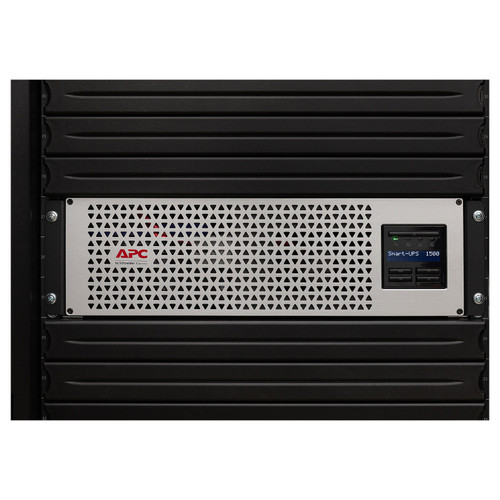
The SMTL1500RM3UC is a 3U rackmount chassis measuring 5.14" H × 17.25" W × 11.89" D and weighing 43 lb. It ships with rack mounting support rails included. Management interfaces include RJ-45 serial, a proprietary Smart-Slot expansion bay (for optional network management cards), and USB. The front panel is a multi-function LCD. The unit ships with an RS-232 signaling cable and USB cable. Outlet count and outlet configuration are not specified in the provided data. The IP rating is IP 20.
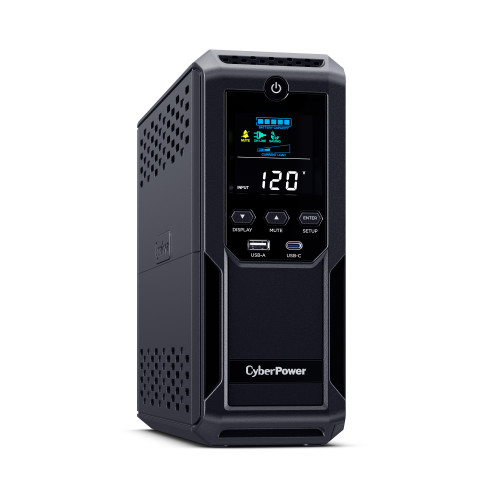
The BRG1500AVRLCD2 is a mini-tower chassis measuring 3.94" W × 10.2" H × 13.78" D and weighing 23.8 lb — 19.2 lb lighter than the APC. It provides 12 total NEMA 5-15R outlets: 6 battery-backed plus surge, and 6 surge-only. Connectivity includes USB and DB9 serial; optional SNMP/HTTP management is available via a separately purchased RMCARD. Two USB charging ports are included (1× USB-A 2.4A, 1× USB-C 18W PD). Data line protection is provided via RJ-45 Ethernet pass-through. The 6 ft input power cord terminates in a NEMA 5-15P plug. Included software is PowerPanel Personal, compatible with Windows, Mac, and Linux. Warranty is stated as 5 years; a $500,000 connected equipment guarantee is specified.
The APC is purpose-built for rack environments and offers a hardware expansion slot for enterprise network management. The CyberPower is a desktop/tower unit targeting decentralized or edge placements; its 12-outlet count and USB charging ports address multi-device desktop deployments. The APC's outlet count is not published in the provided specifications, preventing a direct outlet-count comparison.
Which should you choose: the SMTL1500RM3UC or the BRG1500AVRLCD2?
Our take: The SMTL1500RM3UC is the stronger choice when the load includes active PFC power supplies, the installation is rack-based, or long battery service life is operationally important. Its true sine wave output (vs. simulated sine wave), 1,350W capacity (vs. 900W — a 450W advantage), lithium-ion battery with a spec-stated 5–10 year life, and a hardware Smart-Slot expansion bay for enterprise network management cards are concrete differentiators that favor rack-mounted NVR, server, or network switch deployments. The BRG1500AVRLCD2 is the appropriate selection when the deployment is desktop/tower form factor, outlet count matters (12 outlets vs. unspecified for the APC), runtime figures must be confirmed pre-purchase (12 min at half load is published; the APC's runtime is not stated in available specs), or when the higher surge joule rating (1,500J vs. 680J) and included USB device charging ports align with the use case. Neither unit's price is available for comparison.
Side-by-Side Comparison
Spec-for-spec, from manufacturer data.
| Specification | APC by Schneider Electric SMTL1500RM3UC | CyberPower BRG1500AVRLCD2 |
|---|---|---|
| Topology | Line-Interactive | Line-Interactive |
| Capacity (VA) | 1,440 VA | 1,500 VA |
| Capacity (Watts) | 1,350 W | 900 W |
| Output Waveform | Sine wave | Simulated sine wave |
| Output Voltage Distortion | Less than 5% | ±5% |
| Transfer Time | 6 ms typical / 10 ms max | — |
| Automatic Voltage Regulation | — | ±10% boost/buck |
| Surge Energy Rating (Joules) | 680 J | 1,500 J |
| Battery Type | Lithium-Ion | Sealed Lead-Acid (2× 12V/9Ah) |
| Expected Battery Life | 5–10 years | — |
| Recharge Time | 2 hours | — |
| Published Runtime (Half Load) | — | 12 min at 450 W |
| Published Runtime (Full Load) | — | 2 min at 900 W |
| Form Factor | 3U Rackmount | Mini-Tower |
| Dimensions (W × H × D) | 17.25 × 5.14 × 11.89 in | 3.94 × 10.2 × 13.78 in |
| Weight | 43 lb (19.5 kg) | 23.8 lb |
| Total Outlets | — | 12× NEMA 5-15R |
| Battery-Backed Outlets | — | 6 |
| Surge-Only Outlets | — | 6 |
| Management Interfaces | RJ-45 Serial, Smart-Slot, USB | USB, DB9 Serial, Optional SNMP/HTTP card |
| USB Charging Ports | — | 1× USB-A 2.4A, 1× USB-C 18W PD |
| Data Line Protection | — | RJ-45 Ethernet in/out |
| LCD Display | Multi-function LCD | Multifunction LCD (load, runtime, voltage, battery, faults) |
| Input Frequency | 50/60 Hz ±3 Hz | — |
| Output Frequency | 50/60 Hz ±3 Hz | — |
| Input Voltage Range | — | 57–120 VAC |
| Operating Temperature | 32–104°F (0–40°C) | 32–104°F (0–40°C) |
| IP Rating | IP 20 | — |
| Certifications | UL 1778, UL 1973, CSA C22.2 No. 107.3, FCC Part 15 Class A, NOM, RoHS | UL1778, cUL 107 5th, FCC Class B, RoHS, ENERGY STAR |
| Connected Equipment Guarantee | — | $500,000 |
| Warranty | — | 5 years |
| Included Software | — | PowerPanel Personal (Windows/Mac/Linux) |
| Rack Rails Included | Yes | — |
Frequently Asked Questions
Which should you choose: the SMTL1500RM3UC or the BRG1500AVRLCD2?
The SMTL1500RM3UC is the stronger choice when the load includes active PFC power supplies, the installation is rack-based, or long battery service life is operationally important. Its true sine wave output (vs. simulated sine wave), 1,350W capacity (vs. 900W — a 450W advantage), lithium-ion battery with a spec-stated 5–10 year life, and a hardware Smart-Slot expansion bay for enterprise network management cards are concrete differentiators that favor rack-mounted NVR, server, or network switch deployments. The BRG1500AVRLCD2 is the appropriate selection when the deployment is desktop/tower form factor, outlet count matters (12 outlets vs. unspecified for the APC), runtime figures must be confirmed pre-purchase (12 min at half load is published; the APC's runtime is not stated in available specs), or when the higher surge joule rating (1,500J vs. 680J) and included USB device charging ports align with the use case. Neither unit's price is available for comparison.
Is the SMTL1500RM3UC or BRG1500AVRLCD2 compatible with servers and NVRs that have active PFC power supplies?
Based on the provided specifications, the SMTL1500RM3UC produces a true sine wave output, which is the waveform required by active PFC power supplies commonly found in servers, NVRs, and managed network equipment. The BRG1500AVRLCD2 produces a simulated sine wave; active PFC supplies may not operate correctly or safely on simulated sine wave during battery mode. If your load includes active PFC equipment, the SMTL1500RM3UC is the specification-supported choice.
Which unit has a longer battery life and does it need to be replaced sooner?
The SMTL1500RM3UC uses lithium-ion batteries with a spec-stated expected life of 5–10 years. The BRG1500AVRLCD2 uses sealed lead-acid (2× 12V/9Ah); CyberPower does not state an expected battery life figure in the provided specifications. SLA batteries in line-interactive UPS units conventionally require replacement every 3–5 years, but that figure is not from CyberPower's published spec and cannot be confirmed here. The APC's lithium-ion chemistry carries a documented longevity advantage based on available data.
Which UPS is better suited for a rack cabinet installation versus a desktop or shelf deployment?
The SMTL1500RM3UC is specifically a 3U rackmount unit (5.14" H × 17.25" W) and ships with rack mounting support rails. It is designed exclusively for rack-cabinet installation. The BRG1500AVRLCD2 is a mini-tower unit (3.94" W × 10.2" H) intended for desktop, shelf, or floor placement. It cannot be rack-mounted based on the provided specifications. Form factor is therefore a hard deployment constraint: rack environment favors the APC; desktop or distributed edge placement favors the CyberPower.
More UPS Comparisons
- APC by Schneider Electric SMX1500RMI2U vs CyberPower PRL1500RT2UC
- APC by Schneider Electric SMX1500RMI2U vs CyberPower BRG1500AVRLCD2
- APC by Schneider Electric SMX1500RMI2U vs CyberPower PR1500LCD
- APC by Schneider Electric SMX1500RMI2U vs APC by Schneider Electric BR1500MS2
- APC by Schneider Electric SMX1500RMI2U vs APC by Schneider Electric SMTL1500RM3UCUS
- CyberPower PRL1500RT2UC vs APC by Schneider Electric BR1500MS2
UPS Buying Guides
Get a Second Opinion on Your Camera Choice
Share your site layout, coverage goals, and budget. Our team will validate the camera selection, flag anything we would change, and recommend products that match the use case.