
Altronix NETWAYSP4WP vs Altronix NETWAY4EWPX: Specification Comparison
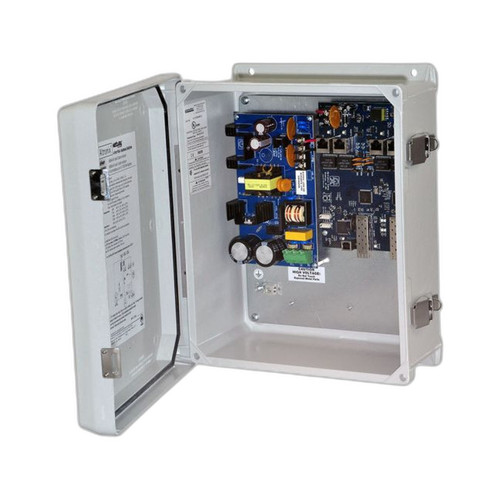
Both the Altronix NETWAYSP4WP and NETWAY4EWPX are 4-port managed PoE+ switches housed in NEMA 4/4X, IP66-rated outdoor enclosures with integrated battery chargers and a 120W PoE budget — squarely the same product class. The comparison turns on fiber uplink count, mounting flexibility, physical dimensions, and management supervision features. Neither unit is an accessory; both are deployable edge switches for outdoor security installations involving IP cameras, access control panels, and similar PoE-powered devices.

In This Guide
- How do the port counts, fiber uplinks, and PoE delivery compare between the two switches?
- How do the enclosures, mounting options, power systems, and environmental ratings differ?
- What management, supervision, and integration capabilities does each switch offer?
- Which should you choose: the NETWAYSP4WP or the NETWAY4EWPX?
- Side-by-Side Specs
- FAQ
How do the port counts, fiber uplinks, and PoE delivery compare between the two switches?
Both switches provide four 10/100/1000 Mbps Gigabit PoE/PoE+ data ports with a shared 120W total PoE budget and dual 60W Hi-PoE capability on two ports — that tier of delivery is identical.
The NETWAYSP4WP specifies two 1G SFP fiber uplink ports, giving it dual backbone paths for redundancy or ring topologies. The NETWAY4EWPX specifies a single 1G SFP fiber uplink; the transceiver is noted as not included. For installations requiring a second fiber path or a ring-protection topology, the NETWAYSP4WP's dual SFP ports are the differentiator.
Standard PoE (15.4W per port per 802.3af) is explicitly cited for the NETWAYSP4WP's four PoE ports alongside the 60W Hi-PoE mode on two ports. The NETWAY4EWPX specifies PoE/PoE+ (802.3at, 30W max) on all four ports; explicit 802.3af fallback mode is not stated in the provided specs.
How do the enclosures, mounting options, power systems, and environmental ratings differ?
Both units carry NEMA 4/4X and IP66 ratings for outdoor use and both integrate a battery charger for backup power. Environmental suitability is equivalent at the rating level.
The NETWAYSP4WP enclosure is specified as stainless steel. The NETWAY4EWPX enclosure material is not stated in the provided specs. The NETWAY4EWPX provides physical dimensions (17.53" × 15.3" × 6.67"); no dimensions are listed for the NETWAYSP4WP.
The NETWAY4EWPX supports wall, pole, and rack mounting. The NETWAYSP4WP lists pole mounting only. For rack-mount or wall-mount installations the NETWAY4EWPX offers greater flexibility; for pole-only deployments both qualify.
The NETWAY4EWPX specifies a storage temperature range of –40°C to 85°C (–40°F to 185°F); operating temperature range is not stated for either model in the provided specs. The NETWAYSP4WP has no storage temperature data in the provided specs.
What management, supervision, and integration capabilities does each switch offer?
Both switches are described as Layer 2 managed with VLAN, QoS, and Spanning Tree Protocol — the foundational managed-switch feature set is equivalent.
The NETWAY4EWPX additionally carries Altronix LINQ supervision, which is Altronix's remote monitoring and management platform. LINQ supervision is not listed for the NETWAYSP4WP in the provided specs. For installations where centralized Altronix LINQ-based remote monitoring of switch health and power status is required, the NETWAY4EWPX is the only option of the two that explicitly supports it.
Neither model lists third-party VMS or access-control platform integrations beyond standard Layer 2 managed switching in the provided specs. Compatible accessories for the NETWAY4EWPX are noted as orderable separately but are not enumerated in the provided specs.
Which should you choose: the NETWAYSP4WP or the NETWAY4EWPX?
Our take: The NETWAYSP4WP is the stronger choice when dual fiber uplinks and a stainless steel enclosure are required — for example, fiber ring topologies or corrosive outdoor environments. Concretely: it ships with two 1G SFP ports versus the NETWAY4EWPX's single SFP uplink; its enclosure is explicitly stainless steel where the NETWAY4EWPX enclosure material is unspecified; and it explicitly supports standard 15.4W PoE alongside Hi-PoE on the same four ports. Conversely, the NETWAY4EWPX is the stronger choice when LINQ remote supervision is required, when wall or rack mounting is needed (it supports wall/pole/rack versus pole-only for the NETWAYSP4WP), or when a known physical footprint matters at planning time (17.53" × 15.3" × 6.67" is specified; no dimensions are provided for the NETWAYSP4WP). PoE budget (120W), Hi-PoE capability (dual 60W), management tier (Layer 2, VLAN/QoS/STP), battery backup, and IP66/NEMA 4/4X ratings are equivalent across both units.
Side-by-Side Comparison
Spec-for-spec, from manufacturer data.
| Specification | Altronix NETWAYSP4WP | Altronix NETWAY4EWPX |
|---|---|---|
| Product Type | PoE Switch | PoE Switch |
| PoE Data Ports | 4 × 10/100/1000 Mbps Gigabit | 4 × Gigabit PoE/PoE+ |
| PoE Standard | PoE+ (802.3at); 802.3af also noted | PoE+ (802.3at) |
| PoE Budget (Total) | 120W | 120W |
| Hi-PoE Capability | 2 ports × 60W | 2 ports × 60W |
| Fiber Uplink Ports | 2 × 1G SFP | 1 × 1G SFP (transceiver not included) |
| Management | Layer 2; VLAN, STP, QoS | Layer 2+; VLAN, QoS, Spanning Tree |
| Supervision | — | Altronix LINQ |
| Enclosure Rating | NEMA 4/4X, IP66 | NEMA 4/4X, IP66 |
| Enclosure Material | Stainless steel | — |
| Mount Type | Pole | Wall; Pole; Rack |
| Battery Backup | Yes (integrated charger) | Yes (integrated charger; supports Altronix backup modules) |
| Environment Rating | Outdoor | Outdoor |
| Dimensions | — | 17.53" × 15.3" × 6.67" |
| Storage Temperature | — | –40°C to 85°C (–40°F to 185°F) |
| Warranty | Lifetime | Lifetime |
Frequently Asked Questions
Which should you choose: the NETWAYSP4WP or the NETWAY4EWPX?
The NETWAYSP4WP is the stronger choice when dual fiber uplinks and a stainless steel enclosure are required — for example, fiber ring topologies or corrosive outdoor environments. Concretely: it ships with two 1G SFP ports versus the NETWAY4EWPX's single SFP uplink; its enclosure is explicitly stainless steel where the NETWAY4EWPX enclosure material is unspecified; and it explicitly supports standard 15.4W PoE alongside Hi-PoE on the same four ports. Conversely, the NETWAY4EWPX is the stronger choice when LINQ remote supervision is required, when wall or rack mounting is needed (it supports wall/pole/rack versus pole-only for the NETWAYSP4WP), or when a known physical footprint matters at planning time (17.53" × 15.3" × 6.67" is specified; no dimensions are provided for the NETWAYSP4WP). PoE budget (120W), Hi-PoE capability (dual 60W), management tier (Layer 2, VLAN/QoS/STP), battery backup, and IP66/NEMA 4/4X ratings are equivalent across both units.
Which switch should I choose if I need to connect two fiber runs for redundancy?
The NETWAYSP4WP specifies two 1G SFP fiber uplink ports, making it suitable for dual-fiber backbone or ring configurations. The NETWAY4EWPX provides only one SFP uplink per the provided specs, so it cannot terminate two independent fiber paths simultaneously.
Does either switch support Altronix LINQ remote monitoring?
Yes — LINQ supervision is explicitly listed as a feature of the NETWAY4EWPX. It is not listed for the NETWAYSP4WP in the provided specifications, so buyers who require LINQ-based remote health and power monitoring should select the NETWAY4EWPX.
Can I rack-mount either of these switches in a control room or IDF cabinet?
The NETWAY4EWPX lists wall, pole, and rack as supported mount types. The NETWAYSP4WP lists pole mounting only in the provided specs. If rack mounting is a requirement, the NETWAY4EWPX is the appropriate choice of the two.
More Network Switch Comparisons
- Vivotek GET-083A-120 vs TP-Link SG1005P
- Vivotek GET-083A-120 vs Axis T8504-E
- Vivotek GET-083A-120 vs Axis D8004
- Vivotek GET-083A-120 vs Ubiquiti N-SW
- TP-Link SG1005P vs Axis T8504-E
- TP-Link SG1005P vs Axis D8004
Network Switch Buying Guides
Get a Second Opinion on Your Camera Choice
Share your site layout, coverage goals, and budget. Our team will validate the camera selection, flag anything we would change, and recommend products that match the use case.