
Altronix NETWAYSP4BTWPX vs TP-Link SG1005P: Specification Comparison
Both the Altronix NETWAYSP4BTWPX and the TP-Link TL-SG1005P are Gigabit PoE switches intended to power IP cameras and other PoE endpoints, placing them in the same general network-switch class. However, they occupy sharply different tiers: the Altronix is a high-power, outdoor-rated managed unit with fiber uplinks and battery-backup capability, while the TP-Link is a compact, unmanaged desktop switch for light indoor installs. A buyer deploying edge infrastructure in harsh environments versus a small indoor closet might legitimately cross-shop both on port count and PoE budget alone.
In This Guide
- Which switch delivers more PoE power and how many ports does each provide?
- How do these switches compare in physical ruggedness, enclosure rating, and operating environment?
- What management, connectivity, and integration capabilities does each switch offer?
- Which should you choose: the NETWAYSP4BTWPX or the SG1005P?
- Side-by-Side Specs
- FAQ
Which switch delivers more PoE power and how many ports does each provide?
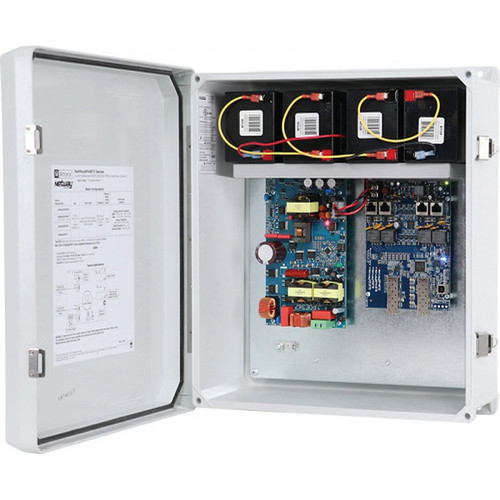
The Altronix NETWAYSP4BTWPX provides 4 PoE++ (IEEE 802.3bt) ports at up to 90W per port, with a total PoE budget of 240W. This supports high-draw endpoints such as PTZ cameras, pan-tilt mounts, and multi-sensor units that exceed the 30W ceiling of earlier PoE standards. It also adds dual 1G SFP fiber uplinks, giving it 6 total physical ports (4 copper PoE + 2 fiber).
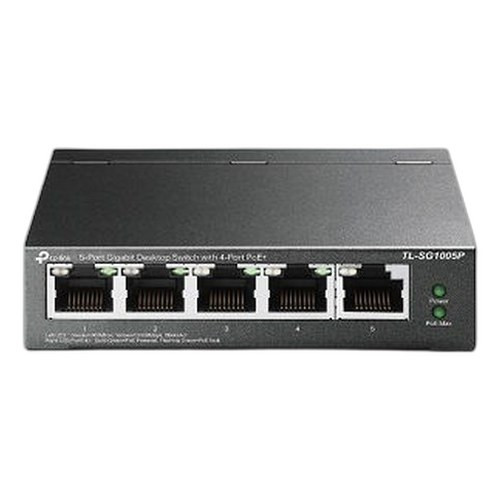
The TP-Link TL-SG1005P provides 5 ports total — 4 PoE ports and 1 standard uplink — with a PoE budget of 65W and a maximum of 30W per port under IEEE 802.3af/at (PoE+). Per-port wattage is not broken out individually in the specs beyond the 30W maximum. Its switching capacity is 10 Gbps. The TP-Link's Extend mode stretches PoE range to 250m at 10 Mbps, a feature the Altronix specs do not list.
In raw PoE delivery the Altronix outpaces the TP-Link by 175W total budget and 60W per port, and supports the newer 802.3bt standard versus 802.3af on the TP-Link.
How do these switches compare in physical ruggedness, enclosure rating, and operating environment?
The Altronix NETWAYSP4BTWPX is housed in a NEMA 4/4X, IP66-rated outdoor enclosure with stainless or powder-coat finish. Its operating temperature spans -40°C to 60°C (-40°F to 140°F), covering extreme cold and moderate heat. Storage is rated -30°C to 85°C. The unit measures 17.53" x 15.3" x 6.67" and supports wall, pole, and rack mounting. It also integrates a LiFePO4 battery charger for backup power capability.
The TP-Link TL-SG1005P is a desktop form factor unit measuring 3.9" x 3.9" x 1.0" (99.8 x 98 x 25 mm). Its operating temperature is rated 0°C to 40°C (32°F to 104°F), with storage rated -40°C to 70°C. It has no stated outdoor, IP, or NEMA rating. It mounts via mounting holes and is powered by an external power adapter included in the package.
The Altronix is purpose-built for outdoor and harsh-environment deployment; the TP-Link is suited only for conditioned indoor spaces. The 40°C operating gap and the absence of any ingress-protection rating on the TP-Link make direct environmental comparison unfavorable to the desktop unit.
What management, connectivity, and integration capabilities does each switch offer?
The Altronix NETWAYSP4BTWPX supports LINQ integration (Altronix's cloud-based power management platform) as well as standard SNMP and a managed switch CLI. The dual 1G SFP fiber uplinks enable single-mode fiber backbone connectivity for long-distance runs — a spec absent on the TP-Link. It carries a Lifetime warranty.
The TP-Link TL-SG1005P is explicitly unmanaged — no SNMP, no CLI, no cloud management. It operates as a plug-and-play device requiring zero configuration. It supports two operating modes (Standard at 100m PoE range; Extend at 250m range but limited to 10 Mbps) selectable via physical switch. Warranty terms are not stated in the provided specifications.
For installers needing remote monitoring, PoE port control, or fiber backbone integration, the Altronix provides those capabilities. The TP-Link's value proposition is simplicity and low configuration overhead, appropriate for small, self-contained installs where central management is not required.
Which should you choose: the NETWAYSP4BTWPX or the SG1005P?
Our take: The NETWAYSP4BTWPX is the stronger choice when deploying outdoor edge nodes, high-power PoE endpoints (PTZ cameras, multi-sensor units), or fiber-backhauled runs in any environment below 0°C or above 40°C. Spec deltas that drive this: (1) PoE budget is 240W vs. 65W — a 175W advantage allowing the Altronix to simultaneously power four 90W devices versus the TP-Link's 65W total pool; (2) operating temperature floor is -40°C vs. 0°C, a critical 40-degree gap for outdoor or unheated cabinet installs; (3) the Altronix adds dual 1G SFP fiber uplinks and SNMP/LINQ managed access, while the TP-Link is unmanaged with copper-only uplinks. The TL-SG1005P is appropriate for small indoor surveillance closets with standard PoE cameras, low configuration overhead, and tight budgets. Platform qualifier: Altronix LINQ-managed deployments should specify the NETWAYSP4BTWPX; standalone desktop installs on TP-Link ecosystems suit the TL-SG1005P.
Side-by-Side Comparison
Spec-for-spec, from manufacturer data.
| Specification | Altronix NETWAYSP4BTWPX | TP-Link SG1005P |
|---|---|---|
| Product Type | Managed PoE++ outdoor switch | Unmanaged PoE+ desktop switch |
| PoE Standard | IEEE 802.3bt (PoE++) | IEEE 802.3af (PoE+) |
| PoE Budget (Total) | 240W | 65W |
| Max PoE per Port | 90W | 30W |
| PoE Ports | 4 | 4 |
| Total Ports | 6 (4x copper + 2x SFP fiber) | 5 (4x PoE + 1x uplink) |
| Fiber Uplinks | Dual 1G SFP (single-mode) | — |
| Switching Capacity | — | 10 Gbps |
| Operating Temperature | -40°C to 60°C | 0°C to 40°C |
| Enclosure / IP Rating | NEMA 4/4X, IP66 | No rating stated |
| Environment | Outdoor rated | Indoor only |
| Management | SNMP, LINQ, managed CLI | Unmanaged |
| Battery Backup Support | Yes (LiFePO4 charger integrated) | — |
| Mounting | Wall, pole, rack | Desktop / mounting holes |
| Dimensions | 17.53" x 15.3" x 6.67" | 3.9" x 3.9" x 1.0" |
| Warranty | Lifetime | Not stated in specs |
Frequently Asked Questions
Which should you choose: the NETWAYSP4BTWPX or the SG1005P?
The NETWAYSP4BTWPX is the stronger choice when deploying outdoor edge nodes, high-power PoE endpoints (PTZ cameras, multi-sensor units), or fiber-backhauled runs in any environment below 0°C or above 40°C. Spec deltas that drive this: (1) PoE budget is 240W vs. 65W — a 175W advantage allowing the Altronix to simultaneously power four 90W devices versus the TP-Link's 65W total pool; (2) operating temperature floor is -40°C vs. 0°C, a critical 40-degree gap for outdoor or unheated cabinet installs; (3) the Altronix adds dual 1G SFP fiber uplinks and SNMP/LINQ managed access, while the TP-Link is unmanaged with copper-only uplinks. The TL-SG1005P is appropriate for small indoor surveillance closets with standard PoE cameras, low configuration overhead, and tight budgets. Platform qualifier: Altronix LINQ-managed deployments should specify the NETWAYSP4BTWPX; standalone desktop installs on TP-Link ecosystems suit the TL-SG1005P.
Can either switch power a PTZ camera that requires more than 30W?
Only the Altronix NETWAYSP4BTWPX supports IEEE 802.3bt (PoE++), delivering up to 90W per port — sufficient for high-power PTZ cameras. The TP-Link TL-SG1005P is rated to a maximum of 30W per port under 802.3af (PoE+), which will not meet the power requirement of endpoints exceeding that threshold.
Is either switch suitable for outdoor installation without an additional enclosure?
The Altronix NETWAYSP4BTWPX ships in a NEMA 4/4X, IP66-rated outdoor enclosure and is rated to operate from -40°C to 60°C, making it suitable for direct outdoor mounting. The TP-Link TL-SG1005P has no stated IP or NEMA rating and an operating range of only 0°C to 40°C; it is not rated for outdoor use and would require a separately sourced weatherproof enclosure.
Which switch is better for a small, budget-conscious indoor security install with standard IP cameras?
The TP-Link TL-SG1005P is designed for that use case: 5 ports (4 PoE+), 65W budget, plug-and-play unmanaged operation, and a compact desktop footprint. For a small indoor install using standard PoE or PoE+ cameras (under 30W each) with no need for remote management or fiber uplinks, the TL-SG1005P fits the profile. Note that its warranty terms are not stated in the available specifications.
More Network Switch Comparisons
- Vivotek GET-083A-120 vs TP-Link SG1005P
- Vivotek GET-083A-120 vs Axis T8504-E
- Vivotek GET-083A-120 vs Axis D8004
- Vivotek GET-083A-120 vs Ubiquiti N-SW
- TP-Link SG1005P vs Axis T8504-E
- TP-Link SG1005P vs Axis D8004
Network Switch Buying Guides
Get a Second Opinion on Your Camera Choice
Share your site layout, coverage goals, and budget. Our team will validate the camera selection, flag anything we would change, and recommend products that match the use case.