
Altronix NETWAYSP4BTWPX vs Axis T8504-E: Specification Comparison
Both the Altronix NETWAYSP4BTWPX and the Axis T8504-E are 4-port outdoor-rated managed PoE switches designed for surveillance and access-control deployments where edge switching must survive harsh environments. The comparison turns on three axes that matter most in this class: raw PoE power delivery and per-port allocation, physical protection and installation flexibility, and network management depth with upstream connectivity. Neither unit is a simple unmanaged injector; both provide fiber uplinks and operate across identical temperature extremes, making them genuine cross-shop candidates for outdoor edge-switch applications.

In This Guide
- Which switch delivers more PoE power, and how is that budget distributed across ports?
- How do the two switches differ in physical protection, enclosure design, and installation options?
- What network management features and upstream connectivity does each switch provide?
- Which should you choose: the NETWAYSP4BTWPX or the T8504-E?
- Side-by-Side Specs
- FAQ
Which switch delivers more PoE power, and how is that budget distributed across ports?
The NETWAYSP4BTWPX specifies a 240 W total PoE budget using IEEE 802.3bt 4PPoE (PoE++), allocating up to 90 W per port across all four RJ45 ports. This means every port can independently power a high-draw endpoint such as a multi-sensor PTZ camera, a pan-tilt-zoom unit with integrated IR, or a PoE-powered access point without robbing adjacent ports.
The T8504-E is rated at a 150 W total PoE budget under IEEE 802.3at Type 2 Class 4 (PoE+), but the allocation is asymmetric: ports 1 and 2 deliver up to 60 W each, while ports 3 and 4 are capped at 30 W each. The maximum any single port can deliver (60 W) is therefore one-third less than the NETWAYSP4BTWPX's 90 W ceiling, and the lower-power ports limit placement of high-draw devices.
For deployments requiring IEEE 802.3bt endpoints — multi-sensor cameras, high-wattage PTZ units, or 802.3bt-class access points — the NETWAYSP4BTWPX's 90 W per-port ceiling and 240 W budget provide headroom the T8504-E cannot match. Where all endpoints are standard 802.3at devices drawing 30 W or less, the T8504-E's 150 W budget may be sufficient across four ports.
How do the two switches differ in physical protection, enclosure design, and installation options?
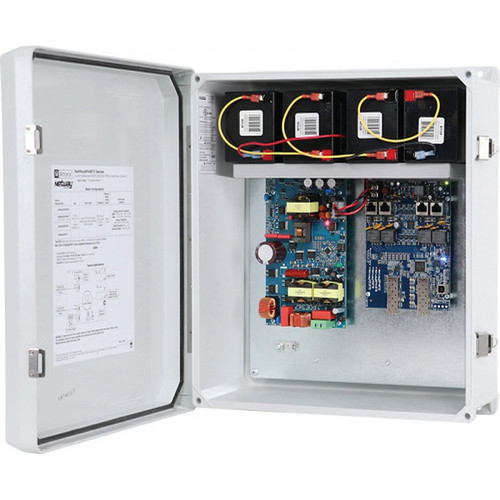
The NETWAYSP4BTWPX is housed in a NEMA 4/4X IP66-rated outdoor enclosure described as stainless/powder-coat construction. Its dimensions are 17.53" × 15.3" × 6.67" (approximately 445 × 389 × 169 mm), and it supports wall, pole, and rack mounting. The enclosure integrates a LiFePO4 battery charger, enabling connection of an external battery for backup power — a capability the T8504-E does not specify. The NEMA 4X rating adds corrosion resistance suitable for coastal or chemical-exposure environments. Operating temperature is -40°C to 60°C.
The T8504-E uses an aluminum casing (color: white, PVC-free) measuring 240 × 166 × 72 mm (8.42" × 5.90" × 2.75"). It is notably more compact and lighter at 2.9 kg (6.39 lbs). Its outdoor rating is specified as NEMA 250 Type 4X per the provided specs, and it includes 6 kV surge protection on all network ports and AC input lines — a surge-protection figure not explicitly stated for the NETWAYSP4BTWPX. Mount type is listed as pole only. Operating temperature is -40°C to 60°C per the structured spec field; the datasheet-sourced annotation lists -40°C to 50°C — a discrepancy in the provided data that installers should verify against the official Axis datasheet.
The NETWAYSP4BTWPX's larger enclosure accommodates battery backup integration and supports more mounting configurations, while the T8504-E is significantly smaller and lighter, simplifying pole-mount installations where footprint and weight are constrained.
What network management features and upstream connectivity does each switch provide?
The NETWAYSP4BTWPX provides LINQ integration (Altronix's cloud/local management platform) plus standard SNMP and managed-switch CLI access. The provided specs do not enumerate specific protocol support such as IPv4/IPv6 stack details, RADIUS, TACACS+, or MAC table size. Upstream connectivity consists of dual 1G SFP fiber uplinks, giving redundant or dual-homed fiber paths — a meaningful resilience advantage for backbone connectivity.
The T8504-E carries a detailed protocol list: IPv4, IPv6, HTTP, HTTPS, SSH, SNMP (v1/v2c/v3 per the datasheet annotation), DNS, TCP, UDP, and VLAN. Security features include password protection, HTTPS encryption, RADIUS, TACACS+, and VLAN segmentation. Switching capacity is specified at 10 Gbps / 7.44 Mpps with an 8 K MAC address table and 10 KB jumbo frame support. Management is via AXIS Device Manager, integrating natively into Axis's device lifecycle and firmware management ecosystem. Upstream connectivity is a single 1G SFP fiber uplink — one port versus the NETWAYSP4BTWPX's two.
The T8504-E's published protocol and security stack is more granular in the provided specs, and its native AXIS Device Manager integration is a direct operational benefit on all-Axis camera deployments. The NETWAYSP4BTWPX's dual SFP uplinks offer fiber path redundancy the T8504-E does not provide, and LINQ offers remote monitoring relevant to Altronix-ecosystem installations.
Which should you choose: the NETWAYSP4BTWPX or the T8504-E?
Our take: The NETWAYSP4BTWPX is the stronger choice when endpoints require 802.3bt PoE++ power levels, battery backup capability is needed, or dual fiber uplinks are required for path redundancy. Its 240 W budget and 90 W per-port ceiling outperform the T8504-E's 150 W / 60 W maximums by 60% and 50% respectively, and its dual SFP slots versus the T8504-E's single SFP uplink add resiliency. The T8504-E, by contrast, is the better fit for Axis-native deployments: AXIS Device Manager integration, a fully enumerated IPv4/IPv6 protocol stack, RADIUS/TACACS+ authentication, 6 kV documented surge protection, and a substantially smaller and lighter form factor (2.9 kg vs no weight specified for the Altronix) suit compact pole-mount installs on all-Axis networks. Buyers on mixed-vendor or Altronix-ecosystem sites with high-draw endpoints should favor the NETWAYSP4BTWPX; Axis-centric integrators prioritizing managed security features and compact footprint should favor the T8504-E.
Side-by-Side Comparison
Spec-for-spec, from manufacturer data.
| Specification | Altronix NETWAYSP4BTWPX | Axis T8504-E |
|---|---|---|
| Product Type | PoE Switch (Outdoor Enclosure) | Managed PoE Switch |
| PoE Standard | IEEE 802.3bt (PoE++) | IEEE 802.3at Type 2 (PoE+) |
| Total PoE Budget | 240 W | 150 W |
| PoE per Port | 90 W (all 4 ports) | 60 W (ports 1-2) / 30 W (ports 3-4) |
| Data Ports | 4x Gigabit RJ45 PoE++ | 4x Gigabit RJ45 PoE+ |
| Fiber Uplinks | 2x 1G SFP | 1x 1G SFP |
| Switching Capacity | — | 10 Gbps / 7.44 Mpps |
| Surge Protection | — | 6 kV (all network ports and AC input) |
| Operating Temperature | -40°C to 60°C | -40°C to 60°C (structured spec; datasheet annotation: -40°C to 50°C — verify) |
| Storage Temperature | -30°C to 85°C | -40°C to 85°C |
| Enclosure / IP Rating | NEMA 4/4X, IP66 | NEMA 250 Type 4X, Aluminum |
| Battery Backup Support | Yes (LiFePO4 charger integrated) | — |
| Management Platform | Altronix LINQ + SNMP/CLI | AXIS Device Manager + SNMP v1/v2c/v3 |
| Security Protocols | — | HTTPS, SSH, RADIUS, TACACS+, VLAN |
| Mount Types | Wall, Pole, Rack | Pole |
| Warranty | Lifetime | 5 years |
Frequently Asked Questions
Which should you choose: the NETWAYSP4BTWPX or the T8504-E?
The NETWAYSP4BTWPX is the stronger choice when endpoints require 802.3bt PoE++ power levels, battery backup capability is needed, or dual fiber uplinks are required for path redundancy. Its 240 W budget and 90 W per-port ceiling outperform the T8504-E's 150 W / 60 W maximums by 60% and 50% respectively, and its dual SFP slots versus the T8504-E's single SFP uplink add resiliency. The T8504-E, by contrast, is the better fit for Axis-native deployments: AXIS Device Manager integration, a fully enumerated IPv4/IPv6 protocol stack, RADIUS/TACACS+ authentication, 6 kV documented surge protection, and a substantially smaller and lighter form factor (2.9 kg vs no weight specified for the Altronix) suit compact pole-mount installs on all-Axis networks. Buyers on mixed-vendor or Altronix-ecosystem sites with high-draw endpoints should favor the NETWAYSP4BTWPX; Axis-centric integrators prioritizing managed security features and compact footprint should favor the T8504-E.
Can either switch power a high-wattage PTZ camera on every port simultaneously?
The NETWAYSP4BTWPX specifies 90 W per port under IEEE 802.3bt, so all four ports can simultaneously drive 802.3bt-class PTZ cameras up to 90 W each within the 240 W total budget. The T8504-E's ports 3 and 4 are limited to 30 W each under 802.3at, and ports 1 and 2 to 60 W each — meaning 802.3bt endpoints cannot be fully powered on any port, and the 30 W ports will not support high-draw PTZ units.
Which switch is easier to manage on an all-Axis camera network?
The T8504-E integrates directly with AXIS Device Manager, Axis's native device lifecycle and firmware management platform, and supports VLAN, SNMP v1/v2c/v3, RADIUS, TACACS+, HTTPS, and SSH per the provided specs. The NETWAYSP4BTWPX uses Altronix LINQ plus standard SNMP/CLI; its protocol stack details are not enumerated in the provided specs. For an all-Axis network, the T8504-E's native management integration is the more operationally straightforward choice.
Does either switch support battery backup for power continuity during AC outages?
The NETWAYSP4BTWPX specifies an integrated LiFePO4 battery charger, which enables connection of an external battery for backup power during AC outages — a feature relevant to installations requiring continuous PoE output through brief power interruptions. The T8504-E specs provided do not mention battery backup or an integrated charger; it operates from 100–240 V AC input with no backup-power capability listed.
More Network Switch Comparisons
- Vivotek GET-083A-120 vs TP-Link SG1005P
- Vivotek GET-083A-120 vs Axis T8504-E
- Vivotek GET-083A-120 vs Axis D8004
- Vivotek GET-083A-120 vs Ubiquiti N-SW
- TP-Link SG1005P vs Axis T8504-E
- TP-Link SG1005P vs Axis D8004
Network Switch Buying Guides
Get a Second Opinion on Your Camera Choice
Share your site layout, coverage goals, and budget. Our team will validate the camera selection, flag anything we would change, and recommend products that match the use case.