
Altronix NETWAY4EWPX vs Altronix NETWAYSP4BTWPX: Specification Comparison
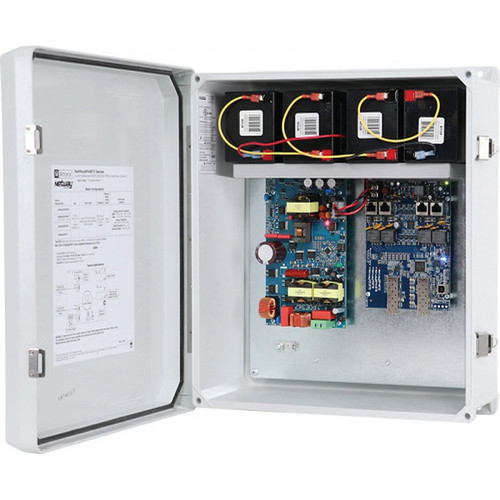
Both the Altronix NETWAY4EWPX and NETWAYSP4BTWPX are 4-port Gigabit PoE outdoor managed switches housed in identically sized NEMA 4/4X, IP66-rated enclosures with integrated battery charger support and LINQ supervision. The key differentiators lie in PoE standard generation, total power budget, per-port power ceiling, and fiber uplink count — all of which directly affect which high-power endpoints each unit can support and how the uplink backbone is architected.

In This Guide
Which switch delivers more PoE power — and how much per port?
The NETWAY4EWPX provides a 120W total PoE budget conforming to IEEE 802.3at (PoE+), with dual ports capable of 60W Hi-PoE output. The remaining two ports operate at standard PoE+ levels. This configuration suits standard PTZ cameras, access control readers, and mid-draw IP cameras that do not exceed 30W per port on most ports, with headroom for two high-draw devices at up to 60W each.
The NETWAYSP4BTWPX doubles the budget to 240W total and upgrades the standard to IEEE 802.3bt 4PPoE (PoE++), delivering up to 90W per port across all four ports. This fully supports the highest-draw PoE++ endpoints currently on the market — including pan-tilt-zoom cameras with integrated heaters, multi-sensor panoramic cameras, and next-generation access control panels — without requiring a separate injector or midspan. Installers running four simultaneous 60W+ devices will find the NETWAY4EWPX's 120W ceiling insufficient, while the NETWAYSP4BTWPX's 240W budget accommodates that load with margin.
How do the fiber uplink options and operating environment specs compare?
The NETWAY4EWPX provides a single 1 Gbps SFP fiber uplink; the transceiver is not included and must be ordered separately. This single uplink provides electrical isolation and extended-distance backbone connectivity but offers no physical redundancy at the uplink layer.
The NETWAYSP4BTWPX ships with dual 1G SFP fiber uplinks. The connectivity spec explicitly lists single-mode fiber compatibility. Dual uplinks enable link aggregation or redundant ring topologies — relevant on campuses or perimeters where a single cable cut would otherwise isolate the switch. Both units share the same NEMA 4/4X, IP66 outdoor enclosure dimensions (17.53" x 15.3" x 6.67") and wall/pole/rack mount options. Operating temperature diverges: the NETWAY4EWPX lists storage range only (–40°C to 85°C storage); the NETWAYSP4BTWPX specifies an operating range of –40°C to 60°C. The NETWAY4EWPX's operating temperature spec is not provided in the supplied specifications.
What management, supervision, and integration capabilities does each switch offer?
Both units include Altronix LINQ supervision, which provides remote monitoring and management via the Altronix ecosystem. The NETWAY4EWPX is specified as a Layer 2+ Managed Switch supporting VLAN, QoS, and Spanning Tree protocols. The NETWAYSP4BTWPX adds standard SNMP and a managed switch CLI on top of LINQ integration, providing a broader set of interoperable management interfaces for IT-centric environments or VMS platforms that poll network devices via SNMP.
Both switches include an integrated battery charger designed to support Altronix backup modules, enabling UPS-style continuity without an external charger. Neither unit includes a battery in the base SKU — backup modules are listed as compatible accessories ordered separately. Both carry a lifetime warranty. The NETWAY4EWPX's NEMA rating field notes the enclosure is IP66-11 rated; the NETWAYSP4BTWPX notes that a pair of air vents must be mounted per enclosure — an installation detail relevant to conduit planning and vandal resistance assessments.
Which should you choose: the NETWAY4EWPX or the NETWAYSP4BTWPX?
Our take: The NETWAYSP4BTWPX is the stronger choice when powering high-draw PoE++ endpoints, requiring uplink redundancy, or deploying into environments where SNMP-based network management is mandatory. It delivers 240W total versus the NETWAY4EWPX's 120W — a 2× budget advantage — and supports 90W per port under IEEE 802.3bt versus the NETWAY4EWPX's 60W maximum on only two ports under 802.3at. Its dual SFP uplinks also enable redundant fiber paths, whereas the NETWAY4EWPX offers a single SFP. The NETWAY4EWPX remains appropriate where endpoints are PoE+ class (≤30W typical, ≤60W peak on two ports), a single fiber uplink is sufficient, and the Altronix LINQ ecosystem covers all required management. Both units share the same enclosure, mount options, battery charger integration, and lifetime warranty, making the choice purely a function of power demand, endpoint type, and uplink architecture.
Side-by-Side Comparison
Spec-for-spec, from manufacturer data.
| Specification | Altronix NETWAY4EWPX | Altronix NETWAYSP4BTWPX |
|---|---|---|
| PoE Standard | IEEE 802.3at (PoE+) | IEEE 802.3bt (PoE++) |
| Total PoE Budget | 120W | 240W |
| Max Per-Port Power | 60W (dual Hi-PoE ports) | 90W (all 4 ports) |
| PoE Ports | 4x Gigabit PoE/PoE+ | 4x 10/100/1000 Gigabit PoE++ |
| Fiber Uplinks | 1x 1G SFP | 2x 1G SFP |
| Fiber Type Specified | Not specified | Single-mode |
| Transceiver Included | No (order separately) | Not specified in supplied specs |
| Management | Layer 2+ Managed; VLAN, QoS, Spanning Tree | LINQ + SNMP + managed switch CLI |
| Supervision | LINQ | LINQ |
| Enclosure Rating | NEMA 4/4X, IP66 | NEMA 4/4X, IP66 |
| Operating Temp | Not specified in supplied specs | -40°C to 60°C (-40°F to 140°F) |
| Storage Temp | -40°C to 85°C (-40°F to 185°F) | -30°C to 85°C (-22°F to 185°F) |
| Battery Backup | Yes (integrated charger; module sold separately) | Yes (LiFePO4 charger; module sold separately) |
| Mount Type | Wall; Pole; Rack | Wall; Pole; Rack |
| Dimensions | 17.53" x 15.3" x 6.67" | 17.53" x 15.3" x 6.67" |
| Warranty | Lifetime | Lifetime |
Frequently Asked Questions
Which should you choose: the NETWAY4EWPX or the NETWAYSP4BTWPX?
The NETWAYSP4BTWPX is the stronger choice when powering high-draw PoE++ endpoints, requiring uplink redundancy, or deploying into environments where SNMP-based network management is mandatory. It delivers 240W total versus the NETWAY4EWPX's 120W — a 2× budget advantage — and supports 90W per port under IEEE 802.3bt versus the NETWAY4EWPX's 60W maximum on only two ports under 802.3at. Its dual SFP uplinks also enable redundant fiber paths, whereas the NETWAY4EWPX offers a single SFP. The NETWAY4EWPX remains appropriate where endpoints are PoE+ class (≤30W typical, ≤60W peak on two ports), a single fiber uplink is sufficient, and the Altronix LINQ ecosystem covers all required management. Both units share the same enclosure, mount options, battery charger integration, and lifetime warranty, making the choice purely a function of power demand, endpoint type, and uplink architecture.
Can the NETWAY4EWPX power PTZ cameras with integrated heaters that draw more than 60W?
Based on the supplied specifications, no. The NETWAY4EWPX provides a maximum of 60W Hi-PoE on its two highest-output ports under IEEE 802.3at. Endpoints requiring more than 60W — such as PTZ cameras with heaters that draw up to 90W — require IEEE 802.3bt (PoE++) support, which only the NETWAYSP4BTWPX provides, at up to 90W per port.
Is the NETWAYSP4BTWPX better for larger or more complex network deployments?
Yes, in two respects. First, its dual SFP fiber uplinks support link aggregation or redundant ring topologies, reducing single-point-of-failure risk at the uplink layer — a capability absent from the single-uplink NETWAY4EWPX. Second, the NETWAYSP4BTWPX adds SNMP and managed switch CLI alongside LINQ, making it compatible with enterprise NMS platforms and VMS systems that poll network infrastructure via standard protocols.
Do both switches include a battery for backup power?
No. Both units include an integrated battery charger that supports Altronix backup modules, but neither switch includes a battery in the base SKU. Compatible backup modules must be ordered separately for either model.
More Network Switch Comparisons
- Vivotek GET-083A-120 vs TP-Link SG1005P
- Vivotek GET-083A-120 vs Axis T8504-E
- Vivotek GET-083A-120 vs Axis D8004
- Vivotek GET-083A-120 vs Ubiquiti N-SW
- TP-Link SG1005P vs Axis T8504-E
- TP-Link SG1005P vs Axis D8004
Network Switch Buying Guides
Get a Second Opinion on Your Camera Choice
Share your site layout, coverage goals, and budget. Our team will validate the camera selection, flag anything we would change, and recommend products that match the use case.