
Altronix NETWAY4EBTWPX vs Vivotek GET-083A-120: Specification Comparison
Both the Altronix NETWAY4EBTWPX and the Vivotek AW-GET-083A-120 are outdoor-rated, 4-port PoE Gigabit Ethernet switches intended for remote surveillance edge deployments — cabinet-mounted or pole-mounted, powered from AC mains, and hardened against weather. A buyer evaluating a small-node outdoor PoE infrastructure point (four cameras, one uplink) would legitimately cross-shop these two units. The comparison turns on three axes: PoE power delivery and budget, physical hardening and environmental ratings, and port topology plus uplink flexibility.
In This Guide
- Which switch delivers more PoE power per port and in total budget?
- How do the two units compare on environmental protection, operating range, and physical durability?
- How do the port configurations and uplink options differ between the two switches?
- Which should you choose: the NETWAY4EBTWPX or the GET-083A-120?
- Side-by-Side Specs
- FAQ
Which switch delivers more PoE power per port and in total budget?
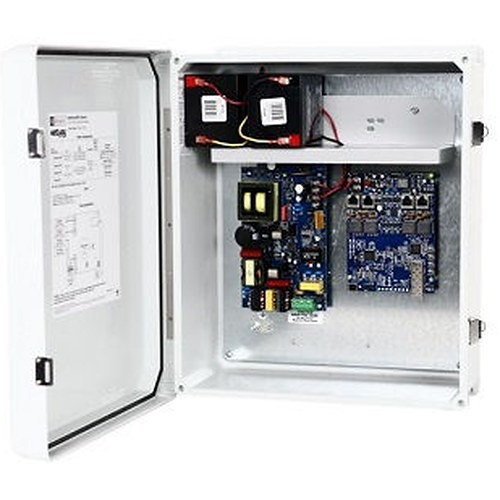
The NETWAY4EBTWPX supports 802.3bt (PoE++) on all four downlink ports, rated at 90 W per port with a 240 W total PoE budget. This accommodates high-power pan-tilt-zoom cameras, multi-sensor panoramic heads, or any device drawing up to the 802.3bt Class 8 ceiling without per-port throttling.
The AW-GET-083A-120 supports IEEE 802.3af and 802.3at (PoE+) on its four downlink ports, with a maximum of 30 W per port and a 120 W total PoE budget. That ceiling covers the large majority of fixed-angle IP cameras and PTZ cameras under the 802.3at standard, but it does not support 802.3bt devices.
The NETWAY4EBTWPX delivers three times the per-port headroom (90 W vs. 30 W) and double the total budget (240 W vs. 120 W). For deployments with thermal cameras, multi-imager units, or any device requiring 802.3bt power, only the Altronix unit qualifies. For standard PoE+ camera loads the Vivotek budget is sufficient and matched to its lower per-port ceiling.
How do the two units compare on environmental protection, operating range, and physical durability?
The NETWAY4EBTWPX is housed in a NEMA 4/4X IP66-rated enclosure designed for outdoor and corrosive environments. IP66 certifies protection against powerful water jets but does not cover temporary submersion. No operating temperature range is listed in the provided specifications. The unit carries a Lifetime warranty.
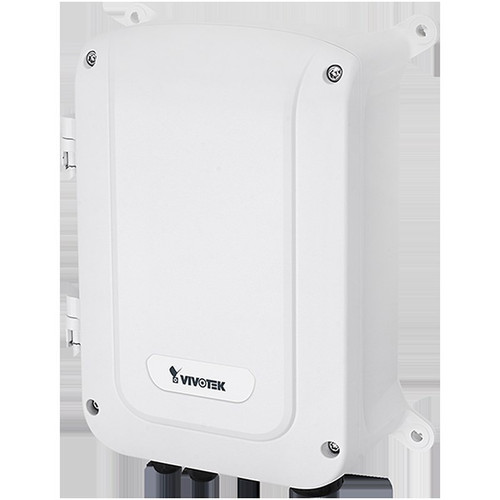
The AW-GET-083A-120 carries an IP67 rating (dust-tight and submersion up to 1 m) and an IK10 impact rating (20-joule vandal resistance). Its operating temperature range is explicitly specified as -40 °C to +65 °C (-40 °F to +149 °F). It also lists certifications for vibration (IEC 60068-2-6), shock (IEC 60068-2-27), and freefall (IEC 60068-2-32), and per-port surge protection of 6 kV with 40 kV on the AC input. The Vivotek warranty is 24 months.
The AW-GET-083A-120 has a more fully documented hardening profile: higher ingress (IP67 vs. IP66), published impact resistance (IK10), a stated operating temperature floor of -40 °C, and explicit surge, vibration, shock, and freefall certifications. The NETWAY4EBTWPX adds NEMA 4X corrosion resistance and a Lifetime warranty, but its operating temperature range is not stated in the provided specifications.
How do the port configurations and uplink options differ between the two switches?
The NETWAY4EBTWPX provides four Gigabit (10/100/1000 Mbps) PoE downlink ports and one SFP uplink slot supporting both single-mode and multi-mode fiber. No additional copper uplink ports are listed in the provided specifications. DIN-rail mounting is specified; pole mount is also noted.
The AW-GET-083A-120 provides four Gigabit PoE+ downlink ports, two additional non-PoE Gigabit copper (RJ-45) ports, and two Gigabit SFP slots. Its switching bandwidth is specified at 16 Gbps with a forwarding capacity of 11.904 Mpps, an 8 K MAC address table, and 9216-byte jumbo frame support. The unit supports Auto-MDI/MDI-X and Auto-Negotiation. It accepts M16 and M25 cable gland connectors. Mounting options include wall, pole, corner, and rack.
The AW-GET-083A-120 offers a richer port matrix: two extra copper Gigabit ports for daisy-chaining or local device connections, and two SFP slots versus one on the Altronix. The NETWAY4EBTWPX does not publish switching throughput figures in the provided specifications. The Vivotek's four mounting options also exceed the Altronix's listed DIN-rail and pole options.
Which should you choose: the NETWAY4EBTWPX or the GET-083A-120?
Our take: The NETWAY4EBTWPX is the stronger choice when powering 802.3bt devices or when a maximum-power-per-port of 90 W is required — no other spec in this comparison replaces that 3× per-port advantage (90 W vs. 30 W) or the 240 W vs. 120 W total budget. It also carries a Lifetime warranty versus the Vivotek's 24 months, and adds NEMA 4X corrosion resistance. The AW-GET-083A-120 is the stronger choice for deployments demanding a fully documented environmental profile: it specifies a -40 °C operating floor (absent in the Altronix specs), adds IP67 submersion and IK10 impact ratings above the Altronix's IP66, lists 6 kV per-port and 40 kV AC surge certification, and provides a larger port matrix (2 additional GbE copper + 2 SFP vs. 1 SFP). Choose the NETWAY4EBTWPX for high-wattage camera loads; choose the AW-GET-083A-120 for harsh-environment installations where submersion risk, impact resistance, surge events, or wide temperature swings are the governing design criteria.
Side-by-Side Comparison
Spec-for-spec, from manufacturer data.
| Specification | Altronix NETWAY4EBTWPX | Vivotek GET-083A-120 |
|---|---|---|
| Product Type | PoE Switch | PoE Switch |
| PoE Standard | 802.3bt (PoE++) | 802.3af / 802.3at (PoE+) |
| Max PoE Per Port | 90 W | 30 W |
| Total PoE Budget | 240 W | 120 W |
| PoE Downlink Ports | 4x Gigabit | 4x Gigabit |
| Additional Copper Ports | — | 2x Gigabit (non-PoE) |
| SFP Uplink Slots | 1x (single/multi-mode) | 2x Gigabit SFP |
| Switching Bandwidth | — | 16 Gbps |
| Forwarding Capacity | — | 11.904 Mpps |
| Ingress Protection | IP66 / NEMA 4/4X | IP67 |
| Impact Rating | — | IK10 |
| Operating Temperature | — | -40 °C to +65 °C |
| Surge Protection (Port) | — | 6 kV per PoE port |
| Surge Protection (AC) | — | 40 kV |
| Battery Backup | Yes (integrated charger) | — |
| Warranty | Lifetime | 24 months |
Frequently Asked Questions
Which should you choose: the NETWAY4EBTWPX or the GET-083A-120?
The NETWAY4EBTWPX is the stronger choice when powering 802.3bt devices or when a maximum-power-per-port of 90 W is required — no other spec in this comparison replaces that 3× per-port advantage (90 W vs. 30 W) or the 240 W vs. 120 W total budget. It also carries a Lifetime warranty versus the Vivotek's 24 months, and adds NEMA 4X corrosion resistance. The AW-GET-083A-120 is the stronger choice for deployments demanding a fully documented environmental profile: it specifies a -40 °C operating floor (absent in the Altronix specs), adds IP67 submersion and IK10 impact ratings above the Altronix's IP66, lists 6 kV per-port and 40 kV AC surge certification, and provides a larger port matrix (2 additional GbE copper + 2 SFP vs. 1 SFP). Choose the NETWAY4EBTWPX for high-wattage camera loads; choose the AW-GET-083A-120 for harsh-environment installations where submersion risk, impact resistance, surge events, or wide temperature swings are the governing design criteria.
Can either switch power a 802.3bt thermal camera or multi-sensor unit that draws more than 30 W?
Yes, but only the NETWAY4EBTWPX supports 802.3bt (PoE++) at up to 90 W per port. The AW-GET-083A-120 tops out at 802.3at (PoE+) with a 30 W per-port ceiling and cannot power 802.3bt devices.
Which unit is better suited for a deployment in a flood-prone or frequently hosed-down area?
The AW-GET-083A-120 is rated IP67, which covers temporary submersion up to 1 m. The NETWAY4EBTWPX is rated IP66, which covers powerful water jets but not submersion. For areas with standing water or wash-down exposure, the IP67 rating of the Vivotek unit provides a higher level of ingress protection per the IEC standard.
Is the NETWAY4EBTWPX or the AW-GET-083A-120 better for a fiber-uplink ring topology with multiple nodes?
The AW-GET-083A-120 includes two SFP slots plus two additional copper Gigabit ports, enabling dual-fiber uplinks or a fiber ring alongside a copper fallback. The NETWAY4EBTWPX lists one SFP uplink. For a multi-node fiber ring or redundant uplink design, the Vivotek's dual-SFP configuration provides more topological flexibility based on the provided specifications.
More Network Switch Comparisons
- Vivotek GET-083A-120 vs TP-Link SG1005P
- Vivotek GET-083A-120 vs Axis T8504-E
- Vivotek GET-083A-120 vs Axis D8004
- Vivotek GET-083A-120 vs Ubiquiti N-SW
- TP-Link SG1005P vs Axis T8504-E
- TP-Link SG1005P vs Axis D8004
Network Switch Buying Guides
Get a Second Opinion on Your Camera Choice
Share your site layout, coverage goals, and budget. Our team will validate the camera selection, flag anything we would change, and recommend products that match the use case.