
Altronix NETWAY4EBTWPX vs Axis T8504-E: Specification Comparison
Both the Altronix NETWAY4EBTWPX and the Axis T8504-E are 4-port outdoor PoE switches with a single SFP fiber uplink, designed for surveillance edge deployments where wiring runs are long or environments are harsh. The comparison spans PoE standard and power budget, physical enclosure and environmental ratings, and network management depth. Buyers typically cross-shop these when specifying a remotely-mounted switch to feed PTZ cameras, access controllers, or multi-sensor units from a fiber backbone in an outdoor or industrial location.

In This Guide
- Which switch delivers more PoE power — and how is that power distributed across ports?
- How does each switch handle outdoor environments, physical protection, and electrical surge events?
- What network management, security, and ecosystem integration does each switch provide?
- Which should you choose: the NETWAY4EBTWPX or the T8504-E?
- Side-by-Side Specs
- FAQ
Which switch delivers more PoE power — and how is that power distributed across ports?
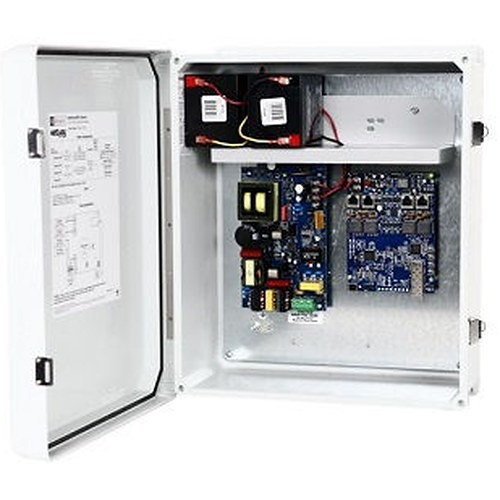
The NETWAY4EBTWPX operates at IEEE 802.3bt (PoE++), supporting up to 90 W per port with a 240 W total budget across its four Gigabit ports. This allows all four ports to simultaneously drive high-draw devices such as pan-tilt-zoom cameras with integrated heaters, multi-sensor panoramic units, or access controllers with electric locking hardware. The integrated 240 W supply also includes a battery charger circuit, enabling a connected battery to sustain PoE output during AC interruptions — a capability relevant to sites without a separate UPS.
The T8504-E is rated to IEEE 802.3at (PoE+, Type 2 Class 4), with an asymmetric per-port budget: ports 1–2 deliver up to 60 W each, and ports 3–4 deliver up to 30 W each, for a 150 W total. The 60 W ceiling on the first two ports accommodates most Class 4 PoE+ cameras and dual-mode devices. However, 802.3bt devices requiring more than 60 W cannot be fully powered. No battery backup capability is specified for the T8504-E.
Net difference: the NETWAY4EBTWPX offers 90 W more total budget (240 W vs 150 W) and a 30 W higher per-port ceiling (90 W vs 60 W), plus onboard battery charging. Buyers deploying 802.3bt-only endpoints or requiring power continuity during outages will find the Altronix spec materially superior on this axis.
How does each switch handle outdoor environments, physical protection, and electrical surge events?
The NETWAY4EBTWPX is housed in a NEMA 4/4X IP66-rated enclosure — NEMA 4X adds corrosion resistance relevant to coastal, industrial, or chemical-wash environments. It mounts on DIN rail or a pole. The datasheet confirms an outdoor environment rating; however, no specific operating temperature range is stated in the provided specifications.
The T8504-E specifies an operating temperature range of −40 °C to 60 °C (storage to 85 °C), making its thermal floor and ceiling explicit. Its aluminum casing is rated for outdoor use and its NEMA rating is listed as 250 Type 4X, which also covers corrosion resistance. Surge protection is documented at 6 kV on all four network ports and on the AC input lines — a concrete electrical specification. The T8504-E is also declared PVC-free. Regulatory approvals include UL/IEC 60950-1, IEC 62368-1, FCC, EMC, ICES, VCCI, RCM, and EAC.
Both units target outdoor installation and share pole-mount capability. The T8504-E's advantage here is documented: a verified −40 °C lower operating limit and an explicit 6 kV surge specification. The NETWAY4EBTWPX's operating temperature range is absent from the provided specs, which is a gap buyers must resolve against the datasheet before specifying in extreme-cold climates.
What network management, security, and ecosystem integration does each switch provide?
The T8504-E is a managed switch. Its listed protocol support includes IPv4, IPv6, HTTP, HTTPS, SSH, SNMP, DNS, TCP, UDP, and VLAN. Security features include password protection, HTTPS encryption, and VLAN segmentation. It integrates directly with AXIS Device Manager, Axis's centralized configuration and firmware-management platform. The switching capacity is specified at 10 Gbps with a throughput of 7.44 Mpps and an 8,000-entry MAC table with 10 KB jumbo frame support — figures relevant to high-density or high-resolution video streams sharing the fabric.
The NETWAY4EBTWPX's provided specifications do not include management protocol support, SNMP capability, VLAN support, switching capacity, throughput, or MAC table size. It is characterized as a PoE switch with DIN-rail mounting and fiber uplink; whether it is managed or unmanaged is not stated in the specifications provided.
For deployments requiring remote configuration, VLAN segmentation for camera traffic isolation, or SNMP-based monitoring via a network management system, the T8504-E provides documented capability. Integrators working within an Axis ecosystem gain native AXIS Device Manager support. The NETWAY4EBTWPX's management capability cannot be assessed from the provided specifications; buyers should consult the Altronix datasheet before assuming parity.
Which should you choose: the NETWAY4EBTWPX or the T8504-E?
Our take: The NETWAY4EBTWPX is the stronger choice when the deployment requires 802.3bt power delivery, a higher per-port ceiling, or battery-backed PoE continuity: it delivers 90 W per port versus 60 W maximum on the T8504-E, carries a 240 W total budget versus 150 W, and includes an integrated battery charger with no equivalent specified on the Axis unit. The T8504-E is the stronger choice when network management depth, documented thermal range, and ecosystem integration are priorities: it provides verified operation down to −40 °C, explicit 6 kV surge protection on all ports, SNMP/VLAN/SSH management, and native AXIS Device Manager support — none of which are confirmed in the NETWAY4EBTWPX's provided specifications. Specify the NETWAY4EBTWPX for high-draw 802.3bt endpoints or sites needing power continuity; specify the T8504-E for managed Axis camera networks where network segmentation, remote administration, and documented environmental limits are non-negotiable.
Side-by-Side Comparison
Spec-for-spec, from manufacturer data.
| Specification | Altronix NETWAY4EBTWPX | Axis T8504-E |
|---|---|---|
| Product Type | PoE Switch | Managed PoE Switch |
| PoE Standard | IEEE 802.3bt (PoE++) | IEEE 802.3at Type 2 Class 4 (PoE+) |
| PoE Ports | 4x Gigabit | 4x Gigabit |
| Max Power Per Port | 90 W | 60 W (ports 1–2) / 30 W (ports 3–4) |
| Total PoE Budget | 240 W | 150 W |
| Fiber Uplink | 1x SFP (single/multi-mode) | 1x SFP |
| Switching Capacity | — | 10 Gbps |
| Throughput | — | 7.44 Mpps |
| MAC Table | — | 8,000 entries |
| Enclosure Rating | NEMA 4/4X, IP66 | NEMA 250 Type 4X |
| Operating Temperature | Not specified | −40 °C to 60 °C |
| Surge Protection | Not specified | 6 kV (all network ports and AC input) |
| Battery Backup | Yes (integrated charger) | — |
| Management | Not specified | SNMP, VLAN, HTTPS, SSH, AXIS Device Manager |
| Mounting | DIN-Rail / Pole | Pole |
| Warranty | Lifetime | 5 years |
Frequently Asked Questions
Which should you choose: the NETWAY4EBTWPX or the T8504-E?
The NETWAY4EBTWPX is the stronger choice when the deployment requires 802.3bt power delivery, a higher per-port ceiling, or battery-backed PoE continuity: it delivers 90 W per port versus 60 W maximum on the T8504-E, carries a 240 W total budget versus 150 W, and includes an integrated battery charger with no equivalent specified on the Axis unit. The T8504-E is the stronger choice when network management depth, documented thermal range, and ecosystem integration are priorities: it provides verified operation down to −40 °C, explicit 6 kV surge protection on all ports, SNMP/VLAN/SSH management, and native AXIS Device Manager support — none of which are confirmed in the NETWAY4EBTWPX's provided specifications. Specify the NETWAY4EBTWPX for high-draw 802.3bt endpoints or sites needing power continuity; specify the T8504-E for managed Axis camera networks where network segmentation, remote administration, and documented environmental limits are non-negotiable.
Can either switch power a 802.3bt PTZ camera with an integrated heater blower?
The NETWAY4EBTWPX supports 802.3bt (PoE++) at up to 90 W per port, which covers the power envelope of most high-draw PTZ cameras with integrated heater-blowers. The T8504-E is limited to IEEE 802.3at (PoE+) with a 60 W ceiling on its two higher-power ports; 802.3bt-only devices are not supported. If the camera requires more than 60 W or a 802.3bt negotiation, the NETWAY4EBTWPX is the appropriate unit based on the provided specifications.
Which switch is better suited for a managed network with VLAN-segmented camera traffic?
The T8504-E is a documented managed switch with VLAN, SNMP, HTTPS, and SSH support, and it integrates with AXIS Device Manager for centralized management. The NETWAY4EBTWPX's provided specifications do not confirm VLAN or SNMP capability. For deployments where camera traffic must be logically isolated on its own VLAN or monitored via a network management system, the T8504-E is the verified choice based on available spec data.
Does either switch keep cameras running during a power outage?
The NETWAY4EBTWPX includes an integrated battery charger as part of its 240 W power supply, allowing a connected battery to sustain PoE output during AC interruptions. The T8504-E's provided specifications do not describe a battery backup or charger circuit. If power continuity during outages is a site requirement, the NETWAY4EBTWPX addresses it directly; the T8504-E would require a separate external UPS to achieve the same result.
More Network Switch Comparisons
- Vivotek GET-083A-120 vs TP-Link SG1005P
- Vivotek GET-083A-120 vs Axis T8504-E
- Vivotek GET-083A-120 vs Axis D8004
- Vivotek GET-083A-120 vs Ubiquiti N-SW
- TP-Link SG1005P vs Axis T8504-E
- TP-Link SG1005P vs Axis D8004
Network Switch Buying Guides
Get a Second Opinion on Your Camera Choice
Share your site layout, coverage goals, and budget. Our team will validate the camera selection, flag anything we would change, and recommend products that match the use case.