
Altronix NETWAY4EBTB vs TP-Link SG1005P: Specification Comparison
Both the Altronix NETWAY4EBTB and the TP-Link TL-SG1005P are gigabit PoE switches aimed at IP security and small-network installations, making them legitimate cross-shop candidates for buyers powering cameras, access control readers, or other PoE endpoints. The Altronix is a board-form-factor unit with a high-power 802.3bt budget and fiber uplink designed for cabinet integration, while the TP-Link is a compact desktop unit with a conventional RJ45-only 802.3af/af+ design. The comparison centers on PoE power class, port count, uplink architecture, and deployment environment.
In This Guide
- Which switch delivers more PoE power, and to what IEEE standard?
- How do the two switches differ in uplink architecture, form factor, and operating environment?
- What management, supervision, and integration capabilities does each switch offer?
- Which should you choose: the NETWAY4EBTB or the SG1005P?
- Side-by-Side Specs
- FAQ
Which switch delivers more PoE power, and to what IEEE standard?
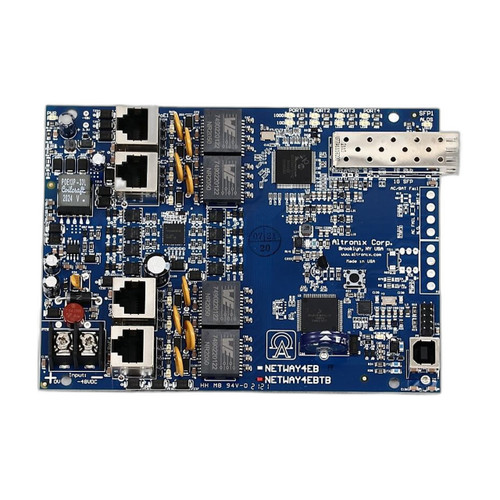
The NETWAY4EBTB provides a 240W total PoE budget across 4 ports at up to 90W per port, conforming to 802.3bt (PoE++, Type 3/4). This supports high-draw devices such as pan-tilt-zoom cameras, multi-sensor units, and 802.3bt-class access control panels without supplemental injectors.
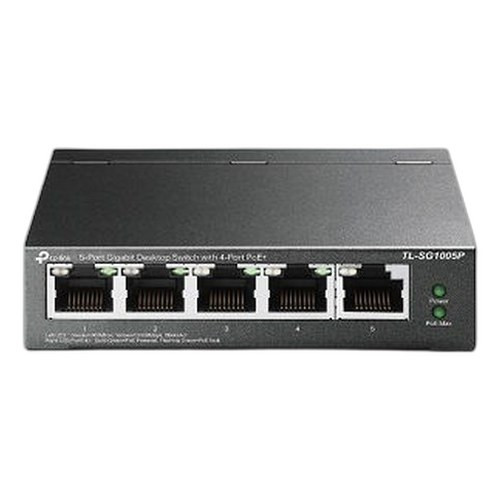
The TL-SG1005P lists a 65W total PoE budget with up to 30W per port (802.3af/PoE+ class). Its spec sheet also references a 56W power supply figure, suggesting the usable PoE budget may be constrained below the stated 65W ceiling depending on simultaneous port load. Four of its five ports are PoE-capable; the fifth is a non-PoE uplink.
The NETWAY4EBTB delivers 3.7× more total PoE power and supports a higher per-port standard. Buyers powering any 802.3bt device — or more than two mid-draw cameras simultaneously — will find the TP-Link budget insufficient.
How do the two switches differ in uplink architecture, form factor, and operating environment?
The NETWAY4EBTB uses a single-mode fiber SFP uplink, enabling backbone runs well beyond the 100m copper limit and providing galvanic isolation from EMI sources common in industrial and outdoor enclosure environments. Its board form factor and 48–56V DC input are designed for integration inside a rack cabinet or alongside a PDU. Storage temperature is rated −30°C to 85°C.
The TL-SG1005P is a desktop-footprint unit (3.9 × 3.9 × 1.0 in.) powered by an external AC adapter. It uses copper RJ45 for all ports including uplink. It supports a Standard mode (100m PoE range at full Gigabit speed) and an Extend mode (250m at 10 Mbps). Operating temperature is listed as 0–40°C with storage to 70°C. Mounting options are limited to surface/wall holes; no rack ears are specified.
The NETWAY4EBTB is suited to enclosed infrastructure deployments where DC power rails exist and fiber backbone is preferred. The TL-SG1005P suits benchtop or wall-mount locations with AC access and copper-only cabling.
What management, supervision, and integration capabilities does each switch offer?
The NETWAY4EBTB is listed as LINQ compatible. Altronix LINQ is a cloud-based supervision and diagnostics platform that allows remote port monitoring, power cycling, and event logging — relevant for alarm dealers and integrators managing distributed sites without on-site visits. No additional management protocol (SNMP, web GUI) is stated in the provided specs.
The TL-SG1005P is explicitly unmanaged. It is plug-and-play with no web interface, SNMP, VLAN, or remote supervision capability. The Extend mode (250m at 10 Mbps) is a hardware toggle, not a software feature. The product was flagged internally with a hide_reason of 'pricing_violation_2026-05-06'; buyers should verify current availability and pricing status before procurement.
For any deployment requiring remote port resets, power-cycle scheduling, or centralized site health monitoring, the NETWAY4EBTB's LINQ compatibility is a concrete differentiator. The TL-SG1005P offers no equivalent capability.
Which should you choose: the NETWAY4EBTB or the SG1005P?
Our take: The NETWAY4EBTB is the stronger choice when the installation demands high-power PoE devices, fiber backbone connectivity, or remote supervision via a management platform. It delivers 240W total versus the TL-SG1005P's 65W — a 3.7× advantage — and supports 90W per port (802.3bt) compared to 30W per port (802.3af/af+). Its fiber SFP uplink eliminates the 100m copper distance limit and provides EMI isolation absent from the TP-Link. LINQ compatibility adds remote diagnostics the unmanaged TP-Link cannot match. The TL-SG1005P is a lower-cost, plug-and-play option for small desktop or wall-mount deployments with modest PoE loads, standard copper cabling, and no management requirement — but its 65W budget (with a 56W power supply noted in specs), copper-only uplink, and unmanaged design make it unsuitable for cabinet integration, 802.3bt devices, or fiber-linked infrastructure. Note: the TL-SG1005P carries an internal pricing_violation flag; confirm availability before ordering.
Side-by-Side Comparison
Spec-for-spec, from manufacturer data.
| Specification | Altronix NETWAY4EBTB | TP-Link SG1005P |
|---|---|---|
| Product Type | PoE Switch (board form factor) | Unmanaged desktop PoE switch |
| Total PoE Budget | 240W | 65W |
| PoE Standard | 802.3bt (PoE++) | 802.3af / PoE+ |
| Max PoE per Port | 90W | 30W |
| PoE-Capable Ports | 4 | 4 (of 5 total) |
| Total Ports | 4 | 5 |
| Uplink Type | Single-mode fiber (SFP) | RJ45 copper only |
| Input Power | 48–56V DC | External AC adapter (56W supply noted) |
| Form Factor | Board / rack | Desktop (surface/wall mount) |
| Management | LINQ compatible (remote supervision) | Unmanaged — no management interface |
| Switching Capacity | — | 10 Gbps |
| Port Speed | Gigabit (1 Gbps) | Gigabit (1 Gbps) |
| Extend Mode | — | 250m at 10 Mbps |
| Operating Temperature | — | 0°C to 40°C |
| Storage Temperature | −30°C to 85°C | −40°C to 70°C |
| Warranty | Lifetime | — |
| Dimensions | 6.25" × 4.5" × 1.25" | 3.9" × 3.9" × 1.0" |
Frequently Asked Questions
Which should you choose: the NETWAY4EBTB or the SG1005P?
The NETWAY4EBTB is the stronger choice when the installation demands high-power PoE devices, fiber backbone connectivity, or remote supervision via a management platform. It delivers 240W total versus the TL-SG1005P's 65W — a 3.7× advantage — and supports 90W per port (802.3bt) compared to 30W per port (802.3af/af+). Its fiber SFP uplink eliminates the 100m copper distance limit and provides EMI isolation absent from the TP-Link. LINQ compatibility adds remote diagnostics the unmanaged TP-Link cannot match. The TL-SG1005P is a lower-cost, plug-and-play option for small desktop or wall-mount deployments with modest PoE loads, standard copper cabling, and no management requirement — but its 65W budget (with a 56W power supply noted in specs), copper-only uplink, and unmanaged design make it unsuitable for cabinet integration, 802.3bt devices, or fiber-linked infrastructure. Note: the TL-SG1005P carries an internal pricing_violation flag; confirm availability before ordering.
Can the NETWAY4EBTB power a PTZ camera that requires 802.3bt (PoE++) while the TL-SG1005P cannot?
Yes. The NETWAY4EBTB is rated for 802.3bt at up to 90W per port, which covers 802.3bt Type 3 (60W) and Type 4 (90W) devices. The TL-SG1005P is rated for 802.3af/PoE+ at up to 30W per port and cannot supply the wattage required by 802.3bt devices.
Is the NETWAY4EBTB or TL-SG1005P better for a small retail or home-office install with just a couple of IP cameras and an AC outlet nearby?
For a simple two- or three-camera desktop install with AC power available and no fiber requirement, the TL-SG1005P's plug-and-play design and compact size are practical. However, buyers should confirm its current availability given the pricing_violation flag in the spec data. If camera PoE draw stays below 30W per port and total load stays under 65W, the TL-SG1005P is operationally adequate for that narrow scenario.
Does the NETWAY4EBTB require a DC power source, and what does that mean for installation?
Yes. The NETWAY4EBTB is specified for 48–56V DC input only. It is designed to be integrated inside an enclosure, rack cabinet, or alongside a compatible Altronix DC power supply — not plugged into a standard AC wall outlet. The TL-SG1005P includes an external AC power adapter in the box and requires no separate power infrastructure.
More Network Switch Comparisons
- Vivotek GET-083A-120 vs TP-Link SG1005P
- Vivotek GET-083A-120 vs Axis T8504-E
- Vivotek GET-083A-120 vs Axis D8004
- Vivotek GET-083A-120 vs Ubiquiti N-SW
- TP-Link SG1005P vs Axis T8504-E
- TP-Link SG1005P vs Axis D8004
Network Switch Buying Guides
Get a Second Opinion on Your Camera Choice
Share your site layout, coverage goals, and budget. Our team will validate the camera selection, flag anything we would change, and recommend products that match the use case.