
Allied Telesis GS980M/52PS-10 vs NETGEAR GS748PP-100NAS: Specification Comparison
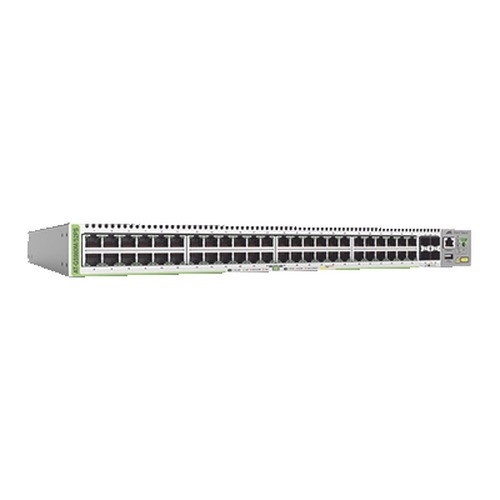
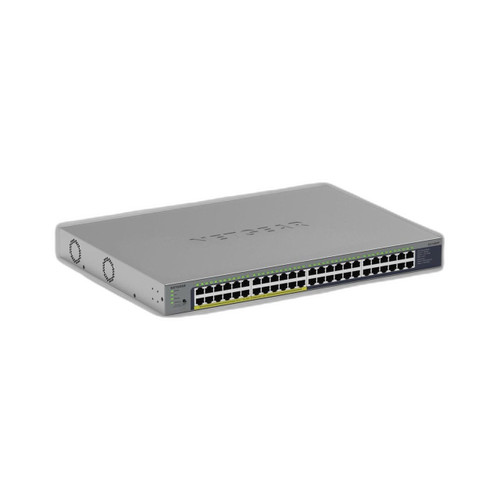
Both the Allied Telesis AT-GS980M/52PS-10 and the NETGEAR GS748PP-100NAS are 48-port Gigabit PoE rack-mount switches targeting enterprise and commercial deployments — IP camera systems, wireless APs, and VoIP endpoints. The Allied Telesis unit is a fully managed Layer 2/3 switch with a 740W PoE budget and 104Gbps fabric, while the NETGEAR is an unmanaged plug-and-play switch claiming a 96Gbps non-blocking fabric and 30W per-port PoE output. This comparison evaluates PoE power delivery, switching performance, and management capability across the two.
In This Guide
- Which switch delivers more total PoE power and how many devices can it realistically support?
- How do the switching fabric capacity and forwarding rates compare under full load?
- Which switch offers the management and integration features required for enterprise or multi-site security deployments?
- Which should you choose: the GS980M/52PS-10 or the GS748PP-100NAS?
- Side-by-Side Specs
- FAQ
Which switch delivers more total PoE power and how many devices can it realistically support?
The AT-GS980M/52PS-10 provides a total PoE budget of 740W across its 48 PoE-enabled ports. Allied Telesis specifies this as 48 ports at 15W each (802.3af) or 24 ports at 30W each (802.3at/PoE+). That aggregate 740W budget is a hard published ceiling derived from the 909W max power consumption spec.
The NETGEAR GS748PP-100NAS lists a per-port figure of 30W and references 802.3bt (PoE++). However, the provided specifications do not state a total aggregate PoE power budget for the switch. The repeated '30W' and '30W per port' entries appear to describe the per-port maximum only. Without a published total PoE budget, it is not possible to confirm whether all 48 ports can simultaneously deliver 30W — a critical unknown for full-density camera or AP deployments.
For deployments where total PoE wattage is a planning constraint — as it almost always is in surveillance and wireless infrastructure projects — the AT-GS980M/52PS-10 provides a verifiable 740W aggregate figure. The NETGEAR's aggregate budget is not specified in the provided data and cannot be assumed.
How do the switching fabric capacity and forwarding rates compare under full load?
The AT-GS980M/52PS-10 specifies a switching fabric of 104Gbps and a forwarding rate of 77.4Mpps. With 48 copper gigabit ports plus 4 SFP uplink ports (52 ports total capacity), a fully non-blocking 52-port gigabit switch would require 104Gbps, meaning the Allied Telesis unit is wire-speed non-blocking across all ports simultaneously.
The NETGEAR GS748PP-100NAS specifies 96Gbps non-blocking bandwidth. A 48-port full-duplex gigabit switch requires 96Gbps for true non-blocking performance, so this figure is consistent with wire-speed operation on all 48 copper ports. No forwarding rate in Mpps is provided for the NETGEAR in the supplied specifications.
The AT-GS980M/52PS-10 has a higher fabric figure (104Gbps vs 96Gbps), which reflects the additional capacity of its four SFP uplink ports. Both switches appear to support non-blocking operation on their copper ports. The NETGEAR's forwarding rate (Mpps) is absent from the provided spec data and cannot be stated.
Which switch offers the management and integration features required for enterprise or multi-site security deployments?
The AT-GS980M/52PS-10 is a managed switch. The provided specifications reference VLAN, QoS, and enterprise security management features. Managed operation enables per-port PoE control, traffic segmentation (VLAN isolation of camera traffic from corporate LAN), QoS prioritization for video streams, and network monitoring — all standard requirements for professional physical security installations with NVRs, access control, and IP intercom on a shared infrastructure.
The NETGEAR GS748PP-100NAS is explicitly specified as unmanaged. It requires zero configuration and operates as a plug-and-play forwarding device. There is no VLAN, QoS, port-level PoE control, or remote management capability indicated in the provided specifications.
For enterprise or multi-site deployments requiring traffic segmentation, storm control, or integration with a network management platform, only the AT-GS980M/52PS-10 provides managed functionality per the supplied specs. The NETGEAR is suited to simpler, flat-network environments where management overhead is intentionally eliminated.
Which should you choose: the GS980M/52PS-10 or the GS748PP-100NAS?
Our take: The AT-GS980M/52PS-10 is the stronger choice when a deployment requires verified aggregate PoE capacity, managed network features, and uplink flexibility. It delivers a confirmed 740W total PoE budget versus an unspecified aggregate for the NETGEAR, supports 48 ports at 15W or 24 ports at 30W simultaneously, and adds four SFP uplink ports absent on the NETGEAR. Its 104Gbps fabric exceeds the NETGEAR's 96Gbps, accommodating uplink bandwidth on top of access-layer capacity. Critically, it is a managed switch with VLAN and QoS support — essential for isolating surveillance traffic and prioritizing video streams in professional installations. The NETGEAR GS748PP-100NAS is appropriate for smaller, budget-conscious, flat-network environments where plug-and-play simplicity is the priority and a managed feature set is not required. Note that the NETGEAR's total PoE budget is not provided in the available specifications and should be confirmed with the manufacturer before committing to a high-density PoE deployment.
Side-by-Side Comparison
Spec-for-spec, from manufacturer data.
| Specification | Allied Telesis GS980M/52PS-10 | NETGEAR GS748PP-100NAS |
|---|---|---|
| Switch Type | Managed | Unmanaged |
| Copper PoE Ports | 48 x 10/100/1000T | 48 x 1G |
| Uplink Ports | 4 x SFP (100/1000X) | — |
| Total Ports | 52 | 48 |
| Switching Fabric | 104 Gbps | 96 Gbps (non-blocking) |
| Forwarding Rate | 77.4 Mpps | — |
| PoE Standard | 802.3at (PoE+) | 802.3bt (PoE++) |
| Max PoE Per Port | 30W (PoE+) | 30W |
| Total PoE Budget | 740W | Not specified |
| Max PoE Ports @ 15W | 48 | — |
| Max PoE Ports @ 30W | 24 | — |
| Max Power Consumption | 909W | — |
| Max Heat Dissipation | 3,102 BTU/h | — |
| Form Factor | 1RU Rack-mount | Rack-mount / Desktop |
| Dimensions (W x D x H) | 441 x 359 x 44 mm | Not specified |
| Weight | 5.8 kg (12.79 lbs) | — |
Frequently Asked Questions
Which should you choose: the GS980M/52PS-10 or the GS748PP-100NAS?
The AT-GS980M/52PS-10 is the stronger choice when a deployment requires verified aggregate PoE capacity, managed network features, and uplink flexibility. It delivers a confirmed 740W total PoE budget versus an unspecified aggregate for the NETGEAR, supports 48 ports at 15W or 24 ports at 30W simultaneously, and adds four SFP uplink ports absent on the NETGEAR. Its 104Gbps fabric exceeds the NETGEAR's 96Gbps, accommodating uplink bandwidth on top of access-layer capacity. Critically, it is a managed switch with VLAN and QoS support — essential for isolating surveillance traffic and prioritizing video streams in professional installations. The NETGEAR GS748PP-100NAS is appropriate for smaller, budget-conscious, flat-network environments where plug-and-play simplicity is the priority and a managed feature set is not required. Note that the NETGEAR's total PoE budget is not provided in the available specifications and should be confirmed with the manufacturer before committing to a high-density PoE deployment.
Is the AT-GS980M/52PS-10 or GS748PP-100NAS better for a 40-camera IP surveillance system?
Based on the provided specifications, the AT-GS980M/52PS-10 is the more suitable choice. It publishes a verified 740W total PoE budget, which supports planning for 40 cameras at 15W each (600W total) with headroom remaining. It also provides managed features such as VLAN and QoS to isolate and prioritize camera traffic. The NETGEAR GS748PP-100NAS does not specify a total aggregate PoE budget in the available data, making capacity planning for a 40-camera deployment impossible to confirm from specs alone.
Can the GS748PP-100NAS handle PoE++ (802.3bt) devices like 90W pan-tilt cameras?
The NETGEAR GS748PP-100NAS references 802.3bt (PoE++) in its specifications, but the per-port maximum listed is 30W. True 802.3bt Class 8 devices can draw up to 90W; the 30W figure stated in the specs suggests either a lower PoE++ class or a per-port cap of 30W. The provided specifications are not sufficient to confirm 90W per-port delivery. The AT-GS980M/52PS-10 specifies a maximum of 30W per port (802.3at/PoE+) and does not claim 802.3bt capability in the provided data.
Does either switch include uplink ports for connecting to a core switch or NVR backbone?
Yes — the AT-GS980M/52PS-10 includes four dedicated 100/1000X SFP uplink ports in addition to its 48 copper PoE+ ports, allowing fiber or copper SFP connections to a core switch or NVR. The NETGEAR GS748PP-100NAS specifications provided do not identify any dedicated uplink or SFP ports; only 48 copper gigabit ports are indicated. Buyers needing fiber uplinks or a dedicated backbone connection should factor this difference into their decision.
More Network Switch Comparisons
- NETGEAR GS748PP-100NAS vs Ubiquiti USW-48-POE
- NETGEAR GS748PP-100NAS vs Ubiquiti USW-PRO-MAX-48-POE
- NETGEAR GS748PP-100NAS vs Ubiquiti USW-ENTERPRISE-48-POE
- NETGEAR GS748PP-100NAS vs Ubiquiti ES-48-500W
- NETGEAR GS748PP-100NAS vs NETGEAR GS348PP-100NAS
- Ubiquiti USW-48-POE vs NETGEAR GS348PP-100NAS
Network Switch Buying Guides
Get a Second Opinion on Your Camera Choice
Share your site layout, coverage goals, and budget. Our team will validate the camera selection, flag anything we would change, and recommend products that match the use case.