
Allied Telesis GS980M/52PS-10 vs NETGEAR GS348PP-100NAS: Specification Comparison
Both the Allied Telesis GS980M/52PS-10 and the NETGEAR GS348PP-100NAS are 48-port Gigabit PoE switch platforms aimed at power-over-Ethernet deployments such as IP surveillance, VoIP, and wireless access points. This comparison examines the three dimensions most critical to installers and IT buyers evaluating these units side by side: PoE power budget and port density, switching performance and throughput, and management capability and form factor. Spec data for Product B contains several internally inconsistent fields; only values that are coherent and self-consistent are used below.
In This Guide
- Which switch delivers more PoE power, and how many cameras or APs can each port realistically support?
- How do the two switches compare on forwarding capacity and throughput for surveillance or converged traffic?
- Which switch offers more control over the network, and how do physical installation requirements differ?
- Which should you choose: the GS980M/52PS-10 or the GS348PP-100NAS?
- Side-by-Side Specs
- FAQ
Which switch delivers more PoE power, and how many cameras or APs can each port realistically support?
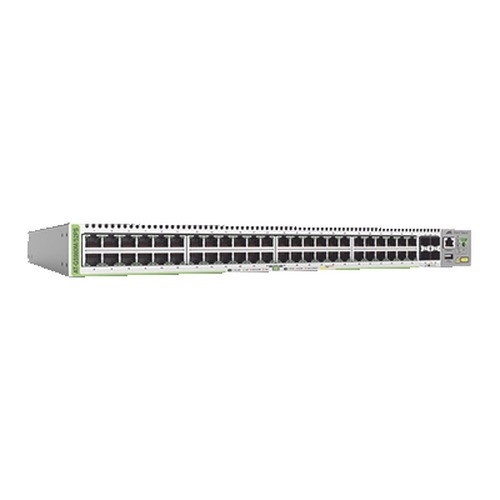
The Allied Telesis GS980M/52PS-10 specifies a maximum PoE power budget of 740W across its 48 PoE-capable ports, rated at up to 15W per port when all 48 are loaded, or up to 30W per port (PoE+, 802.3at) across 24 ports simultaneously. This is a substantial power envelope suited to high-density camera or AP deployments where many endpoints draw near the 802.3at ceiling.
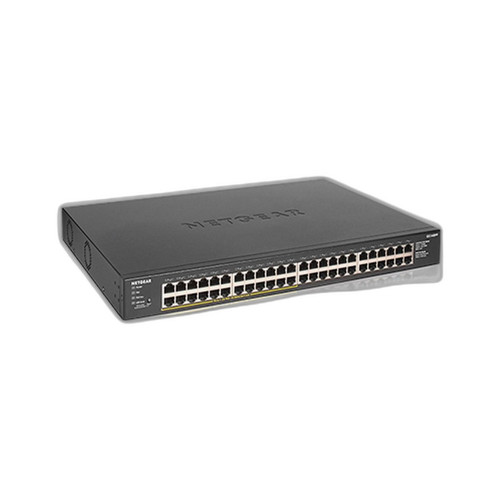
The NETGEAR GS348PP-100NAS specifies a PoE power budget of 380W. Its spec sheet references PoE++ (802.3bt) as the standard, though the per-port wattage ceiling under 802.3bt and the number of ports carrying that budget are not stated in the provided specifications. The 380W total budget is roughly half that of the Allied Telesis unit, meaning average available power per port is significantly lower if all 48 ports are active. Buyers powering high-wattage PTZ cameras or multi-radio APs should calculate headroom carefully against the 380W ceiling.
How do the two switches compare on forwarding capacity and throughput for surveillance or converged traffic?
The Allied Telesis GS980M/52PS-10 declares a switching fabric of 104 Gbps and a forwarding rate of 77.4 Mpps. For a 48-port Gigabit switch, a non-blocking fabric requires 96 Gbps (48 ports × 2 × 1 Gbps); the 104 Gbps figure therefore indicates a non-blocking or near-non-blocking architecture, meaning simultaneous full-rate traffic on all ports should not cause structural congestion.
The NETGEAR GS348PP-100NAS does not provide a switching fabric figure or a forwarding rate (Mpps) in the supplied specifications. The spec field labeled '100G' under speed and 'Ports 1' under Ethernet Rate are internally inconsistent with a 48-port Gigabit device and cannot be used as reliable performance claims. Without a confirmed fabric or forwarding-rate figure, a direct throughput comparison cannot be made. Buyers requiring a verified non-blocking performance guarantee should note this data gap.
Which switch offers more control over the network, and how do physical installation requirements differ?
The Allied Telesis GS980M/52PS-10 is a managed switch supporting VLAN and QoS per its specifications, packaged in a 1RU rack-mount chassis measuring 441 × 359 × 44 mm and weighing 5.8 kg. It is designed for standard 19-inch equipment racks, making it suitable for IDF/MDF closets. Maximum noise is specified at 42 dBA, and maximum power consumption is 909W (including PoE load). Heat dissipation is stated at 3,102 BTU/h, which is relevant for rack thermal planning.
The NETGEAR GS348PP-100NAS is specified as an unmanaged switch, meaning no VLAN segmentation, no QoS prioritization, and no SNMP or CLI access. Its mounting options are listed as wall or ceiling mount with a plastic housing, positioning it as an edge or closet device rather than a rack-resident one. No rack-unit dimension, weight, noise, or heat-dissipation figures are provided in the supplied specifications. The unmanaged design trades configuration flexibility for zero-touch deployment.
Which should you choose: the GS980M/52PS-10 or the GS348PP-100NAS?
Our take: The GS980M/52PS-10 is the stronger choice when the deployment requires managed network control, higher PoE power density, or a verified non-blocking switching architecture. Concretely: its 740W PoE budget is 360W greater than the GS348PP-100NAS's 380W, nearly doubling available power per active port at scale; its 104 Gbps fabric and 77.4 Mpps forwarding rate are confirmed non-blocking figures, whereas the NETGEAR unit provides no fabric or forwarding-rate data; and its managed feature set (VLAN, QoS) enables traffic segmentation critical in mixed surveillance and business networks. The GS348PP-100NAS is appropriate only where zero configuration overhead is acceptable, the total PoE draw fits within 380W, no traffic segmentation is needed, and wall or ceiling mounting is preferred over rack installation.
Side-by-Side Comparison
Spec-for-spec, from manufacturer data.
| Specification | Allied Telesis GS980M/52PS-10 | NETGEAR GS348PP-100NAS |
|---|---|---|
| Total Ports | 52 (48 copper + 4 SFP) | 48 (copper only per spec) |
| Copper (RJ-45) Ports | 48 × 10/100/1000T | 48 × Gigabit (standard not confirmed) |
| Uplink / SFP Ports | 4 × 100/1000X SFP | — |
| PoE Standard | 802.3at (PoE+) | 802.3bt (PoE++) per spec; per-port ceiling not stated |
| Max PoE Budget | 740W | 380W |
| PoE @ 15W — Max Ports | 48 ports | — |
| PoE @ 30W — Max Ports | 24 ports | — |
| Switching Fabric | 104 Gbps | — |
| Forwarding Rate | 77.4 Mpps | — |
| Management | Managed (VLAN, QoS) | Unmanaged |
| Form Factor | 1RU Rack-mount | Wall / Ceiling mount |
| Chassis Material | — | Plastic |
| Dimensions (W × D × H) | 441 × 359 × 44 mm | — |
| Weight | 5.8 kg (12.79 lbs) | — |
| Max Power Consumption | 909W | — |
| Noise Level | 42 dBA | — |
Frequently Asked Questions
Which should you choose: the GS980M/52PS-10 or the GS348PP-100NAS?
The GS980M/52PS-10 is the stronger choice when the deployment requires managed network control, higher PoE power density, or a verified non-blocking switching architecture. Concretely: its 740W PoE budget is 360W greater than the GS348PP-100NAS's 380W, nearly doubling available power per active port at scale; its 104 Gbps fabric and 77.4 Mpps forwarding rate are confirmed non-blocking figures, whereas the NETGEAR unit provides no fabric or forwarding-rate data; and its managed feature set (VLAN, QoS) enables traffic segmentation critical in mixed surveillance and business networks. The GS348PP-100NAS is appropriate only where zero configuration overhead is acceptable, the total PoE draw fits within 380W, no traffic segmentation is needed, and wall or ceiling mounting is preferred over rack installation.
Is the GS980M/52PS-10 or GS348PP-100NAS better for larger surveillance deployments with many high-wattage PTZ cameras?
The GS980M/52PS-10 is better suited. Its 740W PoE budget supports up to 24 ports at 30W simultaneously (PoE+/802.3at), whereas the GS348PP-100NAS's 380W budget limits average available power per port to roughly 7.9W if all 48 ports are active. For high-wattage PTZ cameras that can draw 25–30W, the Allied Telesis unit provides substantially more headroom.
Can I use either switch in a managed network where I need VLANs to separate camera traffic from general office traffic?
Only the Allied Telesis GS980M/52PS-10 supports VLAN and QoS per its specifications. The NETGEAR GS348PP-100NAS is specified as an unmanaged switch with no VLAN or QoS capability. If traffic segmentation, storm control, or quality-of-service prioritization is required, the GS348PP-100NAS cannot fulfill that role.
Which switch is easier to install in a wiring closet rack, and what are the physical differences I should plan for?
The GS980M/52PS-10 is a 1RU rack-mount unit (441 × 359 × 44 mm, 5.8 kg) designed for standard 19-inch racks, with a stated noise level of 42 dBA and heat dissipation of 3,102 BTU/h to plan ventilation around. The GS348PP-100NAS is specified for wall or ceiling mounting with a plastic enclosure; no rack-mount dimensions, weight, noise, or heat figures are provided in its specifications, so rack-closet suitability cannot be confirmed from available data.
More Network Switch Comparisons
- NETGEAR GS748PP-100NAS vs Ubiquiti USW-48-POE
- NETGEAR GS748PP-100NAS vs Ubiquiti USW-PRO-MAX-48-POE
- NETGEAR GS748PP-100NAS vs Ubiquiti USW-ENTERPRISE-48-POE
- NETGEAR GS748PP-100NAS vs Ubiquiti ES-48-500W
- NETGEAR GS748PP-100NAS vs NETGEAR GS348PP-100NAS
- Ubiquiti USW-48-POE vs NETGEAR GS348PP-100NAS
Network Switch Buying Guides
Get a Second Opinion on Your Camera Choice
Share your site layout, coverage goals, and budget. Our team will validate the camera selection, flag anything we would change, and recommend products that match the use case.