
Allied Telesis AT-x530L-10GHXm-10 vs Allied Telesis GS970M/10PS-R-10: Specification Comparison
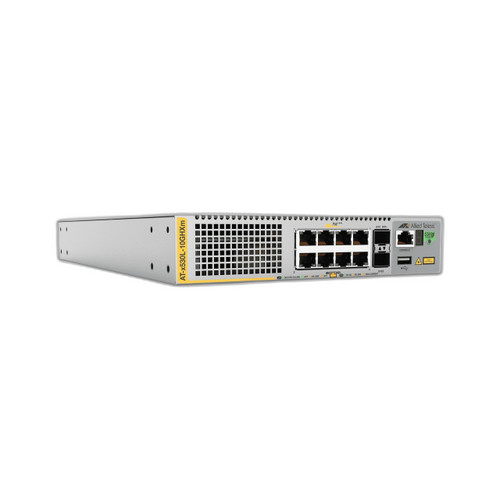
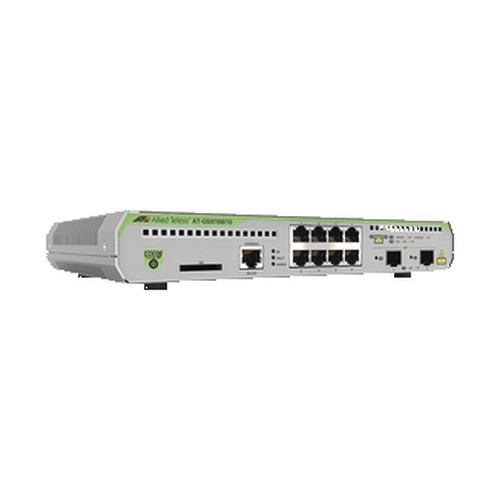
Both products are Allied Telesis 1U rack-mount managed switches sharing an identical 8-port PoE access-port count and 10-port total port count in the same white chassis form factor. The AT-x530L-10GHXm-10 is a multi-gigabit PoE++ switch targeting high-power edge deployments, while the GS970M/10PS-R-10 is a standard Gigabit PoE+ switch aimed at cost-sensitive IP camera and access-point installations. Buyers cross-shopping these two models are weighing per-port speed, PoE power class, uplink technology, acoustic profile, and overall power budget against their infrastructure requirements.
In This Guide
- How do port speed and PoE power delivery compare between the two switches?
- Which switch delivers more throughput and more capable uplink connectivity?
- What are the differences in power consumption, acoustics, and physical footprint?
- Which should you choose: the AT-x530L-10GHXm-10 or the GS970M/10PS-R-10?
- Side-by-Side Specs
- FAQ
How do port speed and PoE power delivery compare between the two switches?
The AT-x530L-10GHXm-10 provides 8 variable-speed ports rated at 100M/1/2.5/5G per port, delivering PoE++ at up to 90W per port (5 ports simultaneously at 90W) and up to 60W across all 8 ports. Its total PoE power budget is 500W. It supports all four 802.3 PoE tiers: 7.5W, 15.4W, 30W, 60W, and 90W across the 8 access ports.
The GS970M/10PS-R-10 provides 8 standard 10/100/1000T (RJ-45) Gigabit ports with PoE+ support. Maximum per-port delivery is 30W (PoE+), with a total PoE budget of 124W. The spec sheet confirms a maximum of 8 ports at 15W each or 4 ports at 30W each simultaneously — no 60W or 90W capability is listed.
For deployments requiring high-wattage endpoints such as PTZ cameras with heaters, multi-radio Wi-Fi 6E access points, or smart displays, the AT-x530L-10GHXm-10's 500W budget and 90W-per-port headroom are decisive. The GS970M/10PS-R-10's 124W budget is adequate for standard 802.3af/at devices but will constrain any site with more than four 30W endpoints.
Which switch delivers more throughput and more capable uplink connectivity?
The AT-x530L-10GHXm-10 has a switching fabric of 120 Gbps and a forwarding rate of 89.2 Mpps. It provides 2× 10G SFP+ uplink ports and 2 stacking ports (noted with an asterisk in the source spec), enabling ring or chain stacking topologies. Latency figures are published at multiple speeds: 2.12 µs at 10 Gbps, 3.49 µs at 5 Gbps, 5.63 µs at 2.5 Gbps, 7.89 µs at 1 Gbps, and 8.24 µs at 100 Mbps.
The GS970M/10PS-R-10 has a switching fabric of 20 Gbps and a forwarding rate of 14.9 Mpps. Uplinks are 2× 100/1000X SFP ports — 1G maximum, no 10G capability. No stacking ports are listed in the provided specifications. No per-speed latency figures are provided in the available spec data.
The x530L outperforms the GS970M on every switching metric: 6× the fabric bandwidth (120 vs 20 Gbps), nearly 6× the forwarding rate (89.2 vs 14.9 Mpps), 10G vs 1G uplinks, and published stacking support. For aggregation or uplink-bound deployments the difference is material; for small edge sites feeding a 1G core the GS970M's fabric is sufficient.
What are the differences in power consumption, acoustics, and physical footprint?
The AT-x530L-10GHXm-10 draws a maximum of 605W and dissipates up to 2,065 BTU/hr, reflecting the overhead of its 500W PoE budget and active cooling. Noise is rated at 64 dBA, indicating fan-cooled operation. Dimensions are 210 × 362 × 42.5 mm (W×D×H) and unpackaged weight is 3.5 kg.
The GS970M/10PS-R-10 draws a maximum of 180W and dissipates 126 BTU/hr — roughly one-third the power and one-sixteenth the heat of the x530L under full load. Noise is rated at 33 dBA. The spec sheet describes the unit as fanless, consistent with the low thermal output. Dimensions are 210 × 275 × 42.5 mm (W×D×H) and weight is 3.45 kg. The GS970M is 87 mm shallower than the x530L.
The GS970M/10PS-R-10 is substantially more suitable for noise-sensitive or thermally constrained environments: 31 dBA quieter, 425W lower peak draw, and a smaller rack depth. The x530L's power and thermal demands require adequate rack PDU capacity and rack-unit airflow planning that the GS970M does not.
Which should you choose: the AT-x530L-10GHXm-10 or the GS970M/10PS-R-10?
Our take: The AT-x530L-10GHXm-10 is the stronger choice when endpoints require high-wattage PoE delivery, multi-gigabit access-layer speeds, or 10G uplink capacity. Three concrete spec deltas define the gap: (1) PoE budget is 500W vs 124W — four times greater, enabling 90W-per-port for PTZ cameras, high-power APs, or ruggedized endpoints that exceed PoE+ limits; (2) switching fabric is 120 Gbps vs 20 Gbps with 89.2 Mpps vs 14.9 Mpps forwarding, providing non-trivial headroom as multi-gig edge traffic grows; (3) uplinks are 10G SFP+ vs 1G SFP, which matters once aggregate port utilization approaches the uplink ceiling. Conversely, the GS970M/10PS-R-10 is the appropriate choice for standard Gigabit PoE+ camera or AP deployments where endpoints draw 15–30W, acoustic limits apply, or rack power budgets are constrained — at 180W max draw and 33 dBA fanless operation, it imposes far fewer infrastructure requirements.
Side-by-Side Comparison
Spec-for-spec, from manufacturer data.
| Specification | Allied Telesis AT-x530L-10GHXm-10 | Allied Telesis GS970M/10PS-R-10 |
|---|---|---|
| Switch Type | Multi-Gigabit PoE++ Access Switch | Gigabit PoE+ Access Switch |
| 10/100/1000T (RJ-45) Copper Ports | — | 8 |
| 100M/1/2.5/5G Ports | 8 | — |
| SFP Uplink Ports | 2× 10G SFP+ | 2× 100/1000X SFP |
| Stacking Ports | 2 (asterisked) | — |
| PoE-Enabled Ports | 8 | 8 |
| Max PoE Power Budget | 500W | 124W |
| Max PoE per Port | 90W (PoE++) | 30W (PoE+) |
| PoE Standards Supported | 7.5W / 15.4W / 30W / 60W / 90W | 15W / 30W |
| Switching Fabric | 120 Gbps | 20 Gbps |
| Forwarding Rate | 89.2 Mpps | 14.9 Mpps |
| Max Power Consumption | 605W | 180W |
| Max Heat Dissipation | 2,065 BTU/hr | 126 BTU/hr |
| Noise Level | 64 dBA | 33 dBA |
| Dimensions (W×D×H mm) | 210 × 362 × 42.5 | 210 × 275 × 42.5 |
| Unpackaged Weight | 3.5 kg (7.72 lb) | 3.45 kg (7.6 lb) |
Frequently Asked Questions
Which should you choose: the AT-x530L-10GHXm-10 or the GS970M/10PS-R-10?
The AT-x530L-10GHXm-10 is the stronger choice when endpoints require high-wattage PoE delivery, multi-gigabit access-layer speeds, or 10G uplink capacity. Three concrete spec deltas define the gap: (1) PoE budget is 500W vs 124W — four times greater, enabling 90W-per-port for PTZ cameras, high-power APs, or ruggedized endpoints that exceed PoE+ limits; (2) switching fabric is 120 Gbps vs 20 Gbps with 89.2 Mpps vs 14.9 Mpps forwarding, providing non-trivial headroom as multi-gig edge traffic grows; (3) uplinks are 10G SFP+ vs 1G SFP, which matters once aggregate port utilization approaches the uplink ceiling. Conversely, the GS970M/10PS-R-10 is the appropriate choice for standard Gigabit PoE+ camera or AP deployments where endpoints draw 15–30W, acoustic limits apply, or rack power budgets are constrained — at 180W max draw and 33 dBA fanless operation, it imposes far fewer infrastructure requirements.
Can either switch power a PTZ camera or Wi-Fi 6E AP that needs more than 30W?
Only the AT-x530L-10GHXm-10 supports PoE++ at 60W and 90W per port. The GS970M/10PS-R-10 is limited to PoE+ at 30W maximum per port per its published specifications, so endpoints requiring more than 30W are not supported on that model.
Is the AT-x530L-10GHXm-10 or GS970M/10PS-R-10 better suited to a wiring closet or IDF with no active cooling?
The GS970M/10PS-R-10 is the better fit: its fanless design produces 33 dBA of noise and dissipates only 126 BTU/hr at maximum load. The AT-x530L-10GHXm-10 is fan-cooled, rated at 64 dBA, and dissipates up to 2,065 BTU/hr — figures that require planned airflow and rack PDU capacity.
Which switch supports stacking for future expansion?
The AT-x530L-10GHXm-10 lists 2 stacking ports in its specifications (noted with an asterisk). The GS970M/10PS-R-10 spec sheet provided does not list any stacking ports or stacking capability.
More Network Switch Comparisons
- Vivotek IHT-1271 vs TP-Link SG3210XHP-M2
- Vivotek IHT-1271 vs TP-Link S4500-8GP2F
- Vivotek IHT-1271 vs TP-Link SG1210P
- Vivotek IHT-1271 vs Allied Telesis AT-x530L-10GHXm-10
- Vivotek IHT-1271 vs Vivotek GEV-108A-130
- Vivotek IHT-1271 vs Vivotek IHT-1000
Network Switch Buying Guides
Get a Second Opinion on Your Camera Choice
Share your site layout, coverage goals, and budget. Our team will validate the camera selection, flag anything we would change, and recommend products that match the use case.