
Zebra ZT42163-T110000Z vs Zebra ZT41142-T0100AGA: Specification Comparison
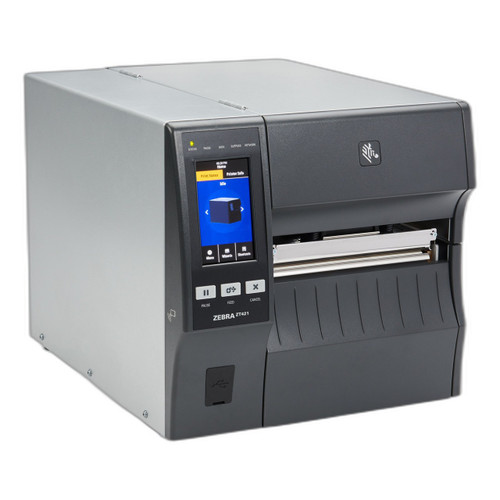
Both the Zebra ZT42163-T110000Z and the Zebra ZT41142-T0100AGA are industrial thermal printers in the ZT400/ZT600 series, designed for high-throughput label production in warehouse, manufacturing, and logistics environments. Both share 14 ips print speed, integrated 2D scan engines, Bluetooth 4.1 MFi connectivity, and the same broad barcode symbology support. The primary differentiators are print width (6-inch vs. 4-inch), RFID capability, native resolution, memory specification, and weight—factors that meaningfully affect deployment fit and label format flexibility.

In This Guide
- Which printer handles wider labels and finer resolution output?
- Which printer offers broader connectivity and RFID or special-deployment support?
- How do physical footprint, memory, and deployment context differ between the two units?
- Which should you choose: the ZT42163-T110000Z or the ZT41142-T0100AGA?
- Side-by-Side Specs
- FAQ
Which printer handles wider labels and finer resolution output?
The ZT42163-T110000Z supports a 6-inch maximum print width, making it suitable for wide-format labels, shipping labels, pallet tags, and compliance labels that exceed the 4-inch constraint of the ZT41142-T0100AGA. Both units support selectable resolution at 203, 300, and 600 dpi according to their respective specs, though the ZT41142-T0100AGA's native/default resolution is explicitly listed as 203 dpi (8 dots per mm), while the ZT42163-T110000Z lists a default of 300 dpi (configurable to 203 or 600 dpi). For operations requiring dense barcodes or fine text on wider media, the ZT42163-T110000Z's broader print width and higher default resolution are directly relevant. The ZT41142-T0100AGA's 4-inch width is standard for most item-level and carton labeling but is a hard ceiling for wider format requirements.
Which printer offers broader connectivity and RFID or special-deployment support?
Both printers share Ethernet and Bluetooth 4.1 MFi connectivity, and both include USB and Serial per their package contents specs. The key differentiator is RFID: the ZT41142-T0100AGA is explicitly spec'd as RFID capable, while no RFID capability is listed for the ZT42163-T110000Z. RFID support is a decisive factor for asset-tracking, government, and regulated deployments requiring simultaneous label printing and RFID tag encoding. The ZT41142-T0100AGA also lists TAA compliance in its card bullets (derived from spec data), which is relevant for federal government and GSA procurement. No TAA compliance spec is provided for the ZT42163-T110000Z. Both units carry a 1-year warranty and ship with the same standard interface set.
How do physical footprint, memory, and deployment context differ between the two units?
The ZT41142-T0100AGA provides an explicit weight spec of 36 lbs. (16.33 kg) to 40 lbs. (18.14 kg) and lists 256 MB SDRAM memory—a directly usable hardware detail for evaluating format storage, firmware headroom, and label template capacity. No weight or memory spec is provided for the ZT42163-T110000Z. The ZT41142-T0100AGA also lists a rack mount type, indicating it may be configured for fixed rack or bench deployments. The ZT42163-T110000Z lists an auto-peel feature among its spec-derived attributes, which is relevant for high-volume automated print-and-apply lines. Both units list the same scan engine class (2D integrated), but only the ZT42163-T110000Z lists an IR lowlight wavelength of 940 nm (invisible), versus 850 nm for the ZT41142-T0100AGA—a minor difference in scan engine illumination.
Which should you choose: the ZT42163-T110000Z or the ZT41142-T0100AGA?
Our take: The ZT42163-T110000Z is the stronger choice when print width, default resolution, and auto-peel are the primary requirements. Its 6-inch maximum print width versus the ZT41142-T0100AGA's 4-inch hard ceiling is the single largest differentiator—directly disqualifying the ZT41142-T0100AGA for any label format wider than 4 inches. Its default resolution of 300 dpi (vs. 203 dpi native on the ZT41142-T0100AGA) produces sharper output at standard settings without reconfiguration. Conversely, the ZT41142-T0100AGA is the appropriate choice for RFID-encoding deployments, government or TAA-regulated procurement, and environments where the 4-inch label format is sufficient—no RFID or TAA spec is listed for the ZT42163-T110000Z. The ZT41142-T0100AGA also provides explicit memory (256 MB SDRAM) and weight data, which aids infrastructure planning. Both units are otherwise matched on speed, symbologies, Bluetooth 4.1 MFi, and warranty.
Side-by-Side Comparison
Spec-for-spec, from manufacturer data.
| Specification | Zebra ZT42163-T110000Z | Zebra ZT41142-T0100AGA |
|---|---|---|
| Product Type | Industrial Thermal Printer | Industrial Thermal Printer |
| Print Width (Max) | 6 inches | 4 inches |
| Print Speed | 14 ips | 14 ips |
| Default/Native Resolution | 300 dpi (configurable 203/600) | 203 dpi / 8 dots per mm |
| Selectable Resolutions | 203, 300, 600 dpi | 203, 300, 600 dpi |
| Scan Engine | 2D integrated | 2D integrated |
| 1D Symbologies | Code 128, Code 39, UPC, EAN | Code 128, Code 39, UPC, EAN |
| 2D Symbologies | QR Code, Data Matrix, PDF417 | QR Code, Data Matrix, PDF417 |
| Bluetooth | Bluetooth 4.1 MFi | Bluetooth 4.1 MFi |
| Connectivity (Wired) | Ethernet, USB, Serial | Ethernet, USB, Serial |
| RFID Capable | — | Yes |
| TAA Compliant | — | Yes (per spec attributes) |
| Memory | — | 256 MB SDRAM |
| Weight | — | 36–40 lbs. (16.33–18.14 kg) |
| Auto Peel | Yes (per spec attributes) | — |
| Warranty | 1-year | 1-year |
Frequently Asked Questions
Which should you choose: the ZT42163-T110000Z or the ZT41142-T0100AGA?
The ZT42163-T110000Z is the stronger choice when print width, default resolution, and auto-peel are the primary requirements. Its 6-inch maximum print width versus the ZT41142-T0100AGA's 4-inch hard ceiling is the single largest differentiator—directly disqualifying the ZT41142-T0100AGA for any label format wider than 4 inches. Its default resolution of 300 dpi (vs. 203 dpi native on the ZT41142-T0100AGA) produces sharper output at standard settings without reconfiguration. Conversely, the ZT41142-T0100AGA is the appropriate choice for RFID-encoding deployments, government or TAA-regulated procurement, and environments where the 4-inch label format is sufficient—no RFID or TAA spec is listed for the ZT42163-T110000Z. The ZT41142-T0100AGA also provides explicit memory (256 MB SDRAM) and weight data, which aids infrastructure planning. Both units are otherwise matched on speed, symbologies, Bluetooth 4.1 MFi, and warranty.
Can the ZT41142-T0100AGA print the same wide shipping or pallet labels as the ZT42163-T110000Z?
No. The ZT41142-T0100AGA has a 4-inch print width per its specifications. The ZT42163-T110000Z supports up to a 6-inch print width. Any label format requiring more than 4 inches of width requires the ZT42163-T110000Z; the ZT41142-T0100AGA cannot accommodate it.
Which model should I choose for a government or asset-tracking deployment requiring RFID?
The ZT41142-T0100AGA is specified as RFID capable and is noted for TAA compliance suitability in its spec-derived attributes. No RFID capability or TAA compliance spec is listed for the ZT42163-T110000Z. For regulated, government, or RFID asset-tracking deployments, the ZT41142-T0100AGA is the indicated choice based on available specifications.
Do both printers support the same barcode symbologies and Bluetooth standard?
Yes. Both the ZT42163-T110000Z and ZT41142-T0100AGA support identical symbology sets—QR Code, Data Matrix, PDF417 (2D), and Code 128, Code 39, UPC, EAN (1D)—and both use Bluetooth 4.1 MFi. Connectivity also matches on Ethernet, USB, and Serial per package contents for both units.
More Label Printer Comparisons
- Honeywell PX940 vs Sato WWCLP3B01-WAR
- Honeywell PX940 vs Sato WWCLP3801-NAR
- Honeywell PX940 vs Sato WWCLP3801-WAR
- Honeywell PX940 vs Wasp WPL408
- Honeywell PX940 vs Honeywell PX4654-020
- Honeywell PX940 vs Honeywell PX6654-000
Label Printer Buying Guides
Get a Second Opinion on Your Camera Choice
Share your site layout, coverage goals, and budget. Our team will validate the camera selection, flag anything we would change, and recommend products that match the use case.