
Zebra ZT41142-T01E0A0Z vs Sato WWCLP3801-WAR: Specification Comparison
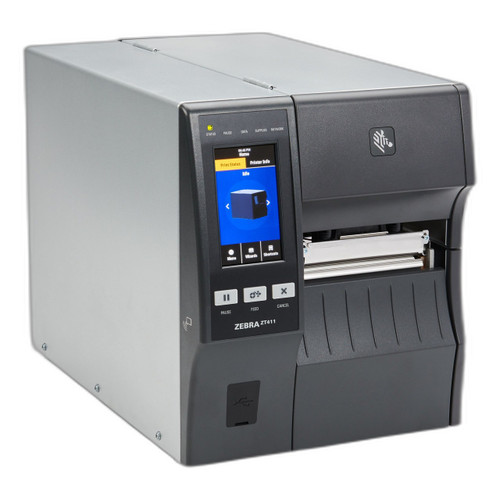
Both the Zebra ZT41142-T01E0A0Z and the Sato WWCLP3801-WAR (CL4NX Plus) are 4-inch industrial thermal printers with RFID capability, targeting warehouse, manufacturing, and logistics labeling environments. The comparison centers on print resolution and fidelity, RFID frequency type, connectivity breadth, media handling capacity, and physical build — the primary axes on which industrial printer buyers differentiate and select between competitive platforms at this tier.

In This Guide
- Which printer delivers the resolution and throughput your label runs actually require?
- Which printer's RFID frequency and connectivity options match your infrastructure?
- Which printer better handles your media range, memory demands, and physical environment?
- Which should you choose: the ZT41142-T01E0A0Z or the WWCLP3801-WAR?
- Side-by-Side Specs
- FAQ
Which printer delivers the resolution and throughput your label runs actually require?
Both units match at 14 ips maximum print speed, so throughput at rated speed is equivalent. Resolution diverges significantly: the Zebra ZT41142-T01E0A0Z offers selectable 203, 300, and 600 DPI, giving operators flexibility from standard warehouse labels up to high-density small-pitch barcodes. The Sato WWCLP3801-WAR (CL4NX Plus) is rated at 609 DPI — the highest single resolution in this comparison — making it the stronger choice for applications demanding photo-grade detail, such as pharmaceutical serialization or fine-pitch electronics component labels. The Zebra's 600 DPI option is close but not identical to 609 DPI. The Sato spec sheet also lists a secondary 'Print Resolution: 203' field, which likely refers to a lower selectable mode, though the specs provided do not enumerate all available DPI steps as clearly as the Zebra listing does.
Which printer's RFID frequency and connectivity options match your infrastructure?
RFID frequency is the sharpest differentiator here. The Zebra ZT41142-T01E0A0Z implements UHF RFID encoding (implied by its 2D/asset-tracking positioning and standard Zebra ZT400-series architecture); however, the provided specs do not explicitly state the RFID frequency band. The Sato WWCLP3801-WAR specifies 13.56 MHz HF RFID with auto-antenna tuning — HF is the mandated frequency for NFC-compatible tags, pharmaceutical track-and-trace, and smart card encoding workflows. Buyers must match RFID frequency to their tag population: HF (13.56 MHz) and UHF (~900 MHz) tags are not interchangeable.
On wired and wireless connectivity, the Zebra includes Ethernet, Bluetooth 5.3 (MFi-certified for iOS), Wi-Fi, USB, and Serial — the broadest connectivity set. The Sato provides Ethernet, Wi-Fi, and USB 2.0 but does not list Bluetooth or Serial in its specs. The Zebra's Bluetooth 5.3 and Serial port give it an edge in mixed environments requiring mobile pairing or legacy host integration.
Which printer better handles your media range, memory demands, and physical environment?
Media handling favors the Sato: maximum media width is 5.04 inches (vs. a stated 4-inch print width on the Zebra, with the spec sheet also citing '6 inch' print width — an apparent data inconsistency that buyers should verify against Zebra's official datasheet). Sato's minimum media width of 0.87 inches and max roll diameter of 10 inches, combined with support for ribbon lengths up to 1,968 ft, indicate strong thermal-transfer compatibility for a wide label stock range. The Sato also supports both Direct Thermal and Thermal Transfer print methods; the Zebra specs provided list only Direct Thermal.
Memory favors the Sato: 2 GB Flash plus 256 MB SDRAM and 100 MB user storage vs. the Zebra's 256 MB SDRAM with no Flash figure provided in the specs. The Sato's 3.5-inch full-color LCD display is specified; no display size is listed for the Zebra. The Sato is built with a cast aluminum frame. The Zebra weighs 36–40 lbs depending on configuration; the Sato weighs 33 lbs. Operating temperature for the Sato is specified at 41°F–104°F; the Zebra spec block does not include an operating temperature range in the provided data. Both carry a 1-year warranty.
Which should you choose: the ZT41142-T01E0A0Z or the WWCLP3801-WAR?
Our take: The WWCLP3801-WAR is the stronger choice when label fidelity and HF RFID encoding are the primary requirements — its 609 DPI resolution exceeds the Zebra's 600 DPI maximum, its 13.56 MHz HF RFID is explicitly specified and supports NFC-compatible and pharmaceutical-grade tag workflows, and its 2 GB Flash memory dwarfs the Zebra's unspecified Flash. The ZT41142-T01E0A0Z is the stronger choice when connectivity breadth matters most: it adds Bluetooth 5.3 (MFi) and Serial that the Sato lacks, enabling mobile iOS pairing and legacy host integration. The Zebra also offers three selectable DPI steps (203/300/600) for operator flexibility across label types. Platform qualifier: buyers standardized on UHF RFID infrastructure should verify the Zebra's RFID band from the official datasheet, as the provided specs do not state it explicitly — and should avoid the Sato's HF-only RFID if UHF tags are in use.
Side-by-Side Comparison
Spec-for-spec, from manufacturer data.
| Specification | Zebra ZT41142-T01E0A0Z | Sato WWCLP3801-WAR |
|---|---|---|
| Product Type | Industrial Thermal Printer | Industrial Thermal Printer |
| Print Speed (max) | 14 ips | 14 ips |
| Print Resolution (DPI) | 203 / 300 / 600 (selectable) | 609 (primary); 203 also listed |
| Print Method | Direct Thermal | Direct Thermal / Thermal Transfer |
| Max Print Width | 4 in (6 in also listed — verify) | 4.09 in |
| Max Media Width | — | 5.04 in |
| Min Media Width | — | 0.87 in |
| Max Media Roll Diameter | — | 10 in |
| Max Ribbon Length | — | 1,968 ft |
| RFID | Yes (frequency not specified in provided specs) | HF, 13.56 MHz, auto-antenna tuning |
| Connectivity | Ethernet, Wi-Fi, Bluetooth 5.3, USB, Serial | Ethernet, Wi-Fi, USB 2.0 |
| Bluetooth | Bluetooth 5.3 (MFi) | — |
| Memory (Flash) | — | 2 GB |
| Memory (SDRAM) | 256 MB | 256 MB |
| User Storage | — | 100 MB |
| Display | — | 3.5 in Full-Color LCD |
| Frame Material | — | Cast aluminum |
| Weight | 36–40 lbs (config-dependent) | 33 lbs |
| Operating Temperature | — | 41°F to 104°F |
| Power | — | AC 100–240V, 50/60Hz |
| Warranty | 1 year | 1 year |
| 2D Symbologies | QR Code, Data Matrix, PDF417 | — |
| 1D Symbologies | Code 128, Code 39, UPC, EAN | — |
Frequently Asked Questions
Which should you choose: the ZT41142-T01E0A0Z or the WWCLP3801-WAR?
The WWCLP3801-WAR is the stronger choice when label fidelity and HF RFID encoding are the primary requirements — its 609 DPI resolution exceeds the Zebra's 600 DPI maximum, its 13.56 MHz HF RFID is explicitly specified and supports NFC-compatible and pharmaceutical-grade tag workflows, and its 2 GB Flash memory dwarfs the Zebra's unspecified Flash. The ZT41142-T01E0A0Z is the stronger choice when connectivity breadth matters most: it adds Bluetooth 5.3 (MFi) and Serial that the Sato lacks, enabling mobile iOS pairing and legacy host integration. The Zebra also offers three selectable DPI steps (203/300/600) for operator flexibility across label types. Platform qualifier: buyers standardized on UHF RFID infrastructure should verify the Zebra's RFID band from the official datasheet, as the provided specs do not state it explicitly — and should avoid the Sato's HF-only RFID if UHF tags are in use.
Is the ZT41142-T01E0A0Z or the WWCLP3801-WAR better for pharmaceutical or NFC label encoding?
The WWCLP3801-WAR is specified with 13.56 MHz HF RFID, which is the frequency used for NFC-compatible tags and many pharmaceutical track-and-trace standards. The Zebra ZT41142-T01E0A0Z specs provided do not state an RFID frequency, so buyers targeting HF or NFC workflows should select the Sato or confirm the Zebra's RFID band with Zebra directly before purchasing.
Which printer supports thermal transfer in addition to direct thermal?
The Sato WWCLP3801-WAR explicitly supports both Direct Thermal and Thermal Transfer print methods, making it suitable for labels requiring ribbon-based printing on non-thermally-coated media. The Zebra ZT41142-T01E0A0Z specs as provided list only Direct Thermal; buyers requiring thermal transfer should verify the Zebra's supported print methods against its official datasheet.
Does either printer support Bluetooth for mobile device pairing?
Yes — the Zebra ZT41142-T01E0A0Z includes Bluetooth 5.3 with MFi certification, enabling pairing with iOS mobile devices. The Sato WWCLP3801-WAR does not list Bluetooth in its provided specifications. If mobile pairing to handhelds or tablets is a workflow requirement, the Zebra has a clear advantage.
More Label Printer Comparisons
- Honeywell PX940 vs Sato WWCLP3B01-WAR
- Honeywell PX940 vs Sato WWCLP3801-NAR
- Honeywell PX940 vs Sato WWCLP3801-WAR
- Honeywell PX940 vs Wasp WPL408
- Honeywell PX940 vs Honeywell PX4654-020
- Honeywell PX940 vs Honeywell PX6654-000
Label Printer Buying Guides
Get a Second Opinion on Your Camera Choice
Share your site layout, coverage goals, and budget. Our team will validate the camera selection, flag anything we would change, and recommend products that match the use case.