
Zebra ZT41142-T0100A0Z vs Sato WWCLP3801-WAR: Specification Comparison
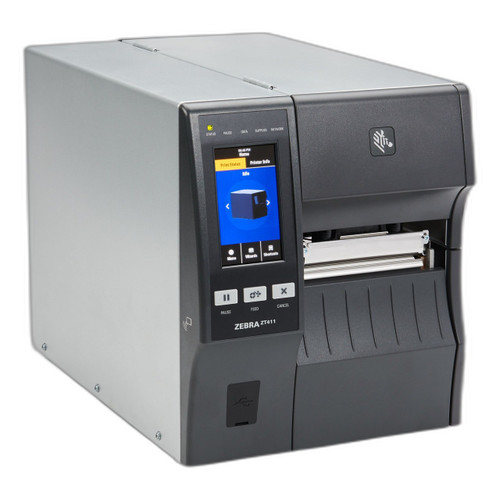
Both the Zebra ZT41142-T0100A0Z and the Sato WWCLP3801-WAR (CL4NX Plus) are 4-inch industrial thermal printers designed for high-volume label production in warehouse, manufacturing, and supply-chain environments. Each supports direct thermal and/or thermal-transfer print methods, runs at 14 ips, and integrates RFID encoding — making them genuine cross-shop candidates for buyers evaluating rugged, network-connected label printers with barcode and RFID output requirements. The primary differentiators are print resolution, RFID frequency band, connectivity options, and media handling capacity.

In This Guide
- How do print resolution and output quality compare between the two printers?
- Which printer offers broader RFID support and connectivity options?
- How do the two printers compare on media capacity, physical build, and operating environment?
- Which should you choose: the ZT41142-T0100A0Z or the WWCLP3801-WAR?
- Side-by-Side Specs
- FAQ
How do print resolution and output quality compare between the two printers?
The Sato WWCLP3801-WAR is specified at 609 dpi (confirmed in both the structured specs and datasheet fields), making it the significantly higher-resolution device. The Zebra ZT41142-T0100A0Z is specified at 203 dpi in its primary resolution field and datasheet, with an additional spec entry indicating optional 300 and 600 dpi configurations depending on print head variant. At its baseline 203 dpi, the Zebra is suited for standard warehouse barcodes and shipping labels where fine detail is not required.
The Sato's 609 dpi output is relevant for applications demanding photo-grade or near-photo-grade label detail — such as pharmaceutical serialization, electronics component marking, or small-format labels where high dot density prevents barcode mis-reads on compact symbologies. Buyers with standard logistics or distribution labeling needs may not require 609 dpi, but those in regulated or precision industries will find the Sato's resolution capability meaningfully differentiated.
Which printer offers broader RFID support and connectivity options?
Both printers include integrated RFID encoding. The Sato WWCLP3801-WAR specifies HF (High Frequency) RFID at 13.56 MHz with auto-antenna tuning noted in the card bullets. The Zebra ZT41142-T0100A0Z specifies 'integrated encoding capability' in the RFID field but does not specify the RFID frequency band or protocol in the provided specs — buyers requiring a specific frequency (UHF vs. HF) should verify the Zebra's RFID specification separately before purchasing.
On wired and wireless connectivity, the Zebra includes Ethernet, Wi-Fi, and Bluetooth 4.1/MFi — the addition of Bluetooth is a meaningful differentiator for mobile pairing scenarios. The Sato specifies Ethernet, Wi-Fi, and USB 2.0, but no Bluetooth is listed in the provided specs. Both support Ethernet for fixed network deployment. The Zebra's Bluetooth MFi certification also indicates compatibility with Apple iOS devices for mobile label printing workflows.
How do the two printers compare on media capacity, physical build, and operating environment?
The Sato WWCLP3801-WAR provides more detailed media specifications: it accepts media widths from 0.87 to 5.04 inches, supports a maximum media roll diameter of 10 inches, and accommodates ribbon lengths up to 1,968 feet. It also features a 3.5-inch full-color LCD display and is constructed with a cast aluminum frame. Operating temperature is specified at 41°F to 104°F (5°C to 40°C). Unit weight is 33 lbs.
The Zebra ZT41142-T0100A0Z lists a maximum print width of 4 inches (with a secondary spec entry of 6 inches, which may indicate a variant or liner width). Weight is listed as 36 lbs (or 40 lbs depending on configuration). The Zebra spec set does not include media roll diameter, ribbon length capacity, display size/type, frame material, or operating temperature range in the provided data — buyers should consult the full Zebra datasheet for these values. Memory is comparable: both units list 256 MB SDRAM; the Sato adds 2 GB Flash and 100 MB user storage, while Zebra's flash/storage is not specified in the provided data.
Which should you choose: the ZT41142-T0100A0Z or the WWCLP3801-WAR?
Our take: The WWCLP3801-WAR is the stronger choice when print resolution, HF RFID specificity, and detailed media handling are the primary decision criteria. The Sato delivers 609 dpi versus the Zebra's 203 dpi baseline — a 3× resolution advantage relevant for pharmaceutical, electronics, or small-label applications. The Sato also explicitly specifies HF RFID at 13.56 MHz with auto-antenna tuning, while the Zebra's RFID frequency is not confirmed in the provided specs. The Sato further documents 2 GB Flash storage and a full-color 3.5-inch LCD not present in the Zebra's spec set. Conversely, the ZT41142-T0100A0Z is the stronger choice for mobile and mixed-deployment environments: it uniquely adds Bluetooth 4.1/MFi connectivity for iOS pairing alongside Wi-Fi and Ethernet, and it supports a broader range of symbologies including QR Code, Data Matrix, and PDF417 per spec. Buyers running standard warehouse or distribution label runs at scale should evaluate both, with the Zebra favored for Bluetooth-dependent mobile workflows and the Sato for high-resolution or HF RFID-specific deployments.
Side-by-Side Comparison
Spec-for-spec, from manufacturer data.
| Specification | Zebra ZT41142-T0100A0Z | Sato WWCLP3801-WAR |
|---|---|---|
| Print Resolution (primary spec) | 203 dpi | 609 dpi |
| Print Speed | 14 ips | 14 ips |
| Max Print Width | 4 inches | 4.09 inches |
| Print Method | Thermal (type not further specified in spec) | Direct Thermal / Thermal Transfer |
| RFID Encoding | Integrated (frequency not specified in provided specs) | HF, 13.56 MHz |
| Bluetooth | Bluetooth 4.1 / MFi | — |
| Wi-Fi | Yes | Yes |
| Ethernet | Yes | Yes |
| USB | Yes (standard, per package contents) | USB 2.0 |
| Display | — (not specified in provided specs) | 3.5-inch Full-Color LCD |
| Memory — SDRAM | 256 MB | 256 MB |
| Memory — Flash | — (not specified in provided specs) | 2 GB |
| User Storage | — (not specified in provided specs) | 100 MB |
| Max Media Roll Diameter | — (not specified in provided specs) | 10 inches |
| Max Ribbon Length | — (not specified in provided specs) | 1,968 ft |
| Warranty | 1-year | 1-year |
| Weight | 36–40 lbs (configuration-dependent) | 33 lbs |
| Frame Material | — (not specified in provided specs) | Cast aluminum |
| Operating Temperature | — (not specified in provided specs) | 41°F to 104°F |
Frequently Asked Questions
Which should you choose: the ZT41142-T0100A0Z or the WWCLP3801-WAR?
The WWCLP3801-WAR is the stronger choice when print resolution, HF RFID specificity, and detailed media handling are the primary decision criteria. The Sato delivers 609 dpi versus the Zebra's 203 dpi baseline — a 3× resolution advantage relevant for pharmaceutical, electronics, or small-label applications. The Sato also explicitly specifies HF RFID at 13.56 MHz with auto-antenna tuning, while the Zebra's RFID frequency is not confirmed in the provided specs. The Sato further documents 2 GB Flash storage and a full-color 3.5-inch LCD not present in the Zebra's spec set. Conversely, the ZT41142-T0100A0Z is the stronger choice for mobile and mixed-deployment environments: it uniquely adds Bluetooth 4.1/MFi connectivity for iOS pairing alongside Wi-Fi and Ethernet, and it supports a broader range of symbologies including QR Code, Data Matrix, and PDF417 per spec. Buyers running standard warehouse or distribution label runs at scale should evaluate both, with the Zebra favored for Bluetooth-dependent mobile workflows and the Sato for high-resolution or HF RFID-specific deployments.
Which printer is better for pharmaceutical or electronics labeling requiring fine print detail?
Based on the provided specs, the Sato WWCLP3801-WAR is better suited for those applications. It is specified at 609 dpi versus the Zebra ZT41142-T0100A0Z's 203 dpi baseline, which translates to significantly finer dot density for small text, tight barcodes, and high-resolution graphics on compact labels. The Zebra spec sheet notes optional 300 and 600 dpi configurations, but the primary/datasheet resolution is 203 dpi — buyers should confirm which print head is included in the specific SKU before assuming higher resolution availability.
Does either printer support Bluetooth for pairing with mobile devices or iOS apps?
Yes — the Zebra ZT41142-T0100A0Z specifies Bluetooth 4.1/MFi connectivity, which indicates compatibility with Apple MFi-certified iOS devices for mobile label printing. The Sato WWCLP3801-WAR does not list Bluetooth in its provided specifications; its connectivity is limited to Ethernet, Wi-Fi, and USB 2.0 per the spec data. If Bluetooth pairing with handhelds or mobile devices is required, the Zebra is the only confirmed option of the two.
What RFID frequency does each printer encode, and does it matter for my tags?
The Sato WWCLP3801-WAR explicitly specifies HF (High Frequency) RFID at 13.56 MHz — commonly used for NFC-compatible tags, pharmaceutical serialization, and access card inlays. The Zebra ZT41142-T0100A0Z lists 'integrated encoding capability' in its RFID field but does not specify the frequency band (HF at 13.56 MHz or UHF at 860–960 MHz) in the provided spec data. If your tag inlays are HF/NFC-based, the Sato is the confirmed match; Zebra ZT400-series printers are available in both HF and UHF RFID variants, so buyers should verify the specific RFID module included in SKU ZT41142-T0100A0Z before purchasing.
More Label Printer Comparisons
- Honeywell PX940 vs Sato WWCLP3B01-WAR
- Honeywell PX940 vs Sato WWCLP3801-NAR
- Honeywell PX940 vs Sato WWCLP3801-WAR
- Honeywell PX940 vs Wasp WPL408
- Honeywell PX940 vs Honeywell PX4654-020
- Honeywell PX940 vs Honeywell PX6654-000
Label Printer Buying Guides
Get a Second Opinion on Your Camera Choice
Share your site layout, coverage goals, and budget. Our team will validate the camera selection, flag anything we would change, and recommend products that match the use case.