
Vivotek FGT-100P-110 vs Speco Technologies P8S10G: Specification Comparison
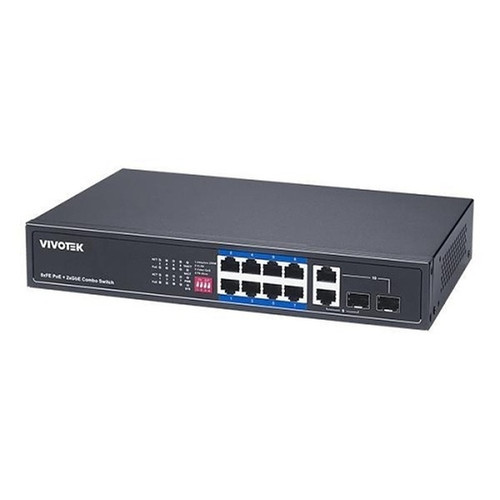
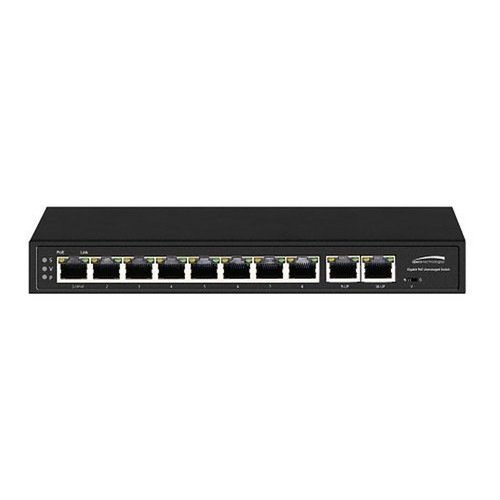
Both the Vivotek AW-FGT-100P-110 and the Speco Technologies P8S10G are 10-port unmanaged/managed PoE switches purpose-built for IP camera networks—the same general product class a surveillance integrator or IT buyer would cross-shop when wiring a small-to-mid camera deployment. The FGT-100P-110 offers 10 PoE ports in an unmanaged, plug-and-play form factor, while the P8S10G provides 8 PoE ports plus 2 dedicated Gigabit uplinks with managed features including VLAN, QoS, and PoE Watchdog. This comparison evaluates port architecture, power delivery, and management capability.
In This Guide
- How do the port counts, uplink topology, and data rates compare between the two switches?
- Which switch delivers more PoE power per port and in total, and how do the PoE standards differ?
- What management features and fault-recovery capabilities does each switch offer?
- Which should you choose: the FGT-100P-110 or the P8S10G?
- Side-by-Side Specs
- FAQ
How do the port counts, uplink topology, and data rates compare between the two switches?
The Vivotek AW-FGT-100P-110 provides 10 ports, all of which deliver simultaneous IEEE 802.3af PoE power and data. No dedicated uplink ports are specified in the provided documentation, meaning all 10 ports serve the same role. Data rate per port is not explicitly stated in the supplied specs.
The Speco P8S10G uses a split architecture: 8 ports deliver PoE power to cameras, while 2 dedicated ports serve as Gigabit (1000 Mbps) uplinks via RJ45. All 10 ports—including the PoE ports—are specified as full Gigabit (1000 Mbps). This uplink separation prevents camera traffic from competing with backbone bandwidth.
For deployments requiring a clear demarcation between edge devices and upstream network infrastructure, the P8S10G's dedicated uplink design is architecturally distinct from the FGT-100P-110's flat 10-port layout. The FGT-100P-110's per-port data rate is not specified in the provided documentation.
Which switch delivers more PoE power per port and in total, and how do the PoE standards differ?
The Vivotek AW-FGT-100P-110 supports IEEE 802.3af only, which caps each port at 15.4 W. Total PoE budget is not stated in the provided specifications. All 10 ports deliver simultaneous PoE according to the datasheet tagline, but aggregate wattage available across those ports is not documented here.
The Speco P8S10G supports both 802.3af (15.4 W per port) and 802.3at (30 W per port) across its 8 PoE ports, with a stated total PoE budget of 110 W. Per-port maximums reach 30 W under 802.3at, enabling compatibility with higher-draw devices such as PTZ cameras, multi-sensor units, or PoE-powered access control readers.
The P8S10G's dual-standard support (802.3af/at) and documented 110 W budget give integrators a concrete power envelope to plan against. The FGT-100P-110's aggregate budget is absent from the provided specs, which limits power-planning confidence for all-port-loaded deployments.
What management features and fault-recovery capabilities does each switch offer?
The Vivotek AW-FGT-100P-110 is explicitly unmanaged and plug-and-play with automatic MDI/MDIX crossover detection. No VLAN segmentation, QoS prioritization, port-level management, or fault-recovery automation is documented in the provided specifications. Configuration effort is effectively zero, which suits installers who require rapid, tool-free deployment.
The Speco P8S10G includes VLAN support, QoS, and port management per its listed specifications, placing it in the lightly managed category. Its PoE Watchdog feature automatically resets unresponsive ports, which can recover frozen IP cameras without a site visit—a meaningful operational advantage in unmanned or remote installations.
Warranty coverage is documented only for the P8S10G at 2 years; no warranty term is stated in the FGT-100P-110 spec data provided. Operating temperature range (32°F–104°F) and storage range (−40°F–150°F) are specified only for the P8S10G; the FGT-100P-110 provides no environmental ratings in the supplied documentation.
Which should you choose: the FGT-100P-110 or the P8S10G?
Our take: The P8S10G is the stronger choice when the installation demands dual-standard PoE (802.3af/at), a documented 110 W power budget, managed features, and automatic fault recovery. Key spec deltas: the P8S10G supports up to 30 W per port versus the FGT-100P-110's 15.4 W ceiling (802.3af only); the P8S10G specifies a 110 W aggregate PoE budget while the FGT-100P-110 provides no total-budget figure; and the P8S10G includes VLAN, QoS, and PoE Watchdog where the FGT-100P-110 is strictly unmanaged. Conversely, the FGT-100P-110 offers 10 PoE-capable edge ports versus the P8S10G's 8, suits zero-configuration closet deployments, and weighs 1.0 lb versus 2.5 lb. Choose the FGT-100P-110 for small, low-power camera runs requiring maximum PoE port count with no management overhead; choose the P8S10G for mixed-wattage camera networks, Speco-centric platforms, or any site where remote PoE fault recovery reduces truck rolls.
Side-by-Side Comparison
Spec-for-spec, from manufacturer data.
| Specification | Vivotek FGT-100P-110 | Speco Technologies P8S10G |
|---|---|---|
| Total Ports | 10 | 10 |
| PoE Ports | 10 | 8 |
| Dedicated Uplink Ports | — | 2 x 1 Gbps RJ45 |
| PoE Standard | 802.3af | 802.3af and 802.3at |
| Max PoE Per Port | 15.4 W (802.3af) | 30 W (802.3at) |
| Total PoE Budget | — | 110 W |
| Data Rate | — | 1000 Mbps (all ports) |
| Management | Unmanaged, plug-and-play | VLAN, QoS, port management |
| PoE Fault Recovery | — | PoE Watchdog auto-recovery |
| Cable Detection | Auto MDI/MDIX crossover | — |
| Form Factor | Compact, rack/cabinet mountable | — |
| Dimensions | — | 10.4 x 8.7 x 2.7 in |
| Weight | 1.0 lb | 2.5 lb |
| Housing Color | White | White |
| Operating Temp | — | 32°F – 104°F |
| Warranty | — | 2-year |
Frequently Asked Questions
Which should you choose: the FGT-100P-110 or the P8S10G?
The P8S10G is the stronger choice when the installation demands dual-standard PoE (802.3af/at), a documented 110 W power budget, managed features, and automatic fault recovery. Key spec deltas: the P8S10G supports up to 30 W per port versus the FGT-100P-110's 15.4 W ceiling (802.3af only); the P8S10G specifies a 110 W aggregate PoE budget while the FGT-100P-110 provides no total-budget figure; and the P8S10G includes VLAN, QoS, and PoE Watchdog where the FGT-100P-110 is strictly unmanaged. Conversely, the FGT-100P-110 offers 10 PoE-capable edge ports versus the P8S10G's 8, suits zero-configuration closet deployments, and weighs 1.0 lb versus 2.5 lb. Choose the FGT-100P-110 for small, low-power camera runs requiring maximum PoE port count with no management overhead; choose the P8S10G for mixed-wattage camera networks, Speco-centric platforms, or any site where remote PoE fault recovery reduces truck rolls.
Is the FGT-100P-110 or P8S10G better for larger deployments with PTZ cameras?
The P8S10G is better suited for deployments that include PTZ cameras or other high-draw devices. It supports 802.3at (up to 30 W per port) in addition to 802.3af (15.4 W), and documents a 110 W total PoE budget. The FGT-100P-110 is limited to 802.3af at 15.4 W per port, and no aggregate PoE budget is provided in its specifications, making power planning for PTZ-heavy layouts difficult.
Can either switch handle network segmentation or camera VLAN isolation?
Only the Speco P8S10G includes VLAN support per its listed specifications. The Vivotek FGT-100P-110 is an unmanaged switch with no documented VLAN, QoS, or port-management capability. Installations requiring camera traffic isolation from corporate LAN segments should use the P8S10G or a separate managed switch upstream of the FGT-100P-110.
Which switch is easier to install and requires less ongoing maintenance?
The FGT-100P-110 requires no configuration—it is plug-and-play with automatic MDI/MDIX crossover detection, making it the faster initial install. However, the P8S10G's PoE Watchdog automatically resets unresponsive camera ports without manual intervention, which can reduce long-term maintenance visits to the site. The easier install is the FGT-100P-110; the lower ongoing maintenance burden is the P8S10G.
More Network Switch Comparisons
- TP-Link SG2210MP vs Lantronix SISPM1242-582-LRT
- TP-Link SG2210MP vs Vivotek FGT-100P-110
- TP-Link SG2210MP vs Speco Technologies P8S10G
- TP-Link SG2210MP vs TP-Link SG1210MPE
- Lantronix SISPM1242-582-LRT vs TP-Link SG1210MPE
- Lantronix SISPM1242-582-LRT vs Vivotek FGT-100P-110
Network Switch Buying Guides
Get a Second Opinion on Your Camera Choice
Share your site layout, coverage goals, and budget. Our team will validate the camera selection, flag anything we would change, and recommend products that match the use case.